Wireless Standards and Cisco Solutions
The number of wireless devices connected to the network increases yearly (roughly 11.930 billion mobile devices globally). This includes data and voice connectivity for the employees, wireless internet access for guests, and connectivity for IoT devices.
Wireless standards have evolved at a pace that challenges even seasoned network engineers to keep up. If you are designing an enterprise wireless network today — or advising a customer on their next refresh — understanding the differences between Wi-Fi 5, Wi-Fi 6, Wi-Fi 6E, and the latest Wi-Fi 7 is no longer optional. It is foundational. This post walks you through the full wireless standards landscape and maps each generation directly to Cisco’s current hardware and management portfolio, so you can make informed deployment decisions.
The IEEE 802.11 Wireless Standards at a Glance
| Standard | Frequencies | Max Data Rate (Theoretical) | Channels | Key Innovations | Alternate Name | Year Introduced |
| 802.11 | 2.4 GHz | 2 Mbps | 11 (20 MHz) each | |||
| 802.11b | 2.4 GHz | 11 Mbps | 11 (20 MHz) each | 1999 | ||
| 802.11a | 5 GHz | 54 Mbps | 45 (40/80 MHz) Each | 2003 | ||
| 802.11g | 2.4 GHz | 54 Mbps | 2004 | |||
| 802.11n | 2.4/5 GHz | 600 Mbps | MIMO + 40 MHz Channels | Wi-Fi 4 | 2009 | |
| 802.11ac | 5 GHz | 6.92 Gbps | DL MU-MIMO, 160 MHz | Wi-Fi 5 | 2013 | |
| 802.11ax | 2.4/5/6 GHz | 9.6 Gbps | OFDMA, UL MU-MIMO, TWT | Wi-Fi 6 | 2019/2020 | |
| 802.11be | 6 GHz | 46 Gbps | 60 (320 MHz) | MLO, 4K-QAM,320 MHz | Wi-Fi 7 | 2021 |
While 802.11a/b/g are now legacy, the progression from Wi-Fi 4 onward represents a continuous expansion in throughput, spectrum access, and client density capabilities. Each generation is backward-compatible, so a Wi-Fi 7 AP will still serve a Wi-Fi 5 laptop — but the real gains come from deploying matched client and infrastructure generations.
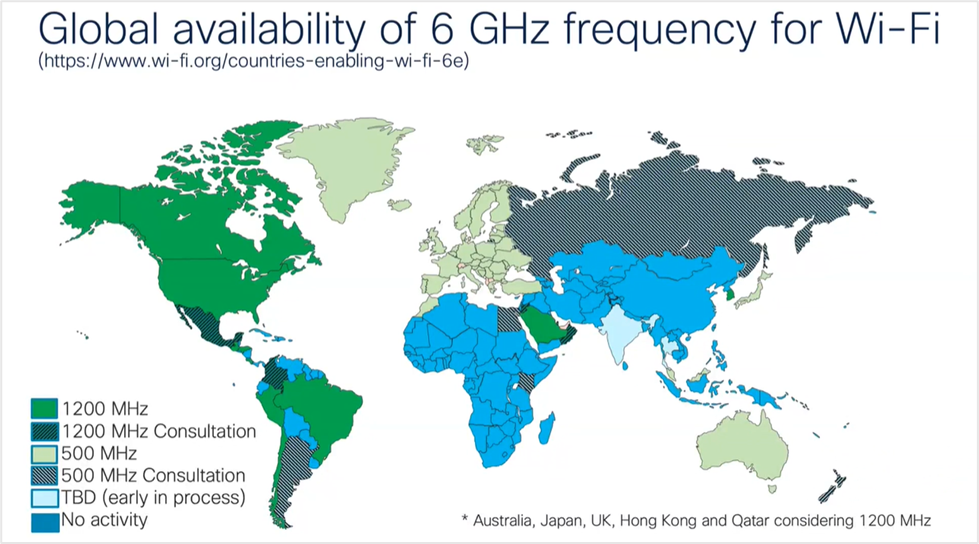
Cisco’s next-generation wireless stack has the below main hardware and software components
- Cisco Catalyst 9800 Series Wireless Controllers (Includes Appliances, Virtual and Embedded)
- Cisco Catalyst 9100 Wi-Fi 6 Aps
- Cisco DNA Center (Assurance and Automation)
- Cisco DNA Spaces
Wireless Controller Platforms and Catalyst Center
Every Cisco wireless AP — from the Catalyst 9105 to the CW9176 — is managed by the Cisco Catalyst 9800 Series Wireless LAN Controller. Running IOS XE, the 9800 provides hitless software upgrades, sub-second HA failover, and a full NETCONF/RESTCONF API for automation. For branch deployments, FlexConnect mode allows APs to switch client traffic locally without routing it back over the WAN to the controller, and to continue serving clients autonomously if the WAN link fails.
Above the controller sits Cisco Catalyst Center (formerly DNA Center) — the AI-driven management platform that brings the entire wired and wireless infrastructure under a single operational view. Its AI/ML assurance engine continuously baselining client experience, detecting anomalies before users report them, and in 2025 Cisco introduced AgenticOps — autonomous remediation of common wireless issues including channel reassignment, power adjustment, and client load balancing — without human intervention.
| Platform | Throughput | Deployment Mode | Preferred Topology | Maximum Aps | Maximum Clients |
| 9800-80 | Up to 80 Gbps | Centralized, Flex connects, or SDA | Large Campus | 6000 | 64000 |
| 9800-40 | Up to 40 Gbps | Centralized, Flex connects, or SDA | Medium Campus | 2000 | 32000 |
| 9800-L | Up to 5 Gbps | Centralized, Flex connects, or SDA | Small Campus/Remote Sites | 250 | 5000 |
| 9800 with Embedded Catalyst 9000 series switches | Up to 9 Gbps | Centralized, Flex connects, or SDA | Small Campus/Remote Sites | 500 | 10000 |
| Virtual Controller for Small, Medium, or Large sites | Local Switching | SDA | SDA Small Distributed site | 200 | 4000 |
| 9800 with embedded on Catalyst 9100 Series access points(EWC) | Local Switching | Local Switching | Small remote site | 100 | 2000 |
| 9800-CL for public clouds | Local Switching | FlexConnect with Local Switching | Small remote site | 1000, 3000 or 6000 | 10000,32000 or 64000 |
| 9800-CL for private clouds | Up to 2.1 Gbps with Central Switching | Centralized, FlexConnect or SD-Access | Small, Medium, or Large sites | 1000,3000 (Central) or 6000 (Flex connect) | 10000,32000 (Central)or 64000 (FlexConnect) |
Indoor Wireless Access Points
| Use case/Feature | 9115AX | 9117AX | 9120AX | 9130AX |
| Best for | Small to Medium Deployments | Small to Medium Deployments | Mission critical high density, large size networks | Mission critical high density, large-size networks |
| Features | Wi-Fi 6 (802.11ax), OFDMA, Uplink/Downlink MU-MIMO, BSS Coloring, Target Wake Time (TWT), Apple Features | Wi-Fi 6 (802.11ax), OFDMA, Uplink/Downlink MU-MIMO, BSS Coloring, Target Wake Time (TWT), Apple Features | Wi-Fi 6 (802.11ax), Cisco RF ASIC, Uplink/Downlink OFDMA, MU-MIMO, BSS Coloring, Target Wake Time (TWT), Intelligent Capture, Container support for applications, Apple Features | Wi-Fi 6 (802.11ax) certified, Cisco RF ASIC, Uplink/Downlink OFDMA, Uplink/Downlink MU-MIMO, BSS Coloring, Target Wake Time (TWT), Intelligent Capture, Container support for applications, Apple Features |
| Radios | Three radios: 2.4 GHz (4×4), 5 GHz (4×4), and BLE | Three radios: 2.4 GHz (4×4), 5 GHz (4×4), and BLE | Four radios: 2.4 GHz (4×4), 5 GHz (4×4), Cisco RF ASIC, and BLE/IoT | Four radios: 2.4 GHz (4×4), 5 GHz (8×8 and 4×4), Cisco RF ASIC, and BLE/IoT* |
| Antennas | Internal and external | Internal | Internal and external | Internal and external |
| Support for Catalyst 9800 EWC | Yes | Yes | Yes | Yes |
| Multigigabit Ethernet Support | Yes | Yes | Yes | Yes |
| HDX Support | No | No | Yes | Yes |
| Cisco Clean Air Technology | No | No | Yes | Yes |
| Flexible Radio Assignment | No | No | Yes | Yes |
| Combined Data Rate | Up to 5 Gbps | Up to 5 Gbps | Up to 5 Gbps | Up to 5 Gbps |
Outdoor & Industrial Wireless APs
| Use case and Features | Catalyst 9124AX | Catalyst IW9167 | IW6300 | IW3700 |
| Wi-Fi6 | Yes | Yes | No | No |
| Tri-radio Architecture | No | Yes | No | No |
| Smart AP | No | Yes | No | No |
| Bluetooth 5 | Yes | Yes | No | No |
| GNSS | No | Yes | No | No |
Wireless Key Terminologies
| Terminologies | Descriptions |
| FlexConnect | It enables configuring and controlling access points (AP) in a branch or remote office from the corporate office through a wide area network (WAN) link without deploying a controller in each office. |
| Frequency | The number of times the signal makes one complete up and down cycle in 1 second. Frequency = 4 cycles/second = 4 Hertz |
| OFDM | In a traditional single-channel modulation scheme, each data bit is sent serially or sequentially one after another. In OFDM, several bits can be sent in parallel, or at the same time, in separate substream channels. |
| Beam Forming | Is a method to customize the transmitted signal to prefer one receiver over others. By leveraging MIMO, the same signal can be sent over multiple antennas to reach specific client locations more efficiently. |
| Wi-Fi Alliance | The Wi-Fi Alliance ( http://wi-fi.org ) is a nonprofit industry association for wireless manufacturers around the world, for promoting wireless use. It addresses the problem of incompatible wireless products, the Wi-Fi Alliance introduced the Wi-Fi CERTIFIED program in 2000. |
| MIMO | multiple-input, multiple-output – a Wi-Fi technology that uses multiple antennas to improve performance and transfer more data simultaneously. |
| Band steering | It helps to send data on both 2.4 and 5 GHz |
| CleanAir Management | It helps to send data on both 2.4 and 5-GHz |
Which Standard Should You Deploy Today?
- Wi-Fi 6 (Catalyst 9115/9105): The minimum standard for any new enterprise deployment. If you are still running Wi-Fi 5 infrastructure, a refresh is overdue
- Wi-Fi 6E (Catalyst 9162–9166): The right choice for most enterprise refreshes in 2025/2026. Clean 6 GHz spectrum delivers measurable performance gains in dense environments
- Wi-Fi 7 (CW9171/72/76): For ultra-high-density venues, latency-sensitive applications (AR/VR, real-time collaboration), or forward-looking campuses. Ensure your switching infrastructure supports multi-gig uplinks — Wi-Fi 7 APs can easily saturate a 1G port
To get the best outcome it is important to do the design/heatmap and solution correctly. Also to note, Cisco/Meraki has a market share of 40%. This makes Cisco the market leader in this space. Other key vendors in this space include HPE-Aruba, Ruckus, Extreme Networks, Fortinet, Arista, and Juniper. For more infrastructure blogs, please visit the Datacenter Networking and Storage section
Final Thoughts
The wireless standards landscape has never moved faster, and Cisco’s portfolio has never been better aligned to the full spectrum of deployment needs. Whether you are serving 50 users in a branch office with a Catalyst 9105 on FlexConnect, or 50,000 attendees at an arena with a CW9176 Wi-Fi 7 cluster managed by Catalyst Center, the underlying architecture — IOS XE, CAPWAP, and AI-driven assurance — is consistent. That consistency is what makes Cisco wireless a safe long-term bet, even as standards continue to evolve.
If you are planning a wireless refresh, now is the time to architect for Wi-Fi 7 — even if you begin the rollout with Wi-Fi 6E.
Cisco Guest Wi-Fi Traffic Tunneling
Cisco DTP Explained: VLANs, Switchport Modes and Connectivity Lab

Cisco UCCX(Contact Center) Administration and Scripting Series
About Author

Muhammad Marakkoottathil(MM)
Expert in the field of SDN, cloud computing, virtualization, active-active data center design & migration. Passionate about helping organizations to achieve their digital transformation objectives with strong 15+ years of experience in design, deployment, and managing heterogeneous network solutions across the industry verticals. Major Industry Certifications: Cisco CCIE, CCDP, VMware VCAP-NV_DESIGN, TOGAF, ITIL, NUTANIX NCSE, Google Cloud Architect, Azure Fundamentals More info please visit my page @ LinkedIn: https://www.linkedin.com/in/contactmm/
helpful to understand the overview.