Arista NDR: Architecture, Components & Key Use Cases
Network Detection and Response (NDR) has become an important part of modern enterprise cybersecurity. As networks expand across data centers, campuses, cloud environments, IoT, and remote infrastructure, security teams need greater visibility into network activity and potential threats.
Arista NDR provides network visibility and AI-driven threat detection by analyzing network traffic and identifying suspicious behavior across users, devices, applications, and workloads.
Arista Networks acquired Awake Security in 2020 and integrated its NDR technology into Arista’s broader security portfolio. Today, Arista NDR combines AVA Sensors, AVA Nucleus, and AI-driven analytics to help security teams discover network entities, investigate suspicious behavior, and respond to potential threats.
In this article, we explore Arista NDR architecture, components, deployment models, and key use cases. We also examine how the platform supports threat hunting and network visibility across enterprise environments.
Arista NDR Platform Architecture and Key Use Cases
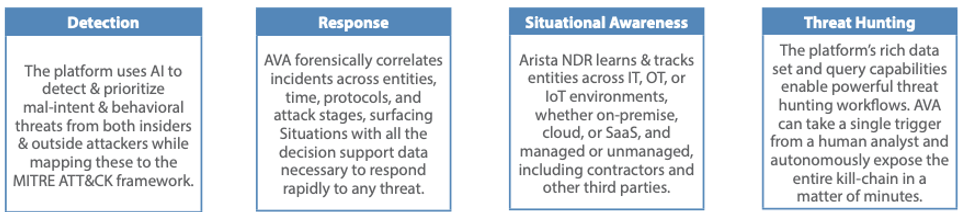
Arista NDR stands out from other network detection and response solutions by parsing over three thousand protocols and processing data from layer 2 through layer 7. The platform also excels in analyzing encrypted protocols, identifying critical context such as the nature of traffic (e.g., file transfer, interactive shell), the applications involved, and any remote access, all without requiring data decryption.
The key use case of Arista NDR is summarized below
Arista NDR Components
Below five Functional components compose the Arista NDR platform
- Sensors
- Nucleus
- AVA (Autonomous Virtual Assist)
- Console or UI
- Analyst Portal
AVA Sensors
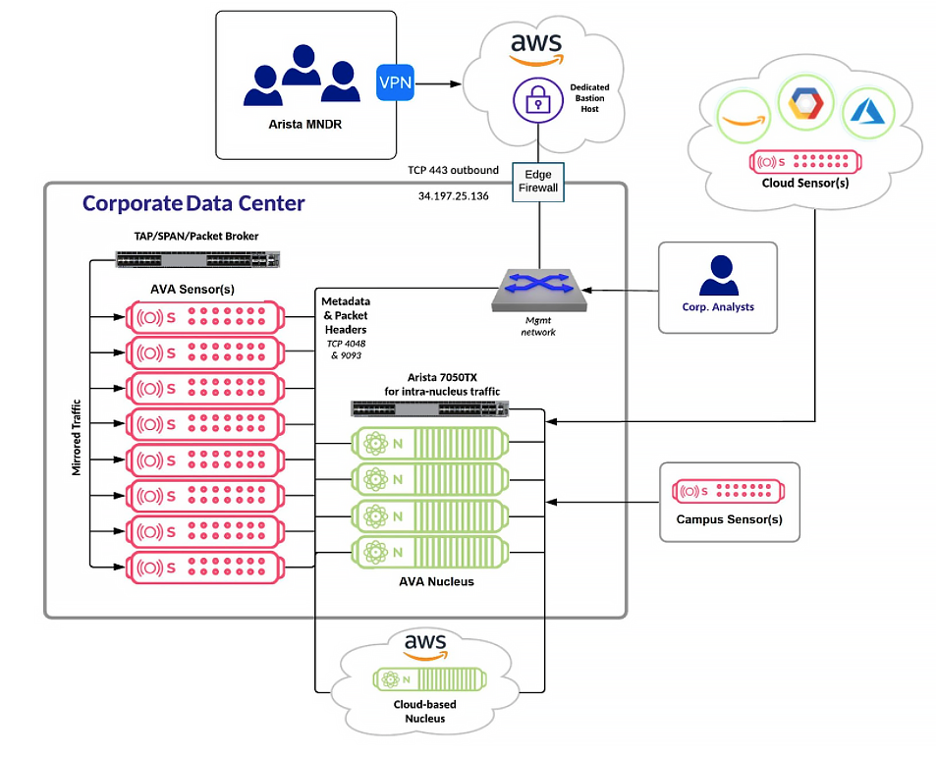
AVA Sensors provide visibility into network traffic at strategic monitoring points. They capture network activity, extract relevant protocol information, maintain forensic data where configured, and send activity information to the AVA Nucleus for further analysis.
Importantly, organizations can deploy sensors in several form factors. These include standalone hardware, virtual appliances, cloud-based deployments, and supported Arista switching platforms.
As a result, security teams can extend Arista NDR visibility across data centers, campus networks, cloud environments, IoT devices, and other parts of the enterprise infrastructure.
This flexible deployment model also allows organizations to select sensor locations according to their network topology, traffic volumes, security requirements, and compliance needs.
AVA Nucleus
The AVA Nucleus turns network information into actionable security intelligence. It analyzes data collected by AVA Sensors and uses AI, machine learning, and security expertise to identify suspicious activity.
First, the Nucleus builds context around users, devices, applications, and other network entities. Next, it analyzes behavioral changes and anomalies that may indicate malicious activity.
In addition, security analysts can use the platform to investigate detected threats and perform threat hunting across network activity.
This approach helps security teams move from raw network data to contextual information that supports investigation, incident response, and remediation.
Autonomous Virtaul Assist (AVA)
The Arista NDR Platform comes standard with AVA, a virtual security analyst that handles large amounts of seemingly unrelated traffic from one or several Sensors, makes associations, finds patterns, and identifies situations that need attention. AVA automates many of the mundane and time-consuming tasks normally undertaken by human analysts, dramatically accelerating their work. AVA includes a cloud component that utilizes a number of data sources, including OSINT to enhance the knowledge of the risk assessments, much like having a new expert security analyst on your team.
Console/UI:
The console or the UI is the primary user interface through which the analyst interacts with the platform. It is a web application served to the user’s browser from the Nucleus cluster or the Analyst Portal. In addition to presenting the results of the automated analysis done by AVA, the console provides extensive tools to manually query and analyze all the data in the Nucleus. This allows analysts to quickly confirm the results of AVA analysis as well as manually hunt for threats the platform has not yet surfaced automatically.
Analyst Portal:
It is an opt-in feature that provides a single pane of glass (hosted in the cloud but can also be hosted on-prem) to interface with Arista-NDR Nucleus deployments in a diverse set of topological configurations. You can obtain a console on any NDR Nucleus cluster from a single host address, easily switch between the different deployments in your installation, and perform the exact same functions as if you were visiting the Nucleus node directly on your network.
Deployment Models and BoQ
You can deploy Arista NDR in two modes, depending on customer requirements and network architecture:
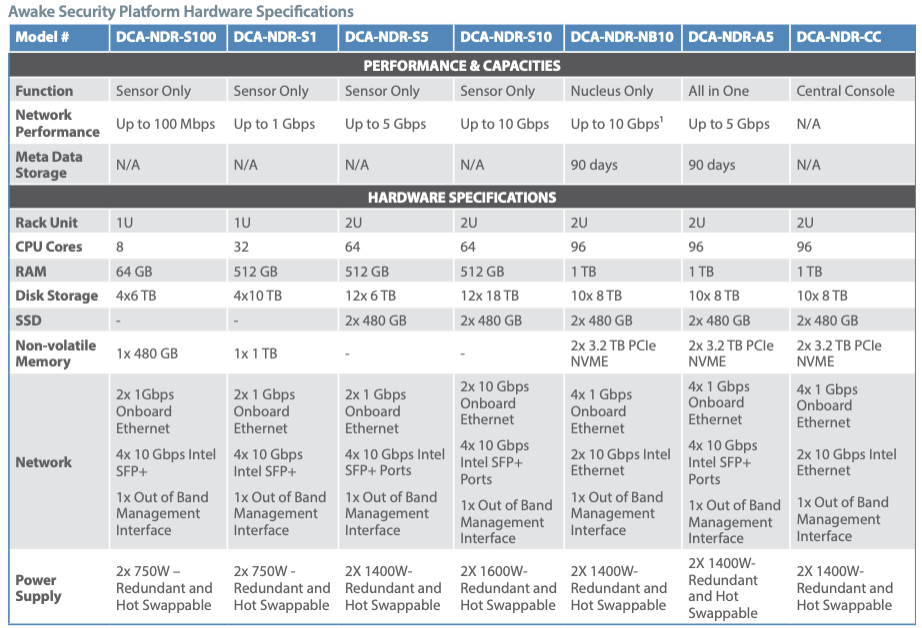
All-in-one The AVA Sensor and AVA Nucleus in this case are deployed on a single appliance. This deployment is ideal for customers who deploy a single instance of Arista NDR or would like to maintain an isolated view of their deployment.
All-in-one
In this case, the AVA Sensor and AVA Nucleus are deployed on a single appliance. This deployment is ideal for customers who deploy a single instance of Arista NDR or would like to maintain an isolated view of their deployment
Split
You deploy the AVA Sensor and AVA Nucleus separately in this mode. Deploy AVA Sensors in various form factors, including on Arista switches, physical or virtual appliances, and within AWS or the GCP. You can also use the AVA Nucleus as on-premises hardware. Which you can configure in cluster mode to support higher performance requirements. It is also available as a SaaS service from Arista. A central console provides a unified analyst portal with complete role-based access control across multiple Nucleus deployments.
Conclusion: Evaluating Arista NDR for Enterprise Security
Network Detection and Response plays an important role in improving visibility across modern enterprise networks. As organizations connect more users, devices, applications, cloud workloads, IoT systems, and remote environments, identifying suspicious network behavior becomes increasingly important.
Arista NDR addresses this challenge by combining network traffic analysis, AVA Sensors, AVA Nucleus, and AI-driven threat detection. Together, these capabilities help security teams discover network entities, identify unusual behavior, investigate potential threats, and improve visibility across distributed environments.
However, technology alone should not determine an NDR strategy. Organizations should first evaluate their network architecture, security requirements, traffic volumes, integration needs, deployment model, compliance requirements, and operational capabilities.
Therefore, before selecting an NDR platform, consider running a structured proof of concept using real network traffic and relevant security use cases. This can help validate visibility, detection quality, deployment requirements, operational impact, and integration with the existing security stack.
Need Help Evaluating NDR for Your Environment?
Selecting and deploying an NDR platform requires more than comparing product features.
TREZBON helps organizations assess cybersecurity architectures, evaluate security technologies, and align solutions with enterprise network and operational requirements.
For cybersecurity consulting, architecture assessment, or technology evaluation:
Explore more cybersecurity technical content and research:
https://www.networkbachelor.com/category/cybersecurity-it-and-ot.
Strengthen Your Network Threat Detection Strategy
Need better visibility into users, devices, applications, IoT, cloud workloads, and suspicious network activity?
TREZBON can help assess your cybersecurity architecture, identify network visibility gaps, and evaluate security technologies against your technical and operational requirements.
Talk to TREZBON about your cybersecurity requirements:
https://trezbon.com/#contact

Nozomi Networks: Securing OT and IoT Environments

Choosing the Right NAC Platform for Your Enterprise: A Data-Driven Evaluation
VMware Carbon Black Solution Analysis
About Author

Muhammad Marakkoottathil(MM)
Expert in the field of SDN, cloud computing, virtualization, active-active data center design & migration. Passionate about helping organizations to achieve their digital transformation objectives with strong 15+ years of experience in design, deployment, and managing heterogeneous network solutions across the industry verticals. Major Industry Certifications: Cisco CCIE, CCDP, VMware VCAP-NV_DESIGN, TOGAF, ITIL, NUTANIX NCSE, Google Cloud Architect, Azure Fundamentals More info please visit my page @ LinkedIn: https://www.linkedin.com/in/contactmm/
Great overview of Arista NDR and its architecture. What stands out from a security operations perspective is the platform’s ability to provide deep visibility across Layer 2–7, including encrypted traffic analysis without decryption, which is increasingly important as attackers hide within legitimate communications
Great post !! The combination of autonomous device profiling, AI-driven threat hunting, and forensic packet retention can significantly reduce investigation time and improve detection accuracy