Choosing the Right Networking Solution is Essential for AI Success
In today’s AI-driven world, digital connectivity has become fundamental to how organizations operate. The environment has shifted from data-centric to network-centric, where networks serve as the neurons of AI operations — facilitating communication, data transfer, and resource sharing across devices and systems. As AI applications grow in complexity and scale, the demand for efficient, high-performance networking solutions has never been greater.
This blog examines the key players in AI networking — Cisco, Juniper Networks, Arista Networks, and NVIDIA — and the specialized technologies each brings to the table. It also explores critical networking performance metrics such as latency, bandwidth, and scalability, as well as the role of Ethernet and InfiniBand technologies. Finally, it covers the Ultra Ethernet Forum’s efforts to advance Ethernet for AI, alongside innovative solutions such as Smart NICs and modern congestion control mechanisms.
The Importance of Network Choice
The choice of network technology has a direct and measurable impact on business operations, particularly in AI-intensive environments. A well-designed network optimizes data flow, reduces latency, improves job completion time (JCT), and enhances overall system performance — directly improving the return on GPU investment.
| Vendor | Key Advantages |
| Cisco Systems. | Extensive product portfolio spanning data center networking and compute; strong enterprise presence; AI-powered network and security management. |
| Juniper Networks | High-performance routing and switching, Junos OS, AI-driven network analytics. |
| Arista Networks | Unified management with AI-based telemetry and a single operating system (EOS) across the networking domain; architecture optimized for AI analytics; Smart NIC capability; AI-optimized chipsets from Broadcom |
| Nvidia – Mellanox(acquired by NVidia) | High-performance GPUs; RDMA (Remote Direct Memory Access) and GPUDirect; InfiniBand for HPC and AI workloads; AI-specific networking solutions and software development tools. The InfiniBand network provides a high-performance interconnect between GPU servers and shared storage. |
AI for Networking, And Networking for AI
The relationship between AI and networking is symbiotic. AI can optimize network performance through intelligent traffic management, anomaly detection, and predictive maintenance. In turn, networks are essential for enabling AI applications to access and process large datasets efficiently. Neither can reach its full potential without the other.
The Impact of Network Performance on AI Workloads
Poor network performance can have a significant and measurable impact on AI workloads, particularly those that rely heavily on GPU clusters. The table below outlines the key parameters to monitor when designing networking solutions for AI environments.
| Key Parameters. | Impact on AI Workloads |
| Latency. | High latency directly degrades AI workloads requiring real-time or near-real-time processing. Autonomous vehicles, for example, depend on low-latency communication to make timely decisions based on live sensor data. |
| Bandwidth | Insufficient bandwidth limits the speed at which data moves between AI components such as GPUs and storage. This creates bottlenecks in both training and inference pipelines. |
| Packet Loss | Packet loss disrupts data transmission and introduces errors or inconsistencies in AI models, degrading their accuracy and reliability |
| Jitter | Variability in packet arrival times affects the synchronization of AI processes — particularly critical for applications requiring precise coordination between distributed components |
| Reliability | Network reliability ensures AI workloads run without interruption. Failures or outages cause downtime and potential data loss, both costly in AI environments |
| Scalability | As AI workloads grow, the network must scale to handle increased traffic and throughput. A scalable architecture prevents performance bottlenecks and protects future investment |
| Security | Network security protects sensitive training data and prevents unauthorized access to AI systems. A compromised network exposes models, pipelines, and data to serious vulnerabilities |
| Tail Latency | Tail latency refers to the highest latency experienced by a small percentage of packets. Even a handful of delayed packets can significantly impact overall system performance and job completion time, delaying the start of subsequent jobs |
The Scale of Generative AI and Its Networking Implications
Generative AI models, often require massive amounts of computational resources. These models can involve billions or even trillions of parameters. Making them highly demanding in terms of both processing power and network bandwidth.
| Applications | GPU and other parameters |
| Google Gemini | Extremely large-scale; estimated to involve thousands of GPUs; approximately 1.56 trillion parameters; training duration spans weeks to months |
| GPT-3 / GPT-4 | GPT-3: 175 billion parameters, ~10,000 × V100 GPUs, ~300 billion training tokens, approximately one month to train. GPT-4 is estimated to reach one trillion parameters |
| Meta LLaMA | Focused on natural language understanding; 65 billion parameters; ~1–1.3 trillion training tokens; 2,048 × A100 GPUs; 21-day training time |
| Tesla FSD | Moderate scale; focuses on real-time performance and efficiency; millions to billions of parameters across perception, planning, and control neural networks |
| Microsoft Autopilot | Similar in profile to Tesla FSD; parameter count in the millions to billions range depending on implementation |
As the table illustrates, most large-scale AI applications rely on thousands of GPU nodes. Given that a single server chassis typically supports between 8 and 16 GPUs, anywhere from 20 to 100 server nodes must be interconnected to support even a mid-sized AI workload.
The table below shows representative compute chassis from leading vendors:
| Company | Server Model | GPU Count |
| HPE | Apollo 6500 | 16 |
| Dell | PowerEdge XE8545 | 8 |
| Supermicro | SuperServer 8028U-R / 1028U-R | 8-16 |
| Lenovo | ThinkSystem SR860 | 8 |
Ethernet vs. InfiniBand: Choosing the Right Fabric
The Case for Ethernet
Ethernet has become the dominant choice for AI networking, driven by its lower cost, broad ecosystem, and proven scalability. It is well-suited for large-scale data centers, offering high bandwidth and a wide range of compatible tools and vendors. Ethernet’s flexibility and lower operational costs make it attractive for organizations looking to scale AI operations efficiently.
The Case for InfiniBand
InfiniBand remains the benchmark for ultra-low latency, which is critical for the most demanding HPC and AI training workloads. Its point-to-point switched fabric architecture and native RDMA support make it highly efficient for tightly coupled GPU clusters.
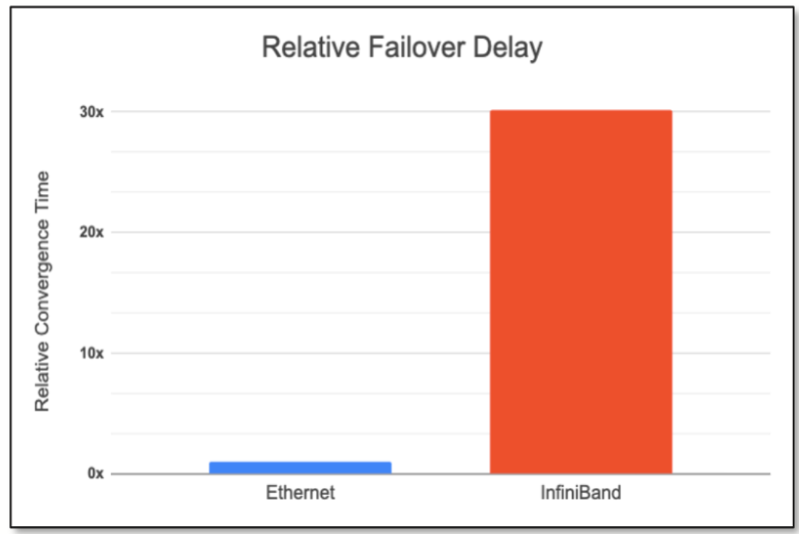
Side-by-Side Comparison
| Feature/Use Cases | Ethernet (RoCE) | Infiniband |
| Protocol | TCP/IP with RDMA over Converged Ethernet | Native RDMA (IBTA) |
| Topology | Star, mesh, ring, tree | Point-to-point, switched fabric |
| Latency | Lower than traditional Ethernet; higher than InfiniBand | Lowest latency of any mainstream networking technology |
| Bandwidth | High; comparable to InfiniBand at scale | High; slightly lower than Ethernet in some configurations |
| Scalability | Proven at rack, data center, and hyperscale deployments | Scalable, but can face constraints at very large scale |
| Cost | Lower; benefits from a competitive ecosystem and economies of scale | Higher; smaller supplier base |
| Ecosystem | Broad adoption across enterprise and cloud | Primarily HPC and supercomputing environments |
The Ultra Ethernet Forum
The Ultra Ethernet Consortium (UEC) is actively working to make Ethernet more suitable for AI and HPC workloads by developing new standards targeting low latency, high bandwidth, and improved reliability. Founding members include Arista Networks, Broadcom, Cisco Systems, Intel, and Juniper Networks, among others. The forum represents a significant industry commitment to advancing Ethernet as the fabric of choice for next-generation AI infrastructure.
Key Ethernet Solutions
| Solution Name. | Description |
| Smart NICs | Smart NICs (Network Interface Cards) are specialized network adapters that offload processing tasks from the host CPU to the NIC itself, freeing up compute resources for AI workloads. Key capabilities include: hardware acceleration (packet processing, checksum calculation, encryption/decryption); RDMA support for direct memory-to-memory transfers between servers without CPU involvement, significantly reducing latency; and virtualization support for network isolation and resource management across multiple virtual machines |
| NVlink | NVIDIA’s high-speed GPU interconnect technology. NVLink enables a GPU to communicate with a NIC through the NVLink bus and PCI interface, reducing data movement overhead in GPU-accelerated nodes |
| Modern Congestion Control | Combines DCQCN (Data Center Quantized Congestion Notification = ECN + PFC), Dynamic Load Balancing (DLB), and adjustable buffer allocation. ECN (Explicit Congestion Notification) provides end-to-end congestion signaling: the receiver adds congestion bits and generates a Congestion Notification Packet (CNP) back to the sender, which then throttles the offending flow. PFC (Priority Flow Control) manages congestion for RoCEv2 transport on a per-hop basis, using pause frames to signal and control congestion from the point of congestion back to the traffic source |
| RoCEv2 | RDMA over Converged Ethernet v2 enables CPUs, GPUs, TPUs, and other accelerators to transfer data directly from sender memory to receiver memory, bypassing the operating system. RoCEv2 brings the InfiniBand Trade Association’s (IBTA) RDMA transport protocol to standard IP and Ethernet networks |
| Multipathing and packet spraying | Unlike ECMP, which uses flow hashing to assign flows to paths (confining high-throughput flows to a single path), packet spraying distributes every flow simultaneously across all available paths to the destination — achieving a more balanced and efficient use of network capacity |
| Flexible Delivery Ordering | In AI applications, flexible ordering allows the system to prioritize when the last segment of a message arrives, eliminating the overhead of full packet reordering. This is particularly beneficial in bandwidth-intensive operations such as packet spraying |
| End-to-End Telemetry | Advanced congestion control algorithms are enabled by real-time, end-to-end telemetry. Network-sourced congestion information identifies the precise location and cause of congestion. Modern switches can rapidly relay accurate congestion data to schedulers and pacers, improving the responsiveness and precision of congestion control across the fabric |
| Large-Scale Reliability | 100G to 800G interfaces with microsecond-to-nanosecond latency targets, combined with spine-leaf architecture, provide the bandwidth, reliability, and linear scalability that AI workloads demand. Ethernet’s proven track record at hyperscale makes it a compelling long-term foundation for AI infrastructure |
Summary
In an AI-driven world, networking is the backbone of infrastructure. Efficient, high-performance networks ensure smooth data flow — which is foundational to AI workloads at every scale, from inference at the edge to large-scale model training in the data center. A well-architected network directly enhances productivity, reduces job completion time, and maximizes the return on GPU investment. As AI models continue to grow in scale and complexity, the network’s role will only become more critical.

vLLM RL Rollouts and Speculative Decoding Guide
NSX-T Series: Part 17 – NSX-T Segment T1 and T0 on same Edge Cluster T0 as SR

LLM Quantization with vLLM: PTQ vs QAT Guide
About Author

Muhammad Marakkoottathil(MM)
Expert in the field of SDN, cloud computing, virtualization, active-active data center design & migration. Passionate about helping organizations to achieve their digital transformation objectives with strong 15+ years of experience in design, deployment, and managing heterogeneous network solutions across the industry verticals. Major Industry Certifications: Cisco CCIE, CCDP, VMware VCAP-NV_DESIGN, TOGAF, ITIL, NUTANIX NCSE, Google Cloud Architect, Azure Fundamentals More info please visit my page @ LinkedIn: https://www.linkedin.com/in/contactmm/
thanks for the blog, it gives an good idea about the networking players and ethernet in AI, however which is best AI solution provider for networking ? how to determine this ????
A great blog