Compression Without Regret: Quantization, QAT, and Shipping Smaller Models
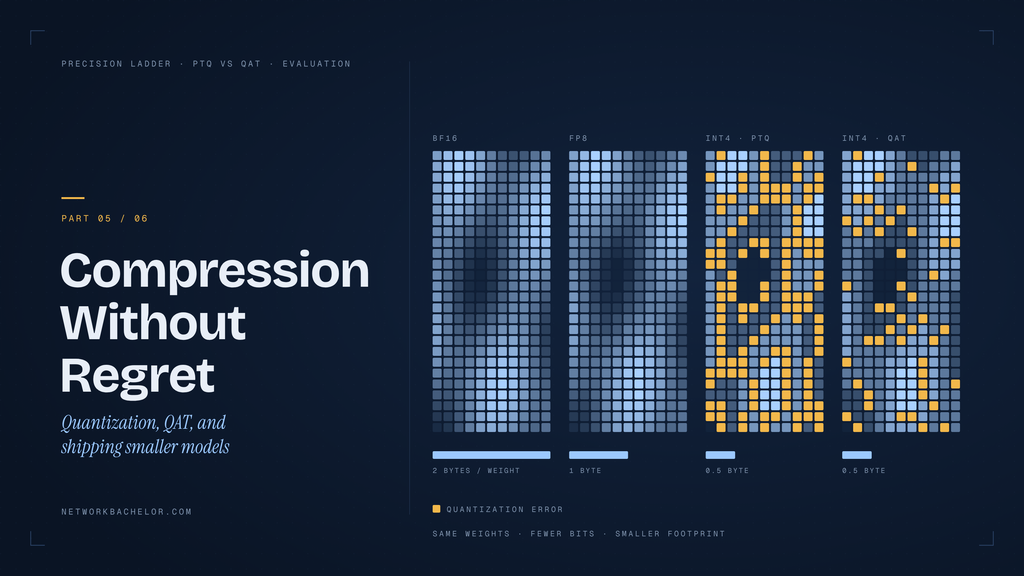
Part 5 of “vLLM in 2026: An Infrastructure Engineer’s Field Guide”
Quantization is the closest thing inference has to a free lunch, and it isn’t free. Cutting precision shrinks weights, shrinks the KV cache, and speeds up memory-bound decode. It also risks quality regressions that don’t show up until a user finds them.
This post covers the precision ladder, the difference between post-training quantization (PTQ) and quantization-aware training (QAT), what each buys you in a vLLM deployment, and how to evaluate before shipping.
[Add from talk: “Highly Compressed Gemma Models with Custom Quantization-Aware Training” (Sara Smoot, Google DeepMind): the specific bit-widths, QAT recipe, quality-versus-size results, and vLLM integration details.]
1. Why quantization pays off
LLM decode is memory-bandwidth-bound: each step reads all active weights and the KV cache from HBM. Fewer bytes per parameter means:
- Smaller footprint: bigger models per GPU, or more KV cache headroom.
- Faster decode: less data to move per token.
- Cheaper hardware requirements: fewer GPUs per replica, less communication if TP degree drops.
Approximate weight memory for a 70B-parameter model:
| Precision | Bytes per weight | Weights only |
|---|---|---|
| BF16 / FP16 | 2 | ~140 GB |
| FP8 / INT8 | 1 | ~70 GB |
| INT4 / FP4 | 0.5 | ~35 GB |
(Add a few percent for scales and metadata. The KV cache and activations are extra.)
2. What you can quantize
Three separate targets, often confused:
| Target | What changes | Main benefit | Main risk |
|---|---|---|---|
| Weights only (e.g., W4A16) | Weights stored in low precision, activations stay BF16 | Memory and decode bandwidth | Small quality loss; kernel needs to dequantize on the fly |
| Weights + activations (e.g., W8A8, FP8) | Both use low precision; matmuls run natively in low precision | Compute speedup too, especially in prefill | Activation outliers make it harder to keep quality |
| KV cache | Cached keys/values stored in FP8 or similar | Roughly halves KV memory, so more concurrency and longer contexts | Attention accuracy at long contexts |
Enabling KV cache quantization in vLLM is a single flag:
vllm serve <model> --kv-cache-dtype fp8Halving KV bytes per token doubles the tokens that fit in the same memory. For long-context and agent workloads (Post 4), this can matter more than weight quantization.
3. The precision ladder

- FP8 is the common first step on hardware with native support. Quality loss is often small with proper scaling.
- INT4 weight-only (methods such as GPTQ and AWQ) is popular for memory-constrained serving.
- FP4-class formats are supported by newer hardware generations and offer more compression, but recipes matter more.
Hardware support drives everything (see Post 2): a format the GPU accelerates natively is fast; one it must emulate can be slower than BF16.
4. PTQ versus QAT
Post-training quantization (PTQ) takes a finished model, uses a small calibration dataset to pick scales, and converts weights. It is cheap and fast (minutes to hours), needs no training infrastructure, and works well down to about 8 bits and often 4 bits for weights.
Quantization-aware training (QAT) simulates quantization during (continued) training, so the model learns to tolerate the rounding error. It costs real training compute, requires access to training data and pipeline, and typically recovers much more quality at aggressive bit-widths.
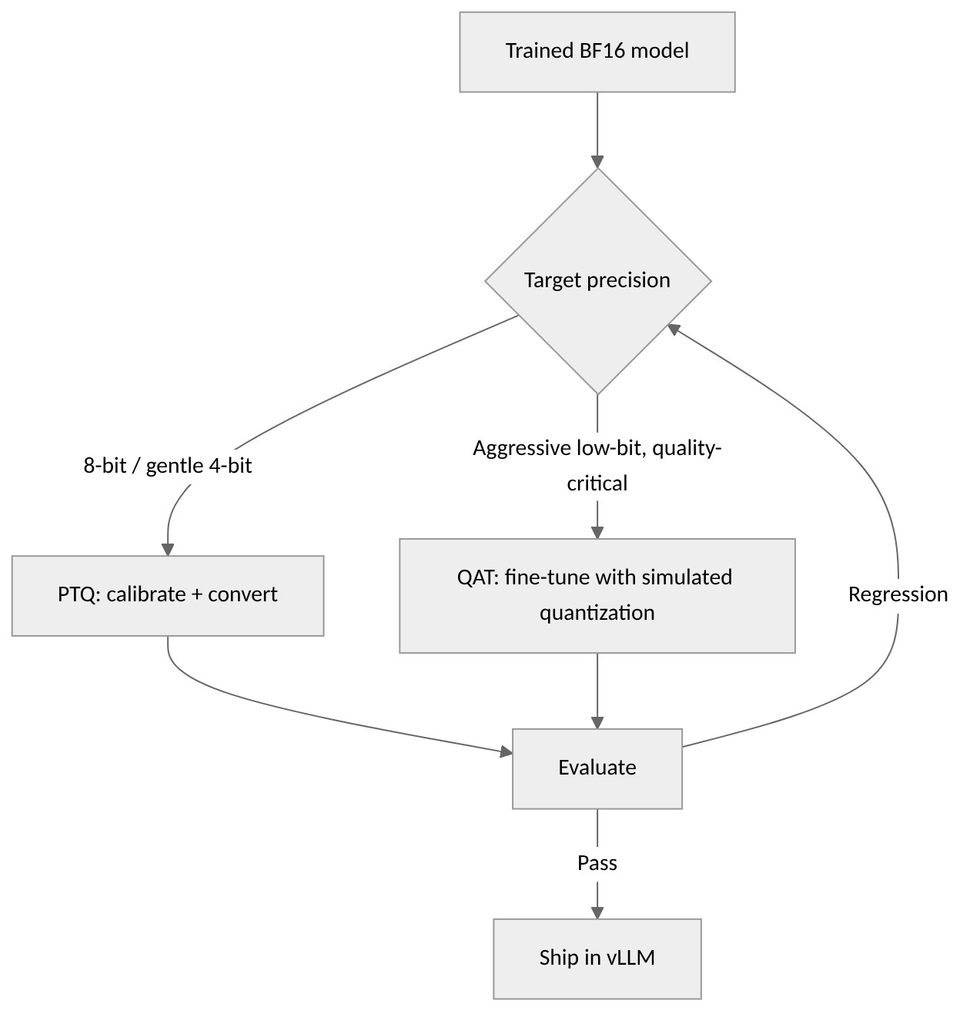
Why QAT matters for model publishers: when a lab releases official QAT checkpoints, users get low-bit models that were trained to be low-bit, rather than squeezed afterward. That tends to keep quality closer to the full-precision model at a fraction of the memory.
For platform teams, the choice is usually: use vendor-provided QAT checkpoints when they exist; otherwise do PTQ with an open tool such as llm-compressor and evaluate carefully.
[Add from talk: the custom QAT approach: what is custom about it, which layers/tensors stay in higher precision, and how vLLM loads the result.]
5. A practical evaluation protocol
“It still sounds right” is not a test. Before shipping any quantized model:
- Freeze a golden eval set covering your real tasks: not only public benchmarks, but also your prompts, tool calls, and long-context cases.
- Compare against the BF16 baseline on the same set, same sampling settings.
- Check the failure modes quantization tends to hit: long-context retrieval, multi-step reasoning, numerical/code tasks, structured output validity, and multilingual quality.
- Measure the systems win: tokens/sec at fixed p99, max concurrency, memory headroom. If the win is small, the quality risk isn’t worth it.
- Canary in production with shadow traffic or a small percentage, and compare downstream metrics (tool-call error rate, task success).
- Re-evaluate per hardware backend: numerics differ by kernel implementation.
6. Interaction with the rest of the stack
- Parallelism. Smaller weights can reduce TP degree, which cuts all-reduce traffic (Post 3).
- Speculative decoding. The draft model and target must agree closely; quantizing the target can change acceptance rates (Post 6).
- Disaggregated serving. A quantized KV cache reduces the bytes to ship between prefill and decode pools.
- Cold start. Smaller checkpoints load faster (Post 1).
Design-review checklist
- Do we know which quantization target we’re applying (weights, activations, KV)?
- Is the format natively accelerated on our hardware?
- Do we have vendor QAT checkpoints available, or are we doing PTQ?
- Is there a frozen eval set with baseline scores, including long-context and structured-output tests?
- Did we measure the throughput and memory gain, not just assume it?
- Is there a rollback path and a canary?

AI-Powered Firewall Troubleshooting: GraphRAG, Neo4j, RAG & Network Automation

Securing the Stack: A Practical Guide to AI and LLM Security

Private LLMaaS and its Business Opportunities
About Author

abhishek
Cloud Platform Lead and AI Infrastructure Architect at e& enterprise, with 12+ years in data center, virtualization, security and AI infrastructure. I design and build private cloud and sovereign AI platforms, working with VMware (NSX-T, vSphere, vSAN, HCX, AVS, SRM), Kubernetes, Terraform and GPU inference infrastructure for LLMs. Previously served Networkers Home (CCIE instructor, trained around 50 CCIEs), VCE/EMC2, Cisco, VMware and Arista across TAC, consulting, design and training. Certifications: CCIE#48639 (Data Center and R&S), VCIX-DCV and NV, CKA, NVIDIA AI Infrastructure, Azure Solutions Architect Expert, Terraform Associate, Palo Alto PCNSE. LinkedIn: https://www.linkedin.com/in/abhishekkunal51/