vLLM Multi-Hardware Inference: NVIDIA vs AMD vs TPU vs Intel
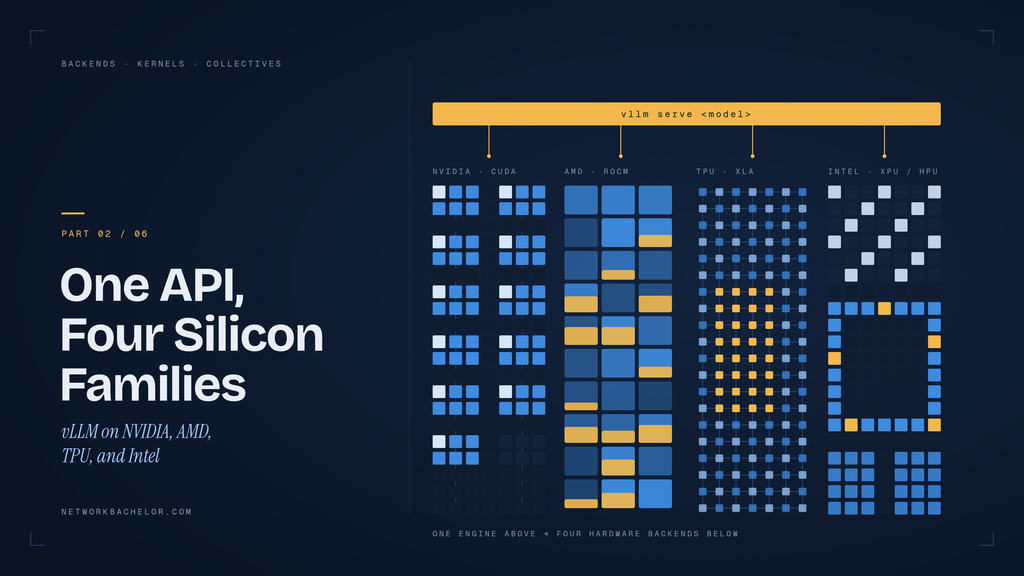
Part 2 of “vLLM in 2026: An Infrastructure Engineer’s Field Guide”
vLLM is no longer limited to a single accelerator ecosystem.
Today, vLLM multi-hardware inference can run across NVIDIA GPUs, AMD Instinct accelerators, Google TPUs, and Intel hardware. As a result, infrastructure teams have more flexibility when designing enterprise AI platforms.
However, hardware compatibility does not guarantee equal performance.
Each platform uses a different software stack, memory architecture, interconnect, kernel implementation, and optimization path. Therefore, organizations must evaluate more than whether a model simply runs.
For infrastructure teams, several questions matter. Which platform delivers the required LLM inference performance? How efficiently does it scale? What is the cost per million tokens? How portable is the deployment? Finally, how much engineering effort does each platform require?
In this guide, we compare vLLM on NVIDIA, AMD, Google TPU, and Intel hardware. We also examine performance, networking, quantization, portability, and infrastructure considerations for modern AI deployments.
1. How vLLM Multi-Hardware Inference Works
vLLM separates its core engine from the hardware-specific execution layer.
The core engine handles scheduling, KV cache management, and API serving. Meanwhile, the hardware layer manages attention kernels, quantization kernels, collective communication, and device memory.
Hardware vendors can integrate their platforms through vLLM’s platform abstraction and plugin mechanisms. As a result, vendors can maintain optimized backends for their own hardware.
The scheduler and PagedAttention logic remain largely shared. However, the underlying execution layer differs across NVIDIA, AMD, Google TPU, and Intel platforms.
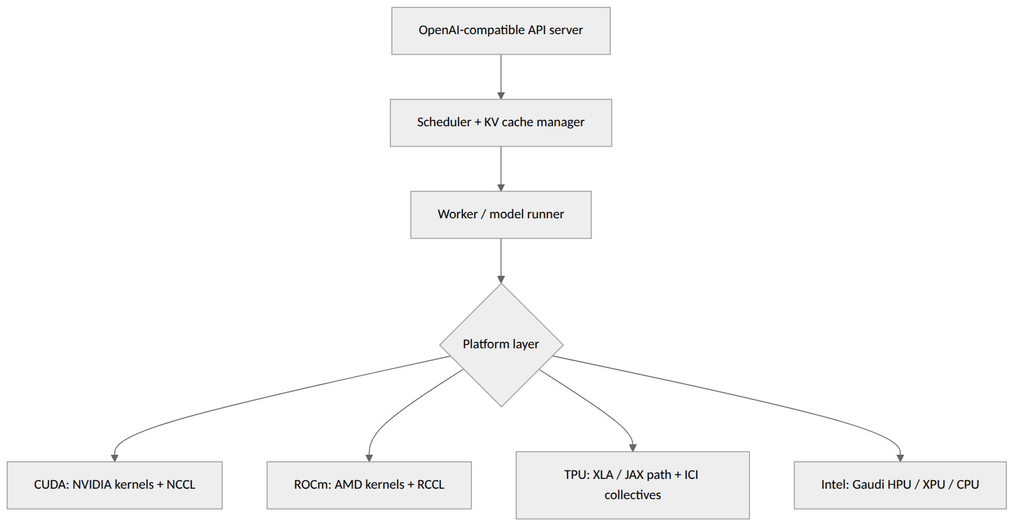
The scheduler and PagedAttention logic above the line is shared. Everything below it differs.
2. What differs, by platform
| NVIDIA | AMD | Google TPU | Intel | |
|---|---|---|---|---|
| Software stack | CUDA, cuDNN, NCCL | ROCm, RCCL | XLA, JAX/Pallas kernels | Gaudi software stack, XPU (oneAPI), CPU |
| Scale-up interconnect | NVLink / NVSwitch | Infinity Fabric | ICI (torus topology) | Gaudi on-chip Ethernet (RoCE) |
| Scale-out | InfiniBand / RoCEv2 | Ethernet/RoCE, IB | Data center network (DCN) | Ethernet |
| Low-precision | FP8; FP4 on Blackwell | FP8; newer generations add lower precision | bfloat16, int8/fp8 depending on generation | FP8 on Gaudi; varies elsewhere |
| Strength | Widest kernel and model coverage, earliest access to new features | Large HBM capacity per accelerator | Tight pod-scale interconnect, strong cost story on Google Cloud | Cost/availability alternative; CPU path for small models |
| Watch out for | Cost and supply | Feature parity lags for new model architectures | Different programming and deployment model | Narrower model/feature coverage |
Treat the table as a framework. Generation-specific numbers change fast, so fill in current figures from vendor specs.
NVIDIA: The Reference Path
NVIDIA remains a common reference platform for vLLM development. New model support and performance optimizations often appear here early.
For very large Mixture-of-Experts (MoE) models, performance depends on several factors. These include fused MoE kernels, efficient expert dispatch, MLA-aware attention kernels, and low-precision execution.
In addition, communication efficiency becomes increasingly important as models scale across multiple accelerators. Technologies such as NCCL, NVLink, NVSwitch, InfiniBand, and RoCE can therefore influence distributed inference performance.
AMD: Capacity and an Expanding Software Ecosystem
In contrast, AMD Instinct accelerators offer another path for large-scale LLM inference.
High HBM capacity can provide more room for model weights and KV cache. As a result, infrastructure teams may be able to support larger models or more demanding inference workloads per node.
Meanwhile, the ROCm ecosystem continues to evolve. Therefore, teams should validate model support, quantization formats, kernels, and required vLLM features before selecting a production architecture.
Google TPU: A Different Infrastructure Model
Unlike traditional GPU clusters, Google TPUs use a different compute and interconnect architecture.
TPUs can operate in slices connected through a high-bandwidth inter-chip interconnect. Meanwhile, the serving stack relies heavily on XLA compilation and TPU-optimized kernels.
As a result, two considerations become especially important.
- Static shapes matter. XLA compilation can depend on tensor shapes. Therefore, batching and padding strategies can affect compilation overhead and latency.
- Topology is part of the deployment decision. The TPU slice configuration can influence available parallelism and scaling strategies.
Consequently, teams moving from GPU infrastructure to TPU should evaluate both application performance and deployment architecture.
Intel: A Broader Range of Deployment Options
Meanwhile, Intel’s vLLM ecosystem spans Gaudi accelerators, Intel GPUs, and CPUs.
The CPU path can be useful for smaller models, embedding workloads, development environments, and lower-traffic services. Therefore, not every inference workload necessarily requires a dedicated GPU accelerator.
However, model support and feature availability can differ between Intel platforms. Teams should validate their specific models and workloads before making production decisions.
3. vLLM NVIDIA vs AMD vs TPU vs Intel: Which Should You Choose?
Choose the platform based on the workload, not the brand.
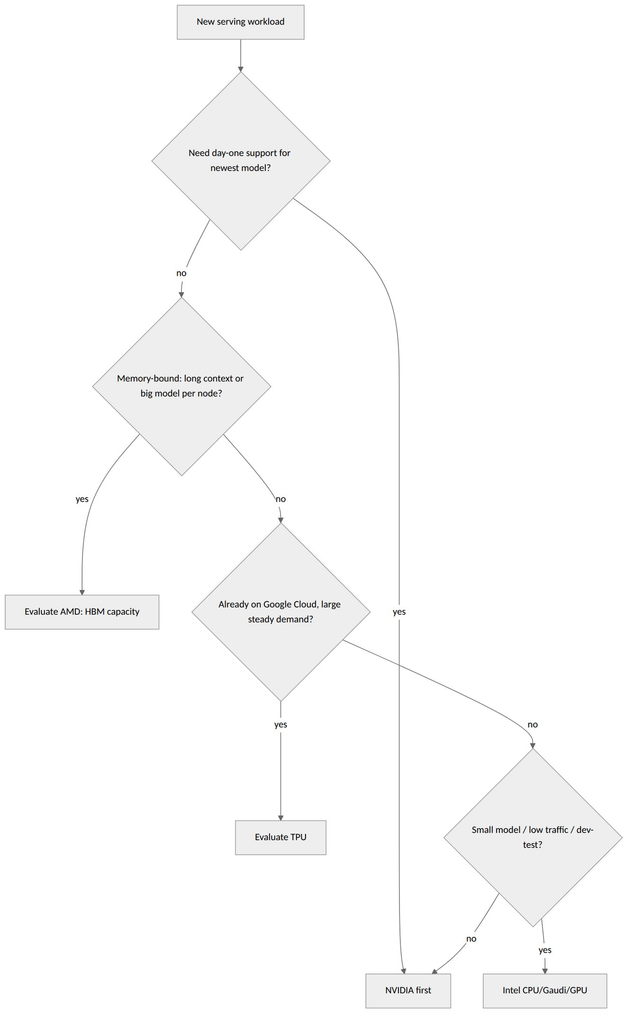
However, hardware specifications alone are not enough. Infrastructure teams should benchmark each platform under realistic production conditions.
For a fair comparison, use the same model, similar quantization where possible, and the same prompt and output-length distribution. In addition, test at realistic concurrency levels.
Measure:
- Tokens per second at a fixed p99 latency target rather than peak throughput.
- Cost per million output tokens, including power and networking.
- Time to first token under realistic concurrency.
- Memory utilization and available KV cache capacity.
- Scaling efficiency across multiple accelerators and nodes.
- Engineering effort required to deploy, optimize, and maintain the platform.
Ultimately, the best platform is the one that meets your performance, reliability, scalability, and cost targets under real production workloads.
4. Portability traps
- Quantization formats are not universal. A checkpoint quantized for one backend’s kernels may not run on another.
- Attention backends differ, so numerics can differ slightly. Re-run your eval suite per platform.
- Collectives differ (NCCL vs RCCL vs ICI). Multi-node tuning knowledge does not transfer one-to-one.
- Container images and drivers become a matrix to maintain: OS, driver, runtime, vLLM version, per hardware family.
Design-review checklist
- Is the multi-vendor requirement real (supply risk, cost leverage) or theoretical?
- Have we benchmarked on our model, quantization, and traffic shape, not vendor demos?
- Do we have an eval suite to catch numerical differences per platform?
- Is the image/driver matrix owned by someone?
- Do we compare on cost per million tokens at a p99 target?
Next: Post 3: Distributed Inference Is a Network Problem
Conclusion: Choose the Platform Around the Workload
vLLM is making multi-hardware LLM inference increasingly practical. However, hardware portability does not mean that every accelerator will deliver the same performance, cost, or operational experience.
NVIDIA currently offers broad model and kernel support. Meanwhile, AMD provides another compelling option for high-memory accelerator deployments. Google TPU introduces a different approach to large-scale AI infrastructure, while Intel provides accelerator and CPU options for a wider range of inference workloads.
Therefore, infrastructure teams should avoid selecting hardware based on specifications alone.
Instead, benchmark each platform using your actual models, quantization formats, prompt lengths, output lengths, concurrency levels, and latency requirements. In addition, measure networking requirements, operational complexity, power consumption, and cost per million tokens.
The best AI accelerator is not simply the fastest chip.
It is the platform that delivers the required LLM inference performance, scalability, reliability, portability, and cost efficiency for your workload.
As vLLM continues to expand across NVIDIA, AMD, Google TPU, and Intel ecosystems, infrastructure teams gain something equally important: greater architectural choice.
Next in the series: Distributed Inference Is a Network Problem
Planning Private or Sovereign AI Infrastructure?
Building a production AI platform requires more than selecting the right accelerator.
GPU compute, high-performance networking, Kubernetes, cybersecurity, storage, observability, and LLM serving must work together as one architecture.
TREZBON helps organizations design and implement secure, scalable infrastructure for enterprise AI workloads.
Whether you are evaluating private AI, sovereign AI, GPU infrastructure, LLM inference, data-centre networking, or cybersecurity architecture, our team can help you move from architecture and technology evaluation to implementation.
Turn Your AI Infrastructure Strategy Into a Deployment Plan
Planning a private AI platform, GPU cluster, or enterprise LLM deployment?
Talk to TREZBON about your infrastructure requirements.
👉 Discuss your AI infrastructure project:
www.trezbon.com/#contact
Choosing the Right Networking Solution is Essential for AI Success

Private LLMaaS and its Business Opportunities
NSX-T ALB AVI Series : Part01
About Author

abhishek
Cloud Platform Lead and AI Infrastructure Architect at e& enterprise, with 12+ years in data center, virtualization, security and AI infrastructure. I design and build private cloud and sovereign AI platforms, working with VMware (NSX-T, vSphere, vSAN, HCX, AVS, SRM), Kubernetes, Terraform and GPU inference infrastructure for LLMs. Previously served Networkers Home (CCIE instructor, trained around 50 CCIEs), VCE/EMC2, Cisco, VMware and Arista across TAC, consulting, design and training. Certifications: CCIE#48639 (Data Center and R&S), VCIX-DCV and NV, CKA, NVIDIA AI Infrastructure, Azure Solutions Architect Expert, Terraform Associate, Palo Alto PCNSE. LinkedIn: https://www.linkedin.com/in/abhishekkunal51/