Comparing Cisco Tetration with VMware NSX
Cisco Secure Workload (formerly Tetration) and VMware NSX Distributed Firewall (now rebranded as Broadcom vDefend) remain the two most recognised platforms for workload microsegmentation. Both have undergone significant changes since their original releases. This updated comparison reflects the current state of both products as of 2025.
Disclaimer: This post is based on publicly available documentation and professional experience. Validate all capabilities and pricing directly with the respective vendors before making purchasing decisions. Network Bachelor is not responsible for any decisions made based on this content
What Has Changed
Cisco Tetration is now Cisco Secure Workload, currently at version 3.9. In Q3 2024, Forrester recognised it as a Leader in the Microsegmentation Solutions Wave
VMware NSX has been restructured under Broadcom
Following the $69 billion acquisition of VMware in November 2023, NSX is no longer sold as a standalone product. The Distributed Firewall has been rebranded as VMware vDefend and bundled into the VMware Cloud Foundation (VCF) subscription — where it is now a paid add-on rather than a default inclusion. Organisations approaching NSX renewal should obtain updated pricing from Broadcom directly, as costs have increased materially for many existing customers.
How Each Solution Works
Cisco Secure Workload deploys a lightweight agent on every protected workload — physical server, virtual machine, or container. The agent collects network flows, running processes, software packages, and system telemetry. An AI and machine learning engine analyses this data, automatically generates microsegmentation policy recommendations based on observed application behaviour, and enforces policy through the native OS firewall. Because enforcement lives inside the operating system, policy follows the workload wherever it runs — on-premise, in AWS, Azure, or any private cloud
VMware NSX / vDefend embeds the firewall directly at the virtual NIC level on the ESXi hypervisor. For VMware-native environments this is operationally efficient — no agent installation is needed on individual VMs for basic Layer 4 enforcement, and the firewall cannot be bypassed from within the guest OS. NSX also delivers a full software-defined networking stack including overlay networks, distributed routing, NAT, and load balancing — capabilities that Cisco Secure Workload does not offer
Comparison Table – Cisco Secure Workload with VMware NSX
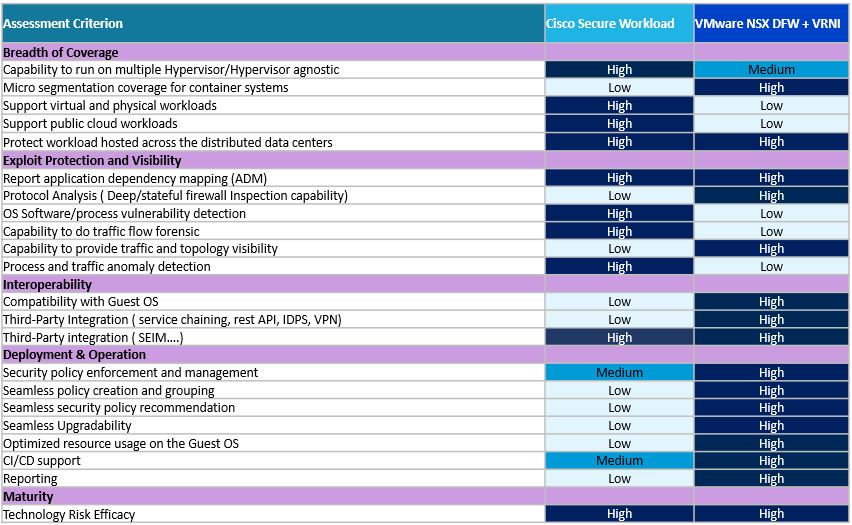
Assessment Criterion Explanation
This section covers the use cases and their reasoning, reference hyperlink for each of the use cases
| Key use cases | Description & Reasoning | References |
| Breadth of coverage | This section covers the capability of the solution to work in heterogenous environments. Which includes multiple hypervisors, containers, physical and cloud, etc | VMware NSX Compatibility Cisco Secure Workload Interoperability |
| Exploit Protection and Visibility | This section covers the key security value-ad offered by the systems such as visibility, enforcement, and vulnerability detection | VMware NSX Datasheet Cisco Secure Workload Datasheet |
| Interoperability | This section look at the capability of the system to interoperate with various L4-L7 systems | VMware NSX Compatibility Cisco Secure Workload Interoperability |
| Deployment and Operation | This section looks at the parameters in terms of how the solution is helping to simplify the overall operation and management of the security policies and associated recommendations. | Cisco secure workload configuration guide VMware NSX Administration Guide |
| Maturity | This section primarily looks at the number of deployment references and how many years this solution in the market | VMware NSX Details Cisco Secure Workload Customer References |
Conclusion: Choosing the Right Microsegmentation Solution
Microsegmentation is now a critical component of modern Zero Trust security architecture, helping organisations protect workloads, limit lateral movement, and reduce cybersecurity risks.
Both Cisco Secure Workload and VMware NSX (Broadcom) offer distinct advantages and limitations. On the one hand, Cisco Secure Workload focuses on application visibility, workload protection, and policy-driven segmentation. On the other hand, VMware NSX provides distributed security controls and microsegmentation capabilities within virtualised environments. Furthermore, both solutions support Zero Trust security strategies, although their deployment approaches and operational requirements differ. Therefore, organisations should carefully evaluate their infrastructure and security objectives before selecting the most suitable solution.
However, organisations must carefully evaluate several factors before selecting a microsegmentation solution. First, they should assess deployment complexity and infrastructure compatibility. Next, they must consider licensing requirements, scalability, and total cost of ownership. Furthermore, VMware vRealize Network Insight (vRNI), later renamed VMware Aria Operations for Networks, may be positioned alongside NSX. Nevertheless, organisations should review its licensing requirements separately. Therefore, a thorough evaluation of technical capabilities, operational requirements, and long-term costs is essential. Ultimately, this approach helps organisations make informed decisions that align with their Zero Trust security objectives.
Ultimately, the best microsegmentation platform is the one that aligns with your organisation’s infrastructure, security objectives, and long-term Zero Trust strategy.
Take the Next Step Towards Stronger Zero Trust Security
Are you evaluating Cisco Secure Workload vs VMware NSX for your enterprise?
At TREZBON TECHNOLOGIES, we help organisations assess cybersecurity solutions, evaluate network security architectures, and make informed technology decisions based on their business requirements.
Explore more insights and connect with our experts:
- Read more: NETWORK BACHELOR – Cyber Security Articles
- Explore professional services: NETWORK BACHELOR – Premium Services
- Discuss your security requirements: Contact TREZBON TECHNOLOGIES
Build a stronger Zero Trust foundation with the right microsegmentation strategy.
Nozomi Networks: Securing OT and IoT Environments

Choosing the Right NAC Platform for Your Enterprise: A Data-Driven Evaluation
AlgoSec – NSPM Solution Quick Review
About Author

Ashraf Abdulla
Founder of Hiraanet group, IT enthusiast & engineer with more than 10 years in the industry - Proven record of generating and building relationships, managing projects from concept to completion, designing educational strategies, and coaching individuals to success. Currently, enjoys blogging and solving customer issues
Thanks for the post
simple and easy to understand thank you for sharing
Great Reading – looking forward for more of these comparisons