Gigamon TLS Decryption: Passive vs. Inline Architecture and TLS 1.3 Challenges
A Comprehensive Technical Deep-Dive into Passive vs. Inline Decryption, Modern TLS 1.3 Challenges,
Offloading ROI, and Security Tool Acceleration.
Introduction to Enterprise TLS Visibility
Enterprise networks carry more encrypted traffic than ever. As a result, security teams face a difficult visibility challenge.
Encryption protects data integrity and user privacy. However, it can also hide malware, command-and-control traffic, and data exfiltration from traditional security tools.
These tools include Intrusion Detection and Prevention Systems (IDPS), Data Loss Prevention (DLP), and Advanced Threat Prevention (ATP) platforms.
Network Packet Brokers (NPBs) help restore this visibility. Gigamon uses its GigaSMART engine to decrypt and process encrypted traffic before sending it to security tools.
So, how does Gigamon handle TLS decryption? More importantly, what changes when organizations move from legacy TLS to TLS 1.3?
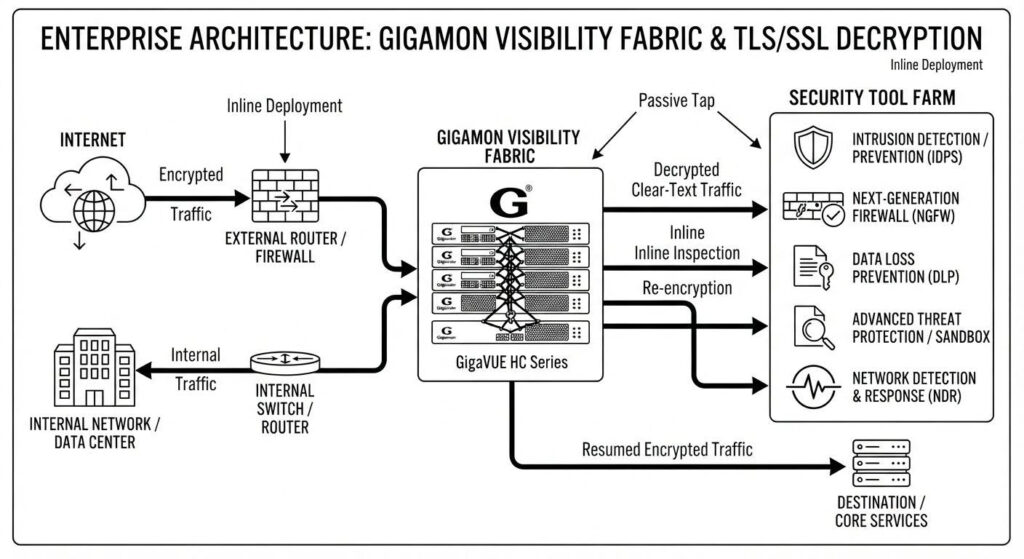
How Gigamon Handles TLS Decryption
Gigamon supports two primary deployment models for TLS decryption:
- Passive or out-of-band decryption
- Inline decryption
The correct architecture depends on the network design, traffic type, security requirements, and supported TLS features.
1. Passive TLS Decryption
In a passive deployment, a network TAP or SPAN port sends a copy of traffic to the Gigamon packet broker.
The production traffic continues along its normal path. Therefore, the monitoring architecture does not introduce latency into the primary traffic flow.
Key Store and Private Keys
Administrators can upload supported server private keys into the Gigamon Key Store.
For legacy RSA-based TLS sessions, the private key can help the system derive session information from captured handshake traffic.
However, this approach has an important limitation.
Modern TLS deployments commonly use Perfect Forward Secrecy (PFS). With ephemeral key exchanges such as ECDHE, a static server private key cannot recover the session keys from a passive traffic capture.
As a result, passive TLS decryption becomes much more limited with modern cipher suites.
2. Inline TLS Decryption
Inline deployment takes a different approach.
Instead of simply observing traffic, Gigamon participates directly in the connection path. The platform can terminate and re-establish TLS sessions as a proxy.
Inbound Traffic Inspection
For inbound traffic, Gigamon can operate as a reverse proxy.
The external client connects to the proxy. Gigamon then establishes a separate secure connection to the internal server.
Outbound Traffic Inspection
For outbound traffic, Gigamon can operate as a forward proxy.
The platform uses an internal Certificate Authority (CA) to establish trusted inspection certificates for supported connections.
As a result, Gigamon can access clear-text traffic for inspection before re-encrypting and forwarding it.
Passive vs. Inline TLS Decryption
The two approaches serve different purposes.
Passive decryption provides visibility without placing the decryption platform directly in the production traffic path. However, modern TLS features can limit what passive architectures can decrypt.
Inline decryption, on the other hand, provides greater control over modern TLS sessions. It also introduces additional infrastructure, certificate management, performance, and availability requirements.
Therefore, organizations should select the architecture based on both security objectives and operational requirements.
TLS Protocol Support and Key Limitations
TLS versions introduce different decryption considerations.
| Protocol | Passive Decryption | Inline Decryption | Key Consideration |
|---|---|---|---|
| SSLv3 / TLS 1.0 / 1.1 | Legacy support | Supported where applicable | Deprecated protocols create security risks |
| TLS 1.2 | Depends on cipher suite | Supported | PFS cipher suites limit passive decryption |
| TLS 1.3 | Static private keys cannot decrypt sessions | Proxy-based inspection | Ephemeral keys and PFS change the decryption model |
Note: Protocol and cipher-suite support can vary by Gigamon platform, software release, deployment model, and configuration. Verify the specific support matrix for the target GigaVUE and GigaSMART release before implementation.
Why TLS 1.3 Changes the Decryption Model
1. Perfect Forward Secrecy
TLS 1.3 requires modern key-exchange mechanisms that provide Perfect Forward Secrecy.
Each session uses ephemeral key material. Therefore, a static server private key does not provide the information required to passively decrypt captured TLS 1.3 traffic.
This creates a major difference between legacy RSA-based decryption and modern TLS inspection.
2. Inline Processing and Performance
Organizations that need real-time TLS 1.3 inspection generally use an inline proxy architecture.
The decryption platform must terminate the TLS session, inspect the traffic, and establish the next encrypted connection.
Consequently, the infrastructure must provide sufficient processing capacity for the expected traffic volume.
Performance planning should consider throughput, concurrent sessions, TLS handshakes, cipher suites, and peak traffic conditions.
3. Certificate Pinning
Certificate pinning creates another challenge.
Some mobile applications and enterprise applications expect a specific server certificate or certificate chain.
When an inspection proxy presents a different certificate, the application may detect the change and terminate the connection.
Therefore, security teams need appropriate bypass policies for applications that cannot support TLS interception.
4. Privacy and Compliance
TLS inspection can expose sensitive information to security infrastructure.
This may include financial information, healthcare data, credentials, and other confidential content.
For this reason, organizations should apply selective decryption policies where appropriate.
They should also define clear rules for sensitive traffic, privacy requirements, access controls, logging, and data retention.
TLS Decryption Offloading and Enterprise ROI
TLS decryption consumes significant processing resources.
When multiple security tools independently decrypt the same traffic, the organization may duplicate expensive cryptographic processing.
Gigamon’s decryption offloading model addresses this problem.
Decrypt Once, Feed Many
Instead of requiring every security appliance to perform TLS decryption, Gigamon can decrypt supported traffic centrally.
It can then distribute the resulting traffic to multiple security tools.
As a result, organizations can reduce duplicate processing and improve the efficiency of their security infrastructure.
Reducing Security Appliance Bottlenecks
Security appliances can spend significant resources on encryption and decryption.
Offloading these operations can allow the tools to focus more of their resources on inspection and threat detection.
Furthermore, centralized processing can simplify traffic distribution across multiple security tools.
The actual performance improvement depends on the platform, traffic profile, cipher suites, security tools, and deployment architecture. Therefore, organizations should validate ROI through capacity planning and testing rather than relying on a fixed percentage improvement.
Security Tools That Benefit from TLS Visibility
Centralized TLS decryption can improve visibility for several security technologies.
Next-Generation Firewalls and Secure Web Gateways
NGFWs and SWGs can inspect clear-text traffic without independently handling every decryption operation.
Intrusion Detection and Prevention Systems
IDPS platforms can analyze application traffic and payloads that would otherwise remain encrypted.
Data Loss Prevention
DLP systems can inspect supported outbound traffic for sensitive information and potential data exfiltration.
Advanced Threat Prevention
Sandbox and ATP platforms can analyze suspicious files and payloads extracted from inspected traffic.
SIEM and NDR Platforms
SIEM and Network Detection and Response platforms can receive richer traffic metadata and security context.
As a result, security teams can improve detection, investigation, and incident response.
Key Considerations Before Deploying TLS Decryption
Before deploying enterprise TLS inspection, organizations should evaluate several factors.
First, assess traffic volume. Estimate average and peak throughput.
Next, review TLS versions and cipher suites. This determines which traffic the architecture can inspect.
In addition, identify applications that use certificate pinning. These applications may require bypass policies.
Then, define privacy and compliance policies. Decide which traffic should remain encrypted.
Finally, validate performance. Test throughput, latency, concurrent sessions, failover, and security-tool capacity before production deployment.
Conclusion
TLS encryption protects modern applications, but it can also create visibility gaps for enterprise security teams.
Gigamon helps address this challenge by providing centralized traffic visibility and TLS decryption capabilities through its visibility architecture.
Passive decryption can remain useful for supported legacy traffic and specific monitoring scenarios. However, modern TLS features such as Perfect Forward Secrecy make static private-key decryption unsuitable for many current sessions.
Inline TLS inspection provides a more practical approach for organizations that need real-time visibility into supported modern encrypted traffic.
At the same time, successful deployment requires more than decryption technology. Organizations must consider application compatibility, certificate management, privacy, compliance, performance, and high availability.
Ultimately, the decrypt-once, feed-many approach can help organizations improve security visibility while reducing duplicated processing across their security toolchain.
Need Help Designing Enterprise TLS Visibility?
Encrypted traffic should not create blind spots in your security architecture.
If your organization is evaluating Gigamon TLS decryption, network visibility, security tool integration, or traffic inspection, Trezbon can help you assess the architecture, deployment requirements, and operational considerations.
Talk to Trezbon’s enterprise technology team to discuss your network visibility and security requirements.
NSX-T Series: Part 16 – NSX-T Segment T1 Gateway with EDGE Cluster(SR)

Distributed LLM Inference: GPU Networking, vLLM & llm-d
NSX-T Series: Part 17 – NSX-T Segment T1 and T0 on same Edge Cluster T0 as SR
About Author

Muhammad Marakkoottathil(MM)
Expert in the field of SDN, cloud computing, virtualization, active-active data center design & migration. Passionate about helping organizations to achieve their digital transformation objectives with strong 15+ years of experience in design, deployment, and managing heterogeneous network solutions across the industry verticals. Major Industry Certifications: Cisco CCIE, CCDP, VMware VCAP-NV_DESIGN, TOGAF, ITIL, NUTANIX NCSE, Google Cloud Architect, Azure Fundamentals More info please visit my page @ LinkedIn: https://www.linkedin.com/in/contactmm/
Great breakdown of the architectural trade-offs between passive and inline TLS decryption, especially the challenges introduced by TLS 1.3 and Perfect Forward Secrecy. The ‘decrypt-once, feed-many’ offloading approach is spot-on for helping organizations scale their security tools without bottlenecking performance. Thanks for sharing such a practical and comprehensive guide!