NSX-T 3.0 Design Bootcamp: Architecture, Components & Overview
Introduction: Understanding NSX-T 3.0 Design
Designing a modern data center requires a clear understanding of both physical and virtual networking. As organizations adopt virtualization and software-defined infrastructure, network architects must ensure that security, performance, and scalability work together.
Welcome to the first article in our NSX-T 3.0 Design Bootcamp series. In this guide, we explore the fundamental components of VMware NSX-T architecture and explain the key considerations for building a reliable, secure, and scalable network.
Why Does NSX-T Architecture Matter?
Traditionally, organizations relied on dedicated hardware for routing, switching, firewalls, and load balancing. However, virtualization has changed how these services are deployed and managed.
With VMware NSX-T, organizations can deliver many networking and security functions through software. As a result, they can manage virtual network services more flexibly without making frequent changes to the underlying physical infrastructure.
Nevertheless, physical networking remains essential. NSX-T transport nodes still depend on physical switches, reliable connectivity, and correctly configured underlay networks.
Therefore, network architects must understand how physical and virtual environments work together.
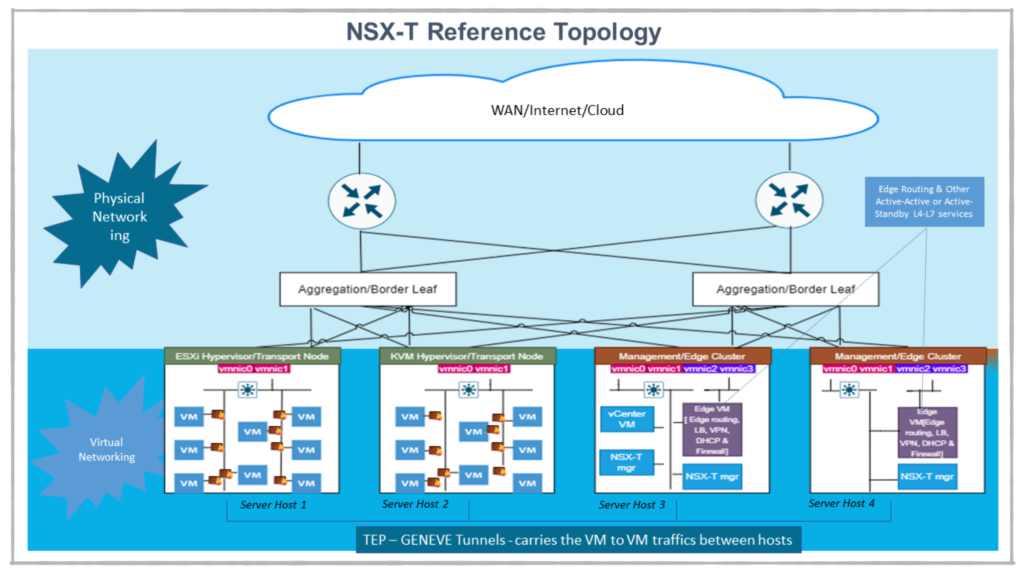
Bringing Networking and Security Closer to Applications
One important benefit of NSX-T is its ability to provide distributed networking and security services close to application workloads.
For example, distributed firewall rules can protect traffic between virtual machines without requiring every connection to pass through a centralized physical firewall.
Additionally, NSX-T supports network segmentation, routing, gateway services, and integration with selected third-party security solutions.
In this first part of the series, we introduce the main NSX-T design building blocks. We also examine physical network requirements, high availability, disaster recovery, performance optimization, and security considerations.
By understanding these components, you can build a stronger foundation for future NSX-T architecture and deployment decisions.
NSX-T Design building Blocks
Below is the 360 degree observation of the NSX-T and related design blocks. And let’s walk around each of these little bit in below sections and will have in-depth looks into each of these in upcoming articles.
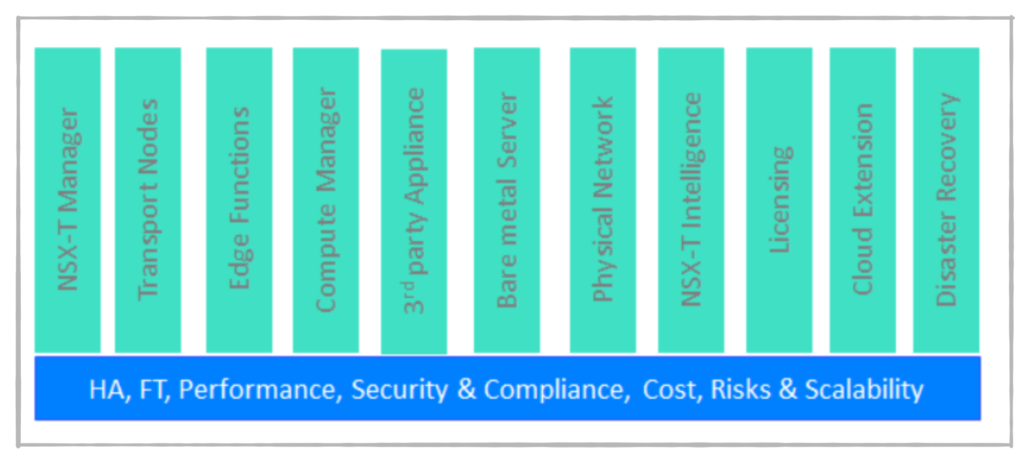
NSX-T Manager
It is the three-node cluster solution combining the management, control plane function. High availability and fault tolerance are part of the software. Also just to note, the vSphere FT feature is not currently supported with NSX-T.
Transport nodes:
In a typical highly virtualization environment the server infrastructure will be mostly dominated by the hypervisors – and the hypervisors nodes hosting NSX-T functions are called transport nodes—– The hypervisors could be ESXi or variety of KVM flavors such as Redhat, Ubuntu, Suse, CentOs etc.
Edge Nodes:
Edge nodes is where one could host all your edge functions – the edge nodes are primarily for connecting your NSX-T network to the external world. Also from design perspective, it is always better option to create separate cluster for workload and management/edge, however this is a design choice
Compute Manger:
Currently, the only the vCenter is the compute manager option with NSX-T. Please note that the NSX-T Data Center does not support the same vCenter Server to be registered with more than one NSX Manager
Service Chaining & 3rd party integration:
NSX-T Data Center provides the functionality to insert third-party services for functions such as network security & introspection etc. However, only ESXi hosts are supported to deploy north-south or east-west service VMs. KVM hosts are not supported
Bare metal Services
To use the NSX-T Data Center on bare metal (BM) server, you must install supported third-party packages.
Physical Network:
Physical switching and routing are mainly for connecting different transport nodes and also sending traffic to outside the NSX-T network such as WAN, cloud, Internet, etc. Apart from the physical cabling topology considerations, the routing protocol and jumbo frame supports are some of the main considerations here.
Correlation and Analytics
NSX-T intelligence is the main solution in this space which is part of the portfolio of NSX. And the key here is to understand even though NSX-T intelligence comes with its own OVA, the NSX-intelligence UI is part of NSX-T itself – it is not separate. Also, considerations for integrating with IBM Qradar, VMware VRNI, Splunk, etc are also important.
Licensing & Cost:
There is multiple licensing models to aware of. And the features and solution will differ based on the selected licensing tier.
Cloud extension
You can deliver consistent networking and security for your applications running natively in public clouds by extending your on-prem NSX-T capability to the cloud. No more infrastructure silos to drive up complexity and operational expense. NSX Cloud currently supports Microsoft Azure and Amazon AWS, including Azure Government and AWS GovCloud (US) regions.
Disaster Recovery:
When it comes to disaster recovery, the discussion is more about how you can do NSX-T across multiple locations. There are two options with latest NSX-T 3.0 1) NSX-T multisite and 2) Federation
Performance & Optimization:
For optimum performance, you need to consider the resource requirement for doing networking and security function with NSX-T such as DPDK, Doing GENEVE offload on the NIC and sizing and scaling the edge function, etc. And the replication mechanism considerations are also an interesting topic – we will talk about this in detail, in upcoming articles.
High Availability & FT
This is a huge design topic, the idea is to look at the HA and redundancy capability from active-active or active-standby option with the routing and L4-L7 services and also for each of the other relevant and related components form NSX-T world!!. And when it comes to FT, Here we look at some of the native features of vSphere and KVM for protecting the workload in case of any issues
Security & Compliance:
The native, east-west distributed firewalling, and north-south gateway firewalling are the key topic and additionally the load-balancer placement and considerations
Sizing and Scalability
The NSX-T managers, edge functions, compute nodes sizing, VM density across the transports are some of the considerations here
Conclusion: Building a Strong Foundation for NSX-T 3.0 Design
A successful NSX-T 3.0 design begins with understanding how physical infrastructure, virtual networking, and security services work together.
Throughout this guide, we explored the essential building blocks of NSX-T architecture, including NSX-T Manager, transport nodes, Edge nodes, physical networking, and service integration. We also discussed important design considerations such as high availability, disaster recovery, performance, security, and scalability.
However, selecting the right components is only the beginning. Network architects must also evaluate application requirements, traffic patterns, infrastructure capacity, and operational needs before finalizing their design.
For example, a well-planned NSX-T architecture can simplify network segmentation, support distributed security policies, and improve flexibility across virtualized environments. Additionally, appropriate sizing and redundancy help organizations maintain reliable connectivity as their infrastructure grows.
Therefore, understanding these design principles is essential for anyone planning, deploying, or managing VMware NSX-T environments.
What’s next?
In the upcoming articles of our NSX-T Design Bootcamp series, we will explore individual components, architectural decisions, deployment considerations, and practical design scenarios in greater detail.
Whether you are a network engineer, virtualization specialist, or security architect, this series will help you strengthen your understanding of NSX-T design.
Continue learning with Network Bachelor and explore more practical VMware NSX-T guides.
Continue Your VMware NSX-T Learning Journey
Want to understand VMware NSX-T architecture beyond the basics?
Explore practical guides covering NSX-T deployment, transport nodes, Edge networking, routing, security, and design best practices.
Explore More VMware NSX-T Tutorials
Follow Network Bachelor for technical tutorials, real-world networking insights, and practical data center architecture guidance.
Have a question about NSX-T design? Share it in the comments and join the discussion with fellow networking professionals.

AI Inference Explained: Prefill, Decode & Scaling

Aviatrix Multicloud Transit: ACE Lessons for Production
LLM Quantization with vLLM: PTQ vs QAT Guide
About Author

Muhammad Marakkoottathil(MM)
Expert in the field of SDN, cloud computing, virtualization, active-active data center design & migration. Passionate about helping organizations to achieve their digital transformation objectives with strong 15+ years of experience in design, deployment, and managing heterogeneous network solutions across the industry verticals. Major Industry Certifications: Cisco CCIE, CCDP, VMware VCAP-NV_DESIGN, TOGAF, ITIL, NUTANIX NCSE, Google Cloud Architect, Azure Fundamentals More info please visit my page @ LinkedIn: https://www.linkedin.com/in/contactmm/
Glad to find this article – waiting for the remaining part
Please go through the bootcamp series 2 and 3 as well
Well defined, Short and crisp. Thank you for sharing
Hello, my name is Angge from TDS. We have a domain that is currently on sale that you might be interested in – T-Design.net
Anytime someone types T-Design, T Design Online, The Best T Design, or any other phrase with these keywords into their browser, your site could be the first they see!
The internet is the most efficient way to acquire new customers
Avg Google Search Results for this domain is: 10,830,000,000
You can easily redirect all the traffic this domain gets to your current site!
Priced at only $998 for a limited time! If interested please go to T-Design.net and select Buy Now, or purchase directly at GoDaddy.
Act Fast! First person to select Buy Now gets it!
Thank you very much for your time.
Best Regards,
Angge Maniquis
You’ve done an impressive work on your website in covering the topic. I am working on content about Website Design and thought you might like to check out Article Star and let me what you think.