AI Inference Explained: Prefill, Decode & Scaling
AI Inference Explained: From Prefill and Decode to Serving at Scale
Training an AI model is a major investment. However, AI inference creates ongoing operational costs. Every chat message, AI agent action, and API request requires computing resources. As demand grows, inference performance directly influences GPU capacity, response times, and cost per token.
Therefore, understanding AI inference optimization is essential for infrastructure engineers, AI architects, and enterprise IT teams.
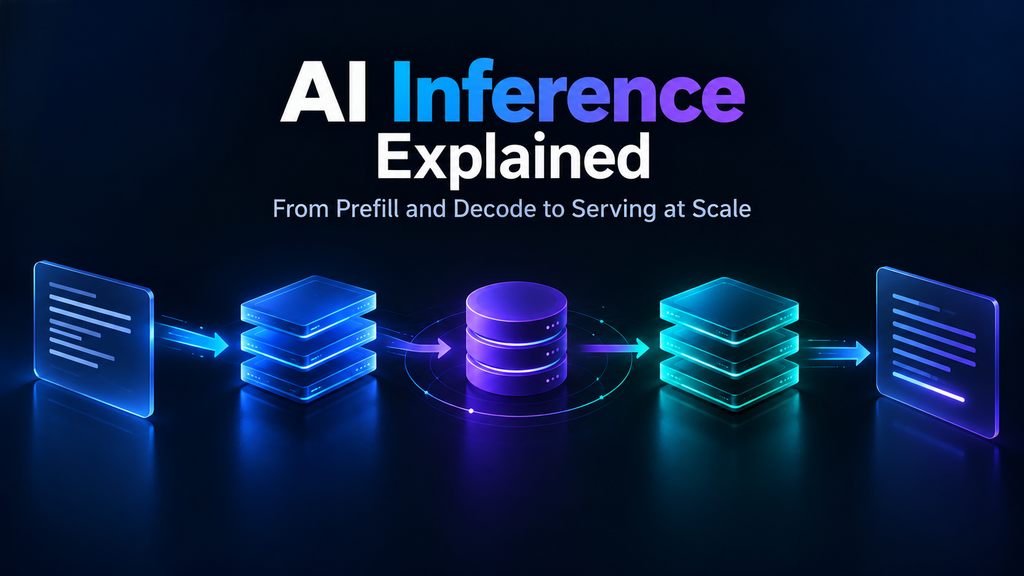
Why AI Inference Matters for Enterprise Infrastructure
At first glance, AI inference may seem like a straightforward process. However, running large language models (LLMs) efficiently requires careful infrastructure planning.
For example, AI inference involves two important phases: prefill and decode. Although both contribute to text generation, they place different demands on GPU resources.
- Prefill: Processes input tokens and typically requires substantial computational capacity.
- Decode: Generates output tokens and is often limited by memory bandwidth, particularly at smaller batch sizes.
Consequently, organizations must balance computational efficiency, memory usage, throughput, and latency.
Furthermore, effective LLM serving depends on several interconnected technologies. These include KV caching, continuous batching, model quantization, and intelligent request scheduling.
What Will You Learn in This Guide?
This article explores AI inference through five essential layers.
- AI Inference Fundamentals: Understand prefill, decode, inference engines, and key performance metrics.
- KV Cache Optimization: Learn how prefix caching and PagedAttention improve memory efficiency.
- Inference Throughput Optimization: Explore continuous batching, speculative decoding, and quantization.
- Scalable LLM Serving Infrastructure: Understand parallelism, model routing, and enterprise AI serving platforms.
- Beyond Autoregressive LLMs: Discover diffusion model inference and local AI deployment.
By the end of this guide, you will understand how these technologies work together. More importantly, you will be better equipped to evaluate vLLM and TensorRT-LLM configurations and make informed infrastructure decisions.
Chapter 1: What Is AI Inference?
AI inference is the process of using a trained artificial intelligence model to generate predictions or outputs from new inputs.
For example, when a user submits a question to an LLM, the model processes the input and generates a response.
Unlike model training, inference uses the model’s learned parameters without updating them during normal execution.
Understanding Prefill and Decode
Autoregressive LLM inference consists of two main phases.
First, the prefill phase processes the input prompt and builds the initial key-value (KV) cache. This stage is generally compute-intensive, especially for long prompts.
Next, the decode phase generates new tokens sequentially. Each token depends on the previously processed context. As a result, decoding can become memory-bandwidth-intensive.
However, actual performance depends on model architecture, batch size, hardware, and workload characteristics.
Therefore, understanding the differences between prefill and decode is essential for optimizing GPU utilization, inference latency, and overall serving efficiency.
Conclusion: Building Efficient and Scalable AI Inference Infrastructure
AI inference is a critical component of modern enterprise AI infrastructure. Although training creates the model, inference determines how efficiently that model delivers results in production.
Therefore, organizations must look beyond GPU capacity alone. They also need to optimize prefill and decode performance, memory utilization, request scheduling, and model serving architecture.
Furthermore, technologies such as KV cache optimization, PagedAttention, continuous batching, speculative decoding, and quantization can improve resource efficiency when applied to suitable workloads.
However, no single optimization works equally well for every AI application. For example, real-time chatbots prioritize low latency, while batch processing systems often prioritize throughput and cost efficiency.
Consequently, infrastructure teams should evaluate performance using meaningful metrics, including time to first token (TTFT), time per output token (TPOT), throughput, GPU utilization, and cost per token.
Ultimately, successful LLM inference optimization requires the right balance of performance, scalability, reliability, and operational cost.
By understanding how AI inference works, enterprise teams can make better architectural decisions and build more efficient AI serving environments.
Need Expert Guidance for Your AI Infrastructure?
Designing scalable AI infrastructure requires expertise across compute, networking, security, and platform integration.
TREZBON TECHNOLOGIES provides IT infrastructure consulting and technology integration expertise to help organizations evaluate infrastructure requirements and plan secure, reliable environments.
Whether you are exploring private AI infrastructure, GPU networking, or enterprise technology modernization, our consultants can help you assess your technical requirements.
Connect with TREZBON TECHNOLOGIES to discuss your infrastructure goals.
For more practical insights into AI infrastructure, enterprise networking, and emerging technologies, explore technical articles on NETWORK BACHELOR.
NSX-T Series: Part 17 – NSX-T Segment T1 and T0 on same Edge Cluster T0 as SR

From Jupyter Notebook to InfiniBand Fabric: What an ML Team Actually Hands the Slurm Admin
The Questions No Single Team Can Answer
About Author

abhishek
Cloud Platform Lead and AI Infrastructure Architect at e& enterprise, with 12+ years in data center, virtualization, security and AI infrastructure. I design and build private cloud and sovereign AI platforms, working with VMware (NSX-T, vSphere, vSAN, HCX, AVS, SRM), Kubernetes, Terraform and GPU inference infrastructure for LLMs. Previously served Networkers Home (CCIE instructor, trained around 50 CCIEs), VCE/EMC2, Cisco, VMware and Arista across TAC, consulting, design and training. Certifications: CCIE#48639 (Data Center and R&S), VCIX-DCV and NV, CKA, NVIDIA AI Infrastructure, Azure Solutions Architect Expert, Terraform Associate, Palo Alto PCNSE. LinkedIn: https://www.linkedin.com/in/abhishekkunal51/