Deep Observability Platform Comparison 2026
Your Enterprise Network Has Evolved. Has Your Visibility Strategy Kept Pace?
Enterprise networks are changing rapidly. Today, businesses operate across hybrid cloud environments, multicloud platforms, Kubernetes containers, and connected IoT and OT devices.
However, traditional network monitoring tools often struggle to provide complete visibility across these environments. As a result, security teams may miss important traffic patterns, encrypted communications, and potential threats.
Choosing the right deep observability platform is therefore more important than ever.
A modern solution should help organizations monitor network traffic, investigate security incidents, and improve visibility across their infrastructure. In addition, it should support their operational and compliance requirements.
But how can enterprises identify the right platform?
To answer this question, Trezbon Technologies conducted a Deep Observability Platform Comparison in March 2026.
The evaluation compared four major solutions:
- Gigamon
- Keysight (Ixia Vision)
- Cisco (Nexus)
- VIAVI Solutions
The study examined 25 capabilities across 10 evaluation dimensions. Each capability received a weighted score based on enterprise priorities, with particular attention to organizations operating in the UAE and GCC.
The objective was simple: Help enterprise decision-makers compare network visibility solutions using structured evaluation criteria rather than relying solely on vendor claims.
In this article, we explore the key findings, platform differences, and practical considerations for selecting a deep observability solution.
The Stakes: Why Platform Selection Matters More Than Ever
Traditional MELT-based observability (metrics, events, logs, traces) was designed for a simpler world. It was never built to inspect encrypted east-west traffic between containers, detect lateral ransomware movement across cloud VPCs, or satisfy regulators who now demand continuous network-level evidence of Zero Trust progress.
For enterprises operating in the UAE and broader GCC, the compliance dimension compounds the risk. NESA, NCA, and CBUAE frameworks now require documented network visibility, not just perimeter firewalling. A platform that can’t reach beyond the physical data center isn’t just technically limited — it’s a regulatory liability.
The evaluation was designed with this reality in mind.
The Methodology: 25 Capabilities, 10 Dimensions, Real Weights
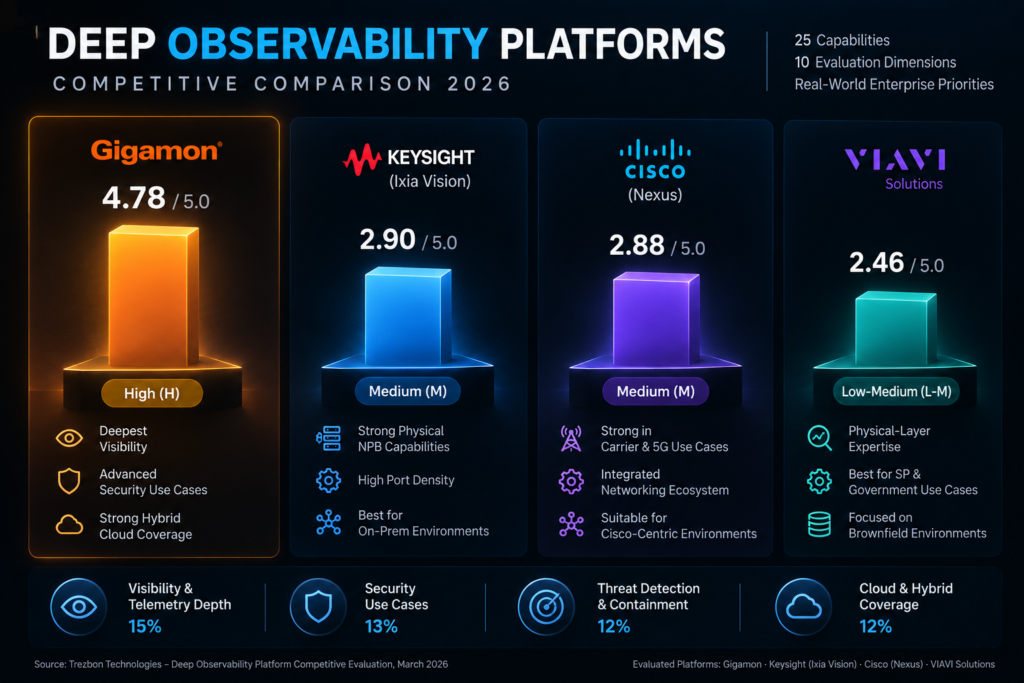
The study assessed 25 key capabilities grouped across 10 evaluation dimensions, each scored 1–5 and weighted according to GCC enterprise priority. The top four dimensions by weight:
- Visibility & Telemetry Depth — 15%
- Security Use Cases — 13%
- Threat Detection & Containment — 12%
- Cloud & Hybrid Coverage — 12%
This wasn’t a checkbox exercise. Capabilities evaluated ranged from physical tap and wire-speed capture, to Kubernetes container tapping, TLS/SSL inline decryption, PII masking in transit, AI/ML-ready metadata output, and GCC regulatory alignment. Sources included Frost & Sullivan TAM research, vendor battle cards, SKO sales training materials, and documented public specifications.
The Headline Scores
The overall weighted scores out of 5.0 tell a clear story:
| Platform | Overall Score | Band |
| Gigamon | 4.78 | High (H) |
| Keysight (Ixia Vision) | 2.90 | Medium (M) |
| Cisco (Nexus) | 2.88 | Medium (M) |
| VIAVI Solutions | 2.46 | Low-Medium (L-M) |
The gap between Gigamon and the nearest competitor — nearly 1.88 points — is not a marginal product differentiation. Across Visibility & Telemetry Depth, Analytics & Metadata Intelligence, and Reporting & Compliance, Gigamon is the only platform to simultaneously achieve the H (≥4.50) rating in all three.
What Sets Gigamon Apart
Three capabilities stood out as genuine differentiators unavailable elsewhere in the evaluation:
Precryption: Gigamon’s exclusive technology accesses virtual traffic in plaintext before host-based encryption is applied. This eliminates the last major east-west blind spot in encrypted container and VM traffic — a gap that every other platform in this evaluation simply cannot close.
Application Metadata Intelligence (AMI): Gigamon extracts 7,000+ packet-level attributes without storing full payload data, producing AI-ready structured telemetry for SIEM, NDR, and UEBA platforms. Competitors in this study offered basic L2–L4 NetFlow with limited enrichment.
Elastic Cloud-Native Visibility: Gigamon’s GigaVUE-V auto-scales tapping coverage on AWS, Azure, and GCP with a unified Fabric Manager that spans physical, virtual, and cloud-native environments from a single pane of glass. Keysight, Cisco, and VIAVI all showed material limitations in hybrid-cloud depth.
Gigamon also holds 52% deep observability market share (Frost & Sullivan, June 2025) and serves 4,000+ enterprise customers — metrics that reflect operational validation at scale, not just feature specifications.
Where the Others Fit
The report is intellectually honest about fit-for-purpose scenarios:
Keysight (Ixia Vision): at 2.90 is a legitimate contender for organizations doing a physical NPB refresh with no near-term cloud or advanced analytics requirements. Its 400G port density and physical-layer heritage remain competitive.
Cisco (Nexus): at 2.88 scores best within its own networking ecosystem — particularly for 5G NetFlow in carrier environments — but introduces vendor lock-in and lacks the cross-platform portability of purpose-built solutions.
VIAVI Solutions: at 2.46 is best positioned for SP and government brownfield environments where physical-layer retrospective analysis is the primary requirement. Cloud-native and AI-era metadata enrichment remain significant gaps.
The Bottom Line for Your Next Evaluation
If your organization runs hybrid cloud workloads, manages encrypted east-west traffic at scale, or needs to demonstrate Zero Trust progress to regulators — this evaluation provides quantitative, weighted evidence for platform selection conversations that are often driven by subjective vendor relationships.
The study doesn’t just rank platforms. It maps specific deployment scenarios — hybrid cloud security, ZTA implementation, financial services compliance, 5G core monitoring, physical NPB refresh — to recommended platforms with documented rationale.
That’s the kind of evidence that accelerates internal alignment, strengthens vendor negotiation, and gives procurement teams something concrete to defend.
Conclusion: Choosing the Right Deep Observability Platform
Enterprise networks are becoming more complex. As organizations adopt hybrid cloud, Kubernetes, IoT, and Zero Trust security, traditional monitoring approaches may no longer provide the visibility they need.
Therefore, choosing the right deep observability platform requires more than comparing technical specifications.
Organizations must consider network visibility, encrypted traffic monitoring, cloud integration, security capabilities, scalability, and compliance requirements. In addition, they should evaluate how each solution fits their existing infrastructure and future plans.
Trezbon Technologies’ Deep Observability Platform Comparison highlights important differences between Gigamon, Keysight, Cisco, and VIAVI Solutions.
According to the evaluation’s weighted scoring model, Gigamon achieved the highest overall score of 4.78 out of 5. This result reflects its performance across the capabilities prioritized in the study.
However, the highest-scoring platform may not be the best choice for every organization.
For example, enterprises focused on physical network packet broker upgrades may have different requirements from businesses managing complex hybrid cloud environments.
Similarly, organizations operating in regulated industries must consider their specific monitoring, security, and compliance obligations.
Ultimately, the right deep observability solution is the one that supports your organization’s security priorities, operational needs, and long-term infrastructure strategy.
A structured comparison can help IT leaders identify suitable platforms, understand technical trade-offs, and make informed investment decisions.
At Trezbon Technologies, we believe technology decisions should be supported by clear requirements, practical expertise, and reliable evidence.
Our evaluation provides a starting point for organizations looking to strengthen network visibility and improve their security monitoring strategy.
Compare Deep Observability Platforms with Confidence
Choosing between Gigamon, Keysight, Cisco, and VIAVI Solutions?
Make your next technology decision with a clearer understanding of each platform’s capabilities, strengths, and limitations.
Explore Trezbon Technologies’ Deep Observability Platform Competitive Evaluation.
The report covers 25 capabilities across 10 evaluation dimensions, including:
- Network visibility and traffic intelligence
- Encrypted traffic monitoring
- Hybrid cloud and Kubernetes visibility
- Security monitoring and threat detection
- Regulatory and compliance considerations
- Platform scoring and deployment recommendations
Whether you are evaluating a new network visibility solution or reviewing your existing infrastructure, the report can help guide your decision.
Ready to evaluate your options?
Visit Trezbon Technologies to explore our technology comparison resources.
Explore the Evaluation: www.trezbon.com
Need expert guidance? Connect with our team to discuss your network visibility requirements.
Talk to Our Experts: www.trezbon.com/contact
Bare Metal GPU Cloud for NVIDIA DGX SuperPOD: vMetal Workbook

LLM Quantization with vLLM: PTQ vs QAT Guide
AI Infrastructure Engineer Workbook: 12-Stage Hands-On Guide
About Author

Muhammad Marakkoottathil(MM)
Expert in the field of SDN, cloud computing, virtualization, active-active data center design & migration. Passionate about helping organizations to achieve their digital transformation objectives with strong 15+ years of experience in design, deployment, and managing heterogeneous network solutions across the industry verticals. Major Industry Certifications: Cisco CCIE, CCDP, VMware VCAP-NV_DESIGN, TOGAF, ITIL, NUTANIX NCSE, Google Cloud Architect, Azure Fundamentals More info please visit my page @ LinkedIn: https://www.linkedin.com/in/contactmm/