vLLM RL Rollouts and Speculative Decoding Guide
What happens when AI model training and inference become part of the same workflow?
Traditionally, organizations managed AI training and inference as separate processes. However, modern reinforcement learning (RL) and speculative decoding are changing this approach.
Today, vLLM RL rollouts help AI teams generate responses efficiently during reinforcement learning. At the same time, speculative decoding can accelerate model inference by allowing smaller draft models to propose tokens for verification.
As a result, AI infrastructure teams must consider training, model serving, GPU utilization, and inference performance together.
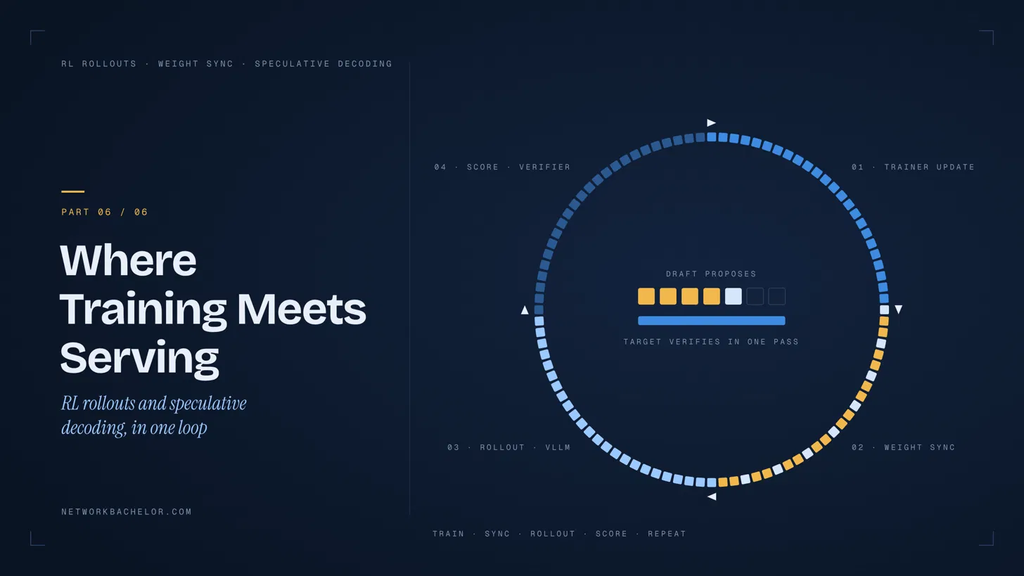
Part 6 of “vLLM in 2026: An Infrastructure Engineer’s Field Guide”
Why does this matter for enterprise AI?
As large language models become more complex, organizations face growing infrastructure demands. Therefore, optimizing inference is no longer only about serving requests faster. It also involves supporting training workflows, managing model updates, and maintaining reliable performance.
In this guide, we explore:
- How vLLM supports reinforcement learning rollouts.
- Why weight synchronization and GPU placement matter.
- How speculative decoding improves inference efficiency.
- Why draft models require training and evaluation.
- How enterprises can connect training, optimization, and deployment.
Ultimately, understanding these connections helps infrastructure teams build more efficient and scalable AI platforms.
Part A: RL training with vLLM as the rollout engine
1. Why RL needs an inference engine
Reinforcement learning requires repeated response generation. During each training cycle, the model produces outputs that are evaluated and used to improve its behavior.

However, generating long responses can consume substantial processing time. As a result, rollout generation may become a major bottleneck.
To address this challenge, AI teams can use vLLM as a dedicated rollout engine. Its batching, KV cache management, and parallel processing capabilities help improve generation efficiency.
Furthermore, vLLM RL rollouts allow infrastructure engineers to apply their inference optimization expertise directly to training workflows.
Consequently, optimizing the rollout engine can improve overall training efficiency.
2. The systems problems
Weight synchronization. After each policy update, rollout workers need access to the updated model weights.
For large models, transferring these weights can involve substantial amounts of data. Therefore, network bandwidth and transfer efficiency become important infrastructure considerations.
Depending on the deployment, teams may use network collectives, shared storage, or memory-sharing techniques.
In addition, they must evaluate synchronization frequency, transfer overhead, and GPU utilization.
Ultimately, an efficient weight synchronization strategy helps reduce delays between training and rollout generation.
Placement: colocated vs disaggregated.
| Colocated | Disaggregated | |
|---|---|---|
| Layout | Trainer and vLLM share the same GPUs, alternating | Separate GPU pools for training and rollout |
| Pros | No idle pool; simpler weight sharing | Each side tuned independently; can overlap work |
| Cons | Must swap memory state between phases | Needs fast weight transfer; risk of one pool idling |
For colocation, vLLM offers a sleep mode that releases GPU memory (weights and KV cache) so the trainer can use it, then restores it afterward. Check your version’s docs for the exact flags.
Long-tail rollouts. Response lengths vary widely: a few very long generations hold up a synchronous batch while most GPUs idle. Asynchronous designs let training proceed on completed rollouts while stragglers finish, at the cost of some off-policy staleness.
Numerical mismatch. The trainer and vLLM compute log-probabilities with different kernels and possibly different precision. Small differences between the sampling policy and the training policy can destabilize RL. Teams handle it with importance-sampling corrections, matching kernels/precision where possible, or explicitly monitoring the mismatch.
Scale and failure. A run spans many nodes for days; a failure mid-run must not lose the run. Checkpointing, worker health checks, and elastic rollout capacity all matter.
[Add from talk: how Prime Intellect structured GLM-5 RL: sync vs async, decentralized/heterogeneous workers if applicable, weight-sync path, measured utilization.]
3. What the inference team should know
- RL workloads are generation-heavy with long outputs, the opposite of agent serving’s prefill-heavy pattern (Post 4). Tune accordingly (decode throughput, large batch, KV headroom).
- Prefix caching helps when many rollouts share a prompt (grouped sampling).
- Version pinning matters: reproducibility of a training run depends on the vLLM version and kernels.
Part B: Training the speculative decoder
4. Speculative decoding in one page
Decode generates one token per forward pass of the big model, and it is bandwidth-bound, so the GPU is underused. Speculative decoding exploits that spare compute:
- A small, fast draft proposes several tokens ahead.
- The target model verifies all proposed tokens in one forward pass.
- Accepted tokens are kept; at the first mismatch, the target’s own token is used.
The output distribution matches the target model (with correct verification), so quality is unchanged; only speed changes.
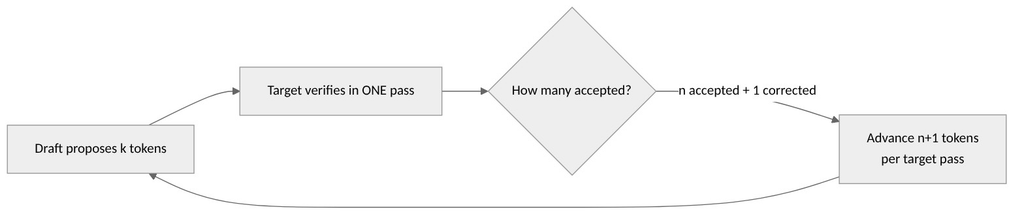
The key metric is acceptance length: the average number of tokens gained per target pass. Higher is better. The end-to-end speedup depends on acceptance length, draft cost, and batch size (speculation helps most at low-to-moderate batch sizes where the GPU has spare compute).
Approaches include separate small draft models and lightweight heads attached to the target (the EAGLE family), which reuse the target’s hidden states and generally achieve better acceptance. In vLLM you configure it with a speculative config:
# Illustrative: EAGLE-style draft
vllm serve <target-model> \
  --speculative-config '{"method":"eagle3","model":"<draft-model>","num_speculative_tokens":3}'
Method names and options change between versions; check the docs.
5. Why the drafter must be trained
A generic small model is a poor drafter for a specific target: its distribution differs, so acceptance is low. A drafter trained on the target’s own behavior (its hidden states and its outputs) tracks the target closely, so acceptance length rises and speedup follows. And every time you change the target (a fine-tune, a new quantization, an RL update), the drafter can drift out of alignment and needs retraining.
That last point ties back to this post’s first half: if you are RL-updating the target regularly, your speculative decoder is also on a training treadmill.
6. What “training at scale” involves
The drafter training pipeline is a data and systems problem:

- Data generation is expensive. Running the big target over lots of data and capturing hidden states produces enormous datasets; storage and I/O bandwidth become the constraint.
- Data distribution matters. Train on data resembling production traffic (including tool calls and code if you serve agents), or acceptance will disappoint in the real world.
- Evaluate in the real engine. Acceptance length measured in the actual serving stack, at realistic batch sizes, is the number that counts.
- A training framework native to your ecosystem reduces glue code; that is the space that tooling like TorchSpec addresses.
[Add from talk: Fred Wang’s TorchSpec design: what the framework automates, scaling results, acceptance-length gains on which models, integration with vLLM.]
The bigger picture
Serving, RL, and speculation form a loop: RL improves the model, which changes the target; the drafter is retrained; quantization is re-validated (Post 5); the fleet is redeployed (Post 3). A platform team that treats these as separate projects will be surprised by the dependencies. One that treats them as a pipeline can automate the loop.
Design-review checklist
- For RL: what is the weight-sync path, and is its bandwidth sized like a fabric design (not an afterthought)?
- Colocated or disaggregated placement chosen deliberately, with a plan for the idle-time tradeoff?
- Trainer/rollout numerical mismatch monitored?
- Rollout throughput tuned for long generations (decode-heavy), not chat defaults?
- For speculation: acceptance length measured on production-like traffic?
- Is there a retrain trigger for the drafter whenever the target changes?
- Is the whole loop (train, draft, quantize, evaluate, deploy) automated end to end?
Conclusion: Building Efficient AI Infrastructure with vLLM
AI training and inference are becoming increasingly interconnected. As organizations deploy more advanced language models, they must optimize both processes to maintain efficiency, scalability, and reliable performance.
First, vLLM RL rollouts help support reinforcement learning by accelerating response generation. However, successful implementation also requires efficient weight synchronization, GPU resource planning, and reliable infrastructure.
Similarly, speculative decoding can improve inference speed by allowing draft models to propose tokens for target-model verification. Nevertheless, its effectiveness depends on draft-model accuracy, acceptance length, and production workload characteristics.
Furthermore, updates to the target model can affect speculative decoding performance. Therefore, organizations should evaluate draft-model alignment, quantization, and inference behavior whenever significant model changes occur.
Ultimately, the key is to treat training, optimization, and deployment as connected stages of one AI infrastructure lifecycle.
By combining reinforcement learning, speculative decoding, and effective inference management, enterprises can build AI platforms that use computing resources more efficiently while supporting evolving application requirements.
The future of enterprise AI infrastructure is not simply about training larger models. It is about building systems that can train, serve, optimize, and adapt together.
Turn AI Infrastructure Complexity into a Clear Strategy
Building an efficient AI platform requires more than powerful GPUs. It requires the right architecture, reliable networking, scalable infrastructure, and well-designed inference workflows.
Looking to optimize your enterprise AI infrastructure?
TREZBON TECHNOLOGIES helps organizations evaluate infrastructure requirements, design enterprise IT environments, and plan technology solutions aligned with their business objectives.
Discuss your infrastructure requirements with our team.
🌐 Contact TREZBON TECHNOLOGIES
Want more practical AI infrastructure insights?
Explore the complete vLLM in 2026: An Infrastructure Engineer’s Field Guide series and follow NETWORK BACHELOR for technical articles on AI infrastructure, enterprise networking, cybersecurity, and modern data center technologies.
LLM Kubernetes Projects: 5 Hands-On AI Infrastructure Labs
VMware NSX-T and AVI Load Balancer: Architecture & Use Cases
Gigamon TLS Decryption: Passive vs. Inline Architecture and TLS 1.3 Challenges
About Author

abhishek
Cloud Platform Lead and AI Infrastructure Architect at e& enterprise, with 12+ years in data center, virtualization, security and AI infrastructure. I design and build private cloud and sovereign AI platforms, working with VMware (NSX-T, vSphere, vSAN, HCX, AVS, SRM), Kubernetes, Terraform and GPU inference infrastructure for LLMs. Previously served Networkers Home (CCIE instructor, trained around 50 CCIEs), VCE/EMC2, Cisco, VMware and Arista across TAC, consulting, design and training. Certifications: CCIE#48639 (Data Center and R&S), VCIX-DCV and NV, CKA, NVIDIA AI Infrastructure, Azure Solutions Architect Expert, Terraform Associate, Palo Alto PCNSE. LinkedIn: https://www.linkedin.com/in/abhishekkunal51/