API Security Architecture: Inline vs Out-of-Band Enforcement
As modern software architectures shift toward microservices, mobile applications, and cloud-native ecosystems, Application Programming Interfaces (APIs) have become the primary digital attack surface. Securing this surface requires a deep understanding of how API security solutions operate, their end-to-end architecture, and how deployment models dictate your security posture.
1. How Enterprise API Security Works
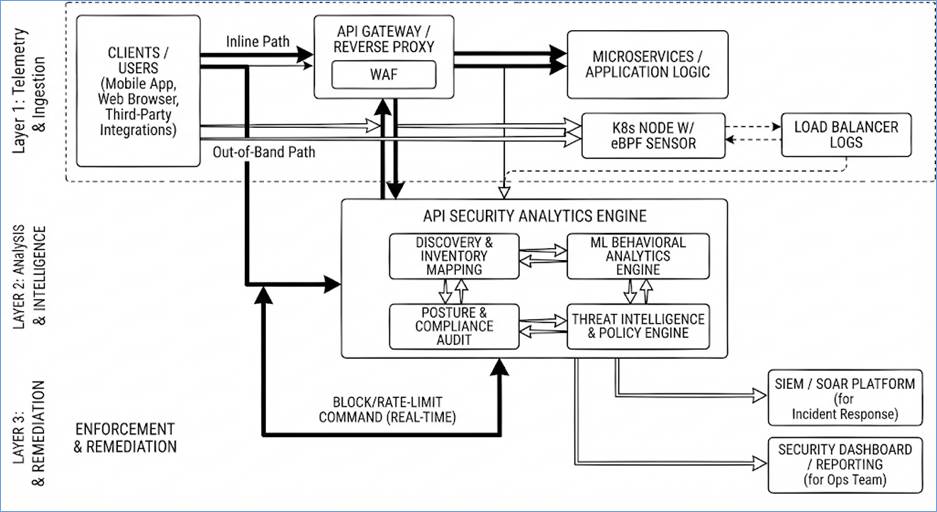
Traditional web application firewalls (WAFs) are often insufficient for modern APIs because they lack business logic context. Enterprise API security solutions operate on a continuous lifecycle framework divided into four core pillars:
- Discovery & Inventory: Automatically discovers all known, unknown (shadow), and rogue APIs by analyzing traffic, source code, or infrastructure configurations. It maps endpoints, parameters, and sensitive data structures (such as PII and financial records).
- Posture & Compliance Assessment: Inspects API specifications (such as OpenAPI/Swagger) for misconfigurations, weak authentication mechanisms, or excessive data exposure before code ever reaches production.
- Runtime Threat Protection: Defends against complex logic-based attacks in real-time, focusing heavily on the OWASP API Top 10—specifically Broken Object Level Authorization (BOLA/IDOR), Broken User Authentication, and Mass Assignment.
- Behavioral Analytics (ML/AI): Establishes a baseline of normal client and user behavior to detect sophisticated anomalies, credential stuffing, and automated scraping that easily bypass static signature-based rules.
2. End-to-End Architecture of an API Security Solution
A typical enterprise-grade API security architecture consists of three functional layers designed to process telemetry, analyze risk, and enforce protective controls:
| Architectural Layer | Core Functions | Typical Components |
| 1. Telemetry & Ingestion | Captures API traffic metadata or payloads for analysis. | API Gateways, WAFs, eBPF Sensors, Load Balancers |
| 2. Analysis & Intelligence | Processes data using machine learning to map APIs and flag threats. | Core Analytics Engine, ML Behavior Models, Threat Intelligence |
| 3. Enforcement & Integration | Pushes blocks, limits, or alerts to infrastructure and operations teams. | Inline Gateways, SIEM/SOAR Platforms (Splunk, Cortex XSOAR) |
Traffic sources feed into the API Security Analytics Engine, which processes the data to discover endpoints and detect anomalies. The engine then routes information to enforcement or reporting systems.
3. The Role of the API Gateway: Is It Mandatory?
An API Gateway (or Application Load Balancer / Reverse Proxy) is frequently a primary component in enterprise architectures. In standard deployments, the API Gateway acts as the inline enforcement point. When the security analytics engine detects a malicious request, it instructs the API Gateway to block or challenge subsequent requests from that client.
However, an API Gateway is not strictly mandatory for an API security solution to function. This distinction brings us to the core architectural choice: Inline vs. Out-of-Band (OOB) deployment.
4. Inline vs. Out-of-Band (OOB) Telemetry Collection
Understanding the trade-offs between inline and out-of-band architectures is critical for designing an enterprise cybersecurity strategy that balances performance, risk, and operational overhead.
A. Inline Deployment (Gateway-Integrated)
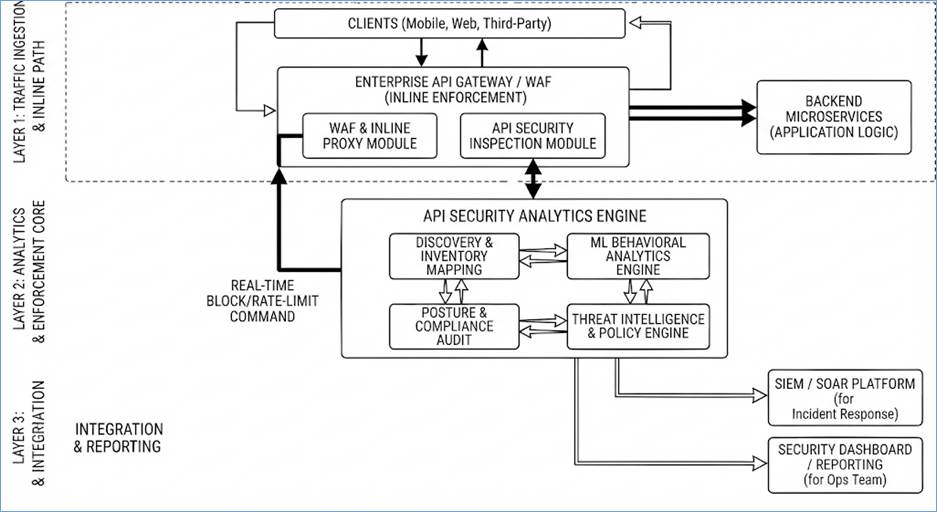
In an inline architecture, the security module or inspection proxy sits directly in the path of the API traffic flow.
- How it works: Every API request passes through the inspection engine before reaching the backend microservices. If an anomaly or BOLA attempt is flagged, the gateway drops or blocks the request immediately.
- Key Advantage: Active, real-time prevention. Malicious requests are stopped before they ever hit application logic.
- Trade-off: Introduces potential latency overhead and requires careful high-availability planning, as any failure in the inline inspection path can impact application availability.
B. Out-of-Band (OOB) Deployment
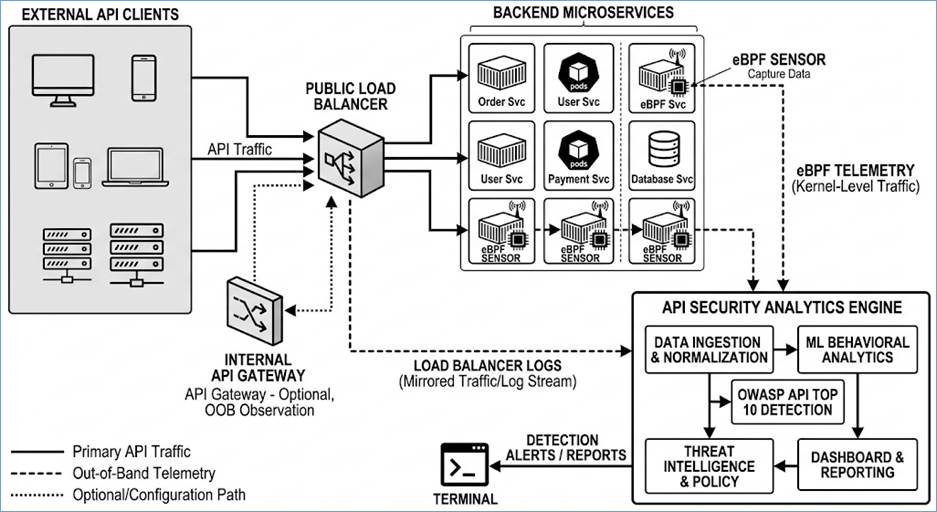
- Load-Balancer Logs: Telemetry flows outbound from the Load Balancer / Reverse Proxy (as access logs or exported streams) directly to the OOB Collector / API Security Analytics Engine.
- Optional API Gateway: If an API Gateway is present, it handles perimeter routing only. It is completely decoupled from the security engine’s analysis and does not act as a mandatory inline blocker.
- Alternative Telemetry Sources: Traffic is captured via network packet duplication (SPAN ports), container-level eBPF sensors, or cloud load balancer logs rather than an inline proxy.
In an out-of-band architecture, the security solution observes traffic without sitting in the direct request-response path.
- How it works: Traffic is observed passively via lightweight mechanisms such as container-level eBPF (Extended Berkeley Packet Filter) sensors that capture kernel-level socket traffic directly on Kubernetes orchestration nodes, network packet duplication (SPAN/TAP ports), or asynchronous log exports from public load balancers and reverse proxies.
- Is an API Gateway Mandatory for OOB? No, an API Gateway is completely optional in an OOB deployment. If an internal API gateway or public load balancer is present, it handles perimeter routing only—it does not sit in the critical path for security inspection. Telemetry flows asynchronously out-of-band from the load balancer logs or eBPF sensors directly into the API Security Analytics Engine.
- Key Advantage: Zero latency impact and high resilience. Because the security tool is completely decoupled from the active data path, it cannot cause application outages or add latency. It provides massive visibility and deep discovery across complex multi-cloud environments.
- Trade-off: Lacks native real-time blocking capabilities out-of-the-box. Remediation relies on alerting security operations (SecOps) teams, triggering automated patches, or integrating with secondary firewalls to block malicious IPs subsequently.
Conclusion: Choosing the Right API Security Architecture
Choosing between inline and out-of-band API security depends on your organization’s security requirements, application architecture, performance goals, and operational maturity.
Inline API security provides immediate enforcement because security controls operate directly in the API traffic path. As a result, organizations can block malicious requests before they reach backend applications and microservices. However, inline inspection must be designed carefully to minimize latency and maintain high availability.
Out-of-band API security, on the other hand, separates security analytics from the application’s request-response path. Telemetry can be collected through eBPF sensors, load balancer logs, SPAN/TAP traffic, reverse proxies, and other infrastructure sources. Therefore, organizations can gain extensive API visibility and behavioral analytics without introducing direct inspection latency into production API traffic.
An API Gateway is not mandatory for every API security architecture. It is particularly valuable when organizations require inline enforcement, centralized routing, authentication, rate limiting, and policy control. In an out-of-band architecture, however, API gateways can remain optional while the security platform independently analyzes API telemetry.
For many enterprises, the strongest strategy may combine both approaches. Out-of-band monitoring can provide broad API discovery, behavioral analysis, shadow API identification, and threat detection, while targeted inline controls protect high-risk APIs that require immediate enforcement.
Ultimately, the objective is not simply to deploy another security product. It is to build an enterprise API security architecture that provides visibility, detects abnormal behavior, protects sensitive data, and reduces API risk without compromising application performance or availability.
Need Help Designing Your API Security Architecture?
Protecting APIs requires more than deploying a WAF or API gateway. Organizations need the right combination of API discovery, security posture management, runtime protection, behavioral analytics, and enforcement controls.
Trezbon Technology LLC helps organizations assess and design enterprise security architectures based on their applications, infrastructure, risk profile, and business requirements.
Whether you are evaluating inline API security, out-of-band monitoring, API gateways, eBPF-based visibility, or enterprise API security solutions, our team can help you determine the right architecture for your environment.
Strengthen your API security architecture before your APIs become the weakest link.
Contact Trezbon Technology LLC to discuss your API security requirements and architecture.

The Questions No Single Team Can Answer

From Jupyter Notebook to InfiniBand Fabric: What an ML Team Actually Hands the Slurm Admin
vCloud Director: NSX-V to NSX-T Migration Part-2
About Author

Muhammad Marakkoottathil(MM)
Expert in the field of SDN, cloud computing, virtualization, active-active data center design & migration. Passionate about helping organizations to achieve their digital transformation objectives with strong 15+ years of experience in design, deployment, and managing heterogeneous network solutions across the industry verticals. Major Industry Certifications: Cisco CCIE, CCDP, VMware VCAP-NV_DESIGN, TOGAF, ITIL, NUTANIX NCSE, Google Cloud Architect, Azure Fundamentals More info please visit my page @ LinkedIn: https://www.linkedin.com/in/contactmm/