The Questions No Single Team Can Answer
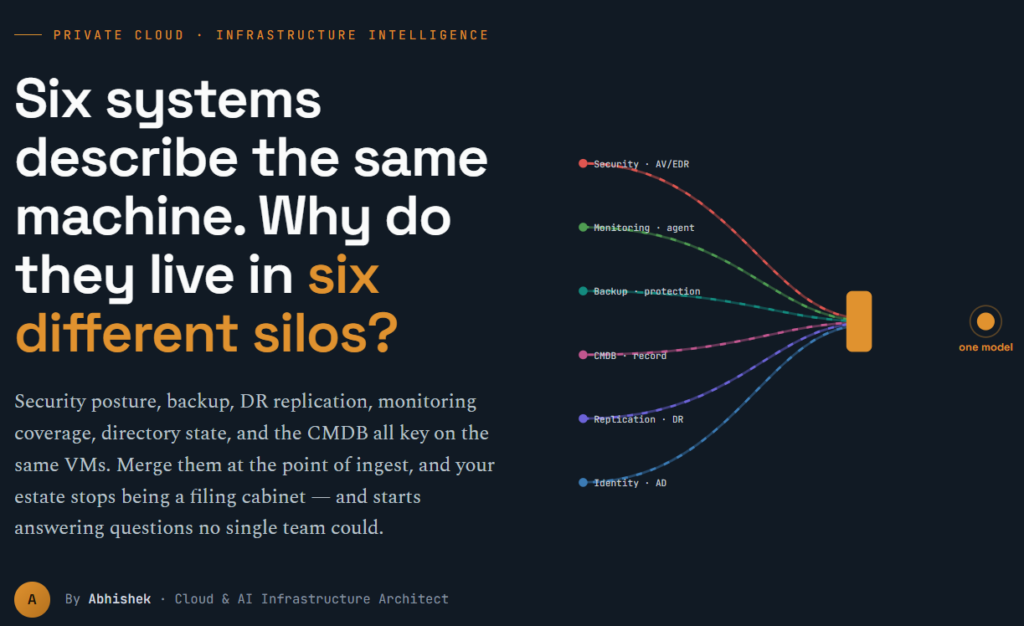
Every infrastructure team is sitting on a goldmine of data and quietly starving for answers. The data isn’t missing. It’s just scattered across owners who never join their tables.
It’s a familiar Monday. An auditor asks a question that sounds trivial: “Show me every production server that has no endpoint protection and isn’t being backed up.” It is, on its face, a reasonable thing to want to know. It is also, in most enterprises, nearly impossible to answer before lunch.
Why? Because the answer lives in places that have never spoken to one another. The security team owns the EDR coverage export. The backup team owns the data-protection report. The DR team owns the replication matrix. The operations team owns the monitoring console. The identity team owns the Active Directory join status. And the CMDB — the supposed system of record — sits to one side, confidently describing an estate that drifted out from under it months ago. Each source is correct in its own frame. Each is current. And each is a closed island.
The frustrating part is that all of them are describing the same machines. They share a primary key — the asset — and nobody is joining on it.
01 / THE PROBLEM
Six owners, six truths, zero joins
Walk into any mature private cloud and you’ll find the same pattern. The operational reality of every virtual machine is split across departmental silos, each with its own tool, its own export format, and its own refresh cadence:
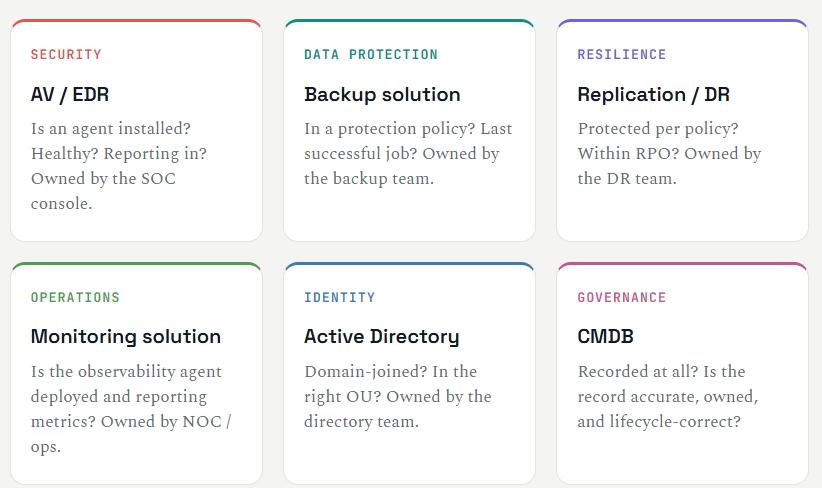
Individually, each report is useful. Collectively, they’re inert. The questions that actually matter to risk and compliance — the ones that span two or more of these domains — fall straight into the gaps between the silos. Nobody owns the join, so nobody asks the question. And the list above isn’t even exhaustive: privileged-access (PAM) coverage, patch and vulnerability state, tagging and ownership all live in their own islands too. Every one of them keys on the same asset.
A report tells you the state of one thing. Intelligence tells you what the combination of things means.
02 / THE INSIGHT
Classify once, query forever
The unlock is almost boringly simple, and it’s the single most important design decision in the whole platform: classify and normalise every machine at the moment of ingest, against one shared model.
When a source feed lands — an inventory export, a backup-job report, an EDR coverage dump, a monitoring inventory, a directory query, a CMDB extract — you don’t store it as a foreign blob. You resolve it to a known entity and stamp it onto a single canonical record. The VM name, the folder path, the network segment, the OS string: each is parsed once and turned into stable, queryable attributes.
tenant— derived from naming convention, so a department’s estate is always addressableenvironment— production vs. non-production, derived from placementzone— DMZ or internal, derived from the attached network segmentcategory— Windows / Linux / appliance, derived from the OS string
Once every machine carries those tags, the departmental feeds collapse onto it as columns rather than separate files. Security coverage becomes an attribute. Backup state becomes an attribute. Replication, monitoring, AD join, CMDB presence — each becomes an attribute on the same row. And the moment they’re columns on one record, a question that used to take a half-day of spreadsheet reconciliation becomes a single filter.
03 / THE PAYOFF
The questions you can finally ask
This is where the platform earns its keep. None of the questions below can be answered by any single team’s tool. All of them are one query away once the data is merged. Each card shows the question, the domains it crosses, and the intelligence it surfaces.
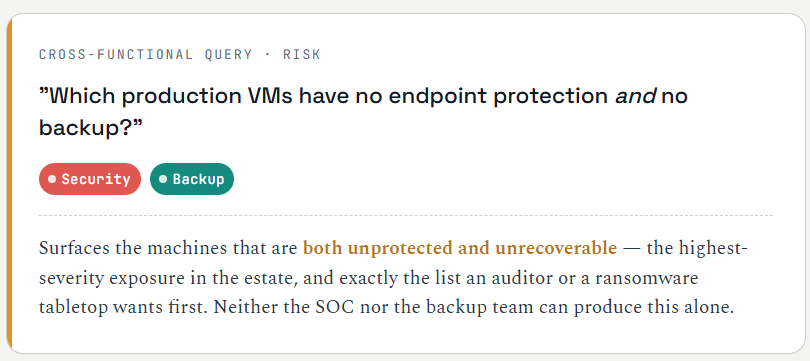
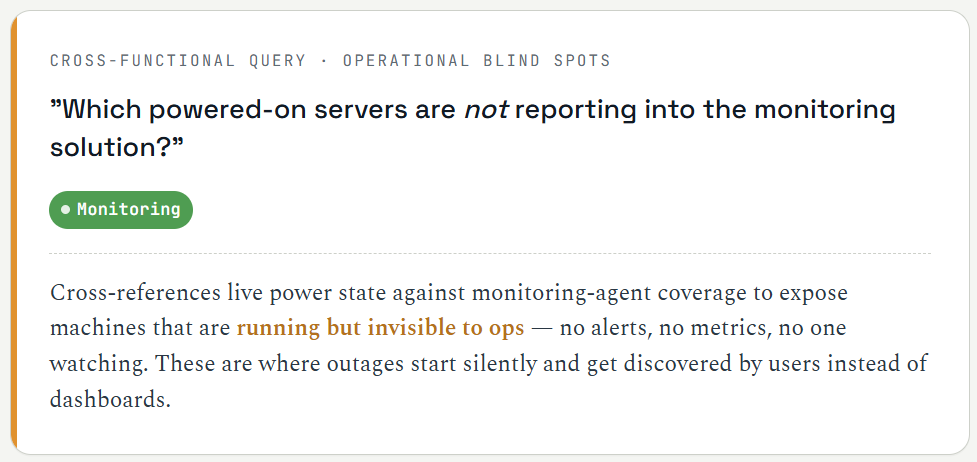
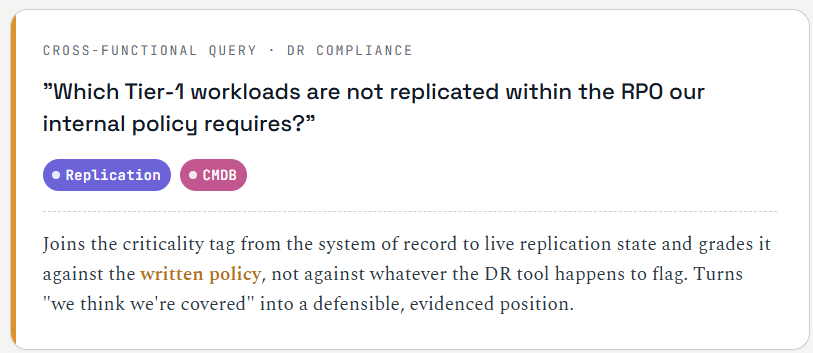
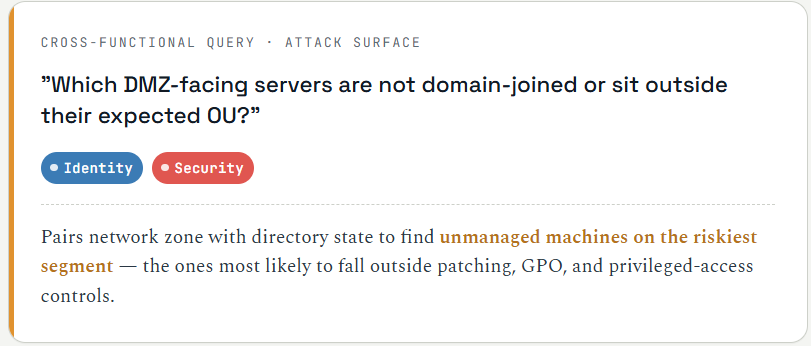
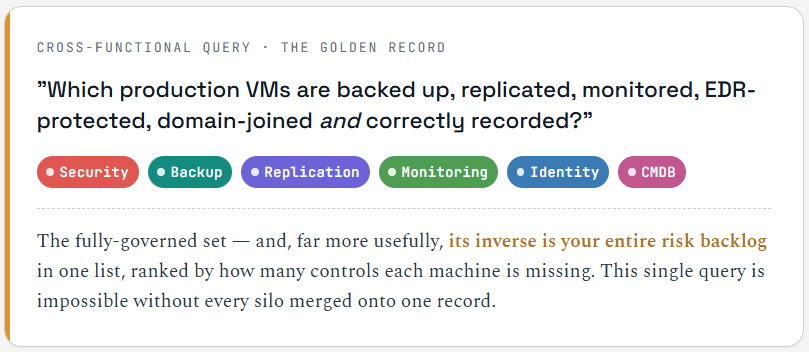
Each of these is a one-line filter against the merged model. None of them required a new data source — only a join that no department was positioned to make.
04 / THE SCORECARD
From lists to posture
Once the joins exist, the natural next step is to stop shipping lists and start shipping posture. Roll the attributes up per department and you get a compliance scorecard that an executive can read in ten seconds and a team lead can drill into immediately. The same merged data, expressed as coverage:
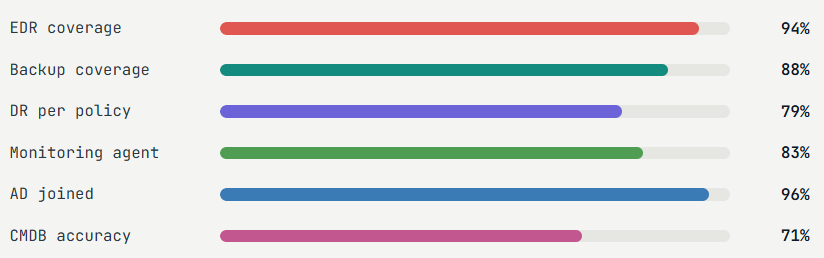
Illustrative figures. The point isn’t the numbers — it’s that they’re now derivable on demand from one source, sliced by tenant, environment, or zone, instead of assembled by hand once a quarter and obsolete on arrival. Note which bar is lowest: the CMDB, the one system that’s supposed to be the source of truth, is almost always the least accurate until something finally reconciles it against reality.
05 / THE ARCHITECTURE
How the pieces fit
The shape of the system follows directly from the insight. Many narrow feeds in; one normalised model in the middle; many ways to ask questions out. Deliberately air-gappable, deliberately boring in its dependencies — the cleverness lives in the model, not in the plumbing.
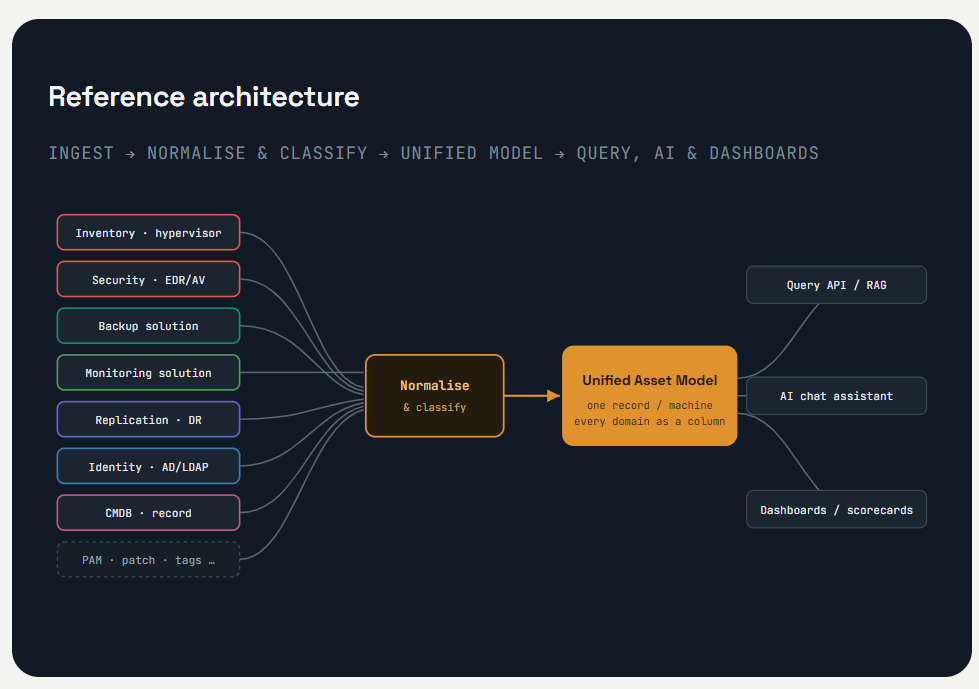
A few principles keep it honest. Read-only by default — the platform observes and correlates; it doesn’t mutate source systems without an explicit, gated action. On-premises and air-gap-friendly, because hostnames, network state, and protection status are sensitive operational data that shouldn’t leave the network. And model-first, because the value is entirely in the normalisation: get the canonical record right and every dashboard, query, and report downstream is just a view over it. New feeds — a PAM export today, a patch-compliance scan tomorrow — slot in as additional columns without redesigning anything.
06 / THE INTERFACE
Let people ask in plain language
Here’s the quietly transformative part. Once every machine is a structured, fully-attributed record, putting a natural-language layer on top is no longer exotic — it’s the obvious front door. The cross-functional questions stop being engineering tasks and become things anyone can type:
“Show me Windows servers in the payments tenant that are DMZ-facing and domain-joined, but missing an EDR agent or not reporting to monitoring.”
A model translates that into a structured query over the unified record, the platform executes it, and the answer comes back in seconds — grounded entirely in your own data, running on your own infrastructure. The auditor’s Monday-morning question goes from a half-day reconciliation to a sentence. That is the whole game: the intelligence was always latent in the data; merging the silos is what lets you reach it.
07 / WHY IT MATTERS
From custodians of reports to owners of truth
This isn’t really a story about a tool. It’s a story about what changes when an organisation decides that its operational data should describe entities, not departments. When that decision is made, four things shift at once:
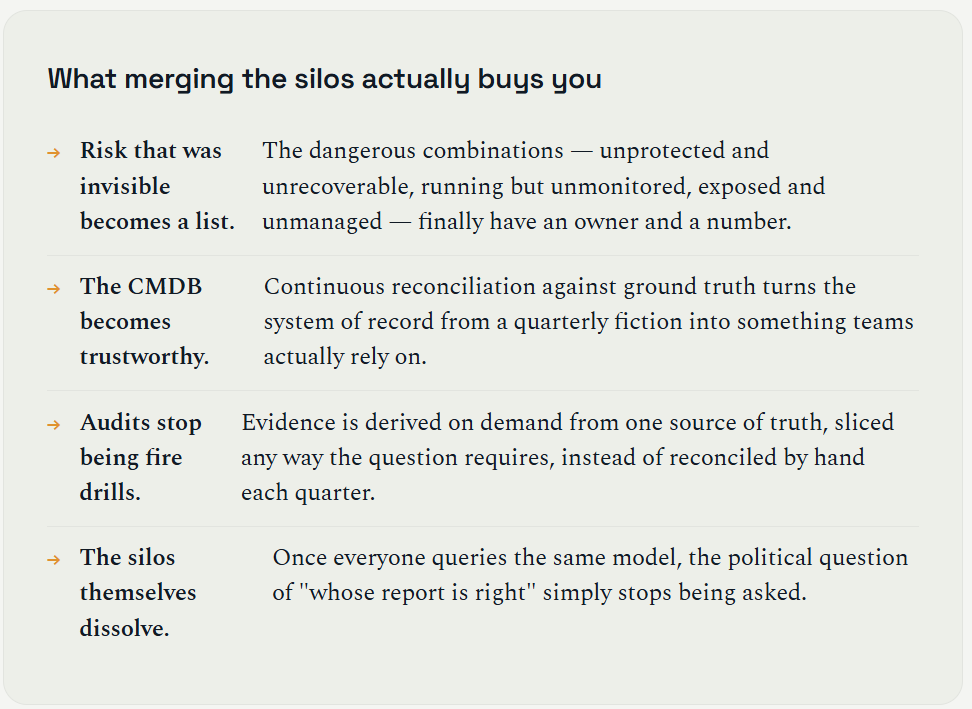
The hard part was never collecting the data — every team already has theirs. The hard part is the decision to join it. Pick the shared key, classify once at ingest, and let every system’s report become a column on the same machine. Do that, and the infrastructure you already run quietly turns into something it has never been before: a system that knows what it knows.
Written by Abhishek · Cloud & AI Infrastructure Architect
VMware NSX-T and Cisco ACI and Its Complimenting Use Cases
From Business Requirement to Production LLM: A Full-Cycle Scenario
NVIDIA GPU Workloads on Kubernetes — Part 3: What Happens Inside the Cluster After Operators Deploy
About Author

abhishek
Cloud Platform Lead and AI Infrastructure Architect at e& enterprise, with 12+ years in data center, virtualization, security and AI infrastructure. I design and build private cloud and sovereign AI platforms, working with VMware (NSX-T, vSphere, vSAN, HCX, AVS, SRM), Kubernetes, Terraform and GPU inference infrastructure for LLMs. Previously served Networkers Home (CCIE instructor, trained around 50 CCIEs), VCE/EMC2, Cisco, VMware and Arista across TAC, consulting, design and training. Certifications: CCIE#48639 (Data Center and R&S), VCIX-DCV and NV, CKA, NVIDIA AI Infrastructure, Azure Solutions Architect Expert, Terraform Associate, Palo Alto PCNSE. LinkedIn: https://www.linkedin.com/in/abhishekkunal51/