VeloCloud Licensing, Support & BOQ: Complete SD-WAN Guide
Demystifying VeloCloud: A Comprehensive Guide to Licensing, Support and BOQ
As enterprises move away from rigid legacy WAN architectures, SD-WAN has become an important part of modern network transformation. VeloCloud SD-WAN provides organizations with a flexible way to connect branches, data centers, cloud environments, and remote locations while improving application performance and network visibility.
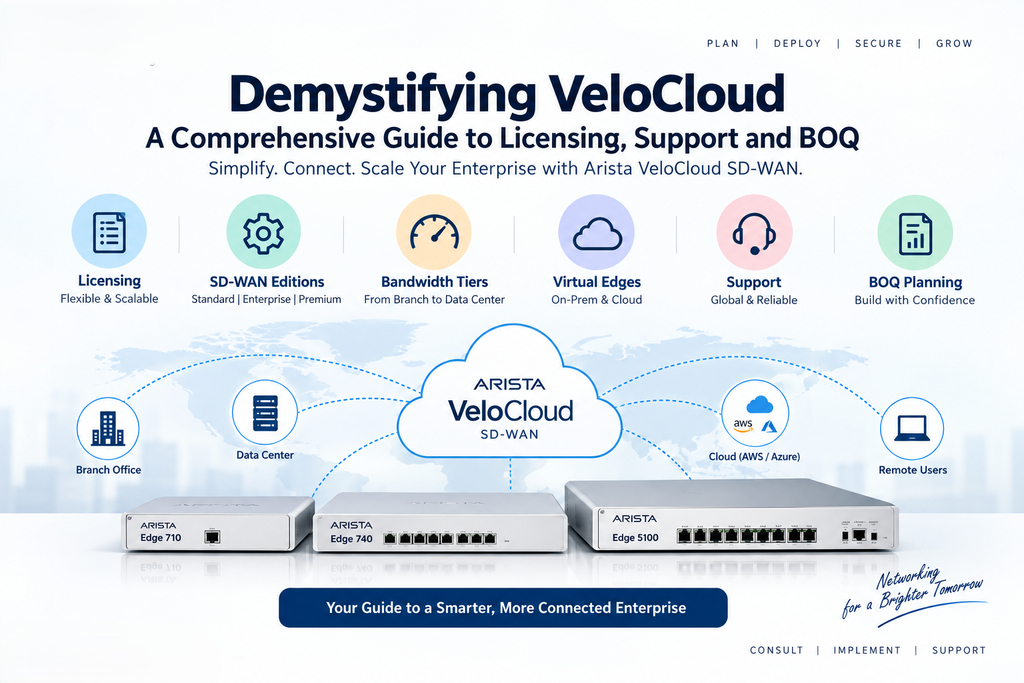
However, choosing the right VeloCloud solution involves more than selecting an Edge appliance. Organizations must also understand VeloCloud licensing, bandwidth tiers, software editions, Virtual Edge licensing, regional gateway requirements, subscription terms, and support options.
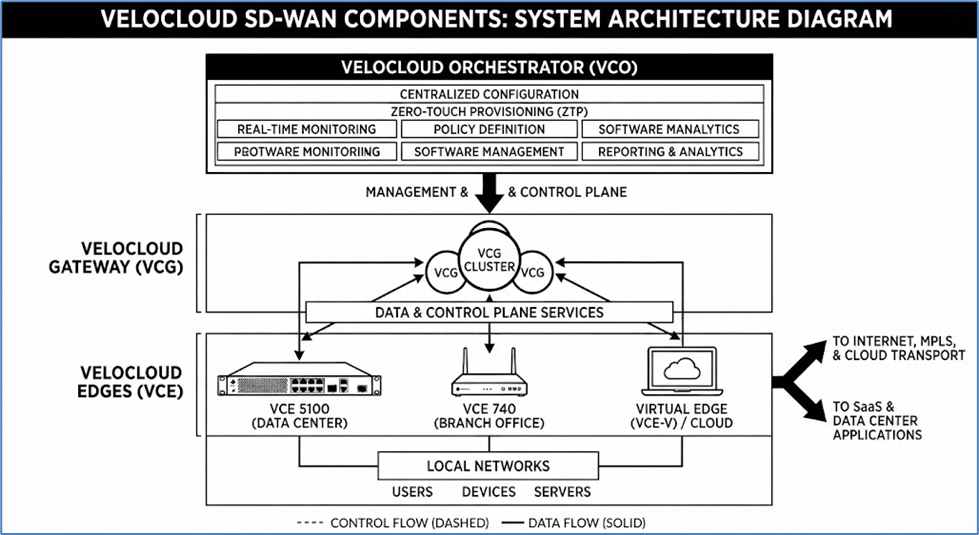
Therefore, accurate planning is essential before building a VeloCloud Bill of Quantities (BOQ).
This guide explains the key components of VeloCloud SD-WAN licensing and support. In addition, it shows how hardware, software subscriptions, Virtual Edges, orchestration, and support services can be combined into an enterprise deployment.
Understanding VeloCloud Licensing
VeloCloud Edge licensing is structured around several important attributes. These determine the capacity, functionality, regional coverage, and commercial duration of an SD-WAN deployment.
Bandwidth Tiers
First, organizations should select a bandwidth tier based on expected traffic requirements at each site. Available tiers can range from smaller branch capacities to multi-gigabit options for large enterprise hubs and data centers.
As a result, bandwidth planning should consider both current utilization and expected growth. Selecting a tier based only on today’s traffic can lead to unnecessary upgrades later.
Software Editions
Next, the software edition determines which SD-WAN capabilities are available.
Standard Edition is designed for simpler branch deployments. It provides essential SD-WAN capabilities, including orchestration, routing, segmentation, and core connectivity features.
Enterprise Edition expands those capabilities for larger and more complex environments. For example, it supports greater segmentation, additional profiles, multicast routing, and more sophisticated connectivity requirements.
Premium editions extend the Enterprise feature set with advanced cloud gateway and cloud connectivity capabilities. Depending on the current SKU structure, organizations should also evaluate Premium1 and Premium2 options when advanced security or cloud functionality is required.
Therefore, businesses should select an edition based on required features rather than simply choosing the highest available tier.
Physical VeloCloud Edges vs. Virtual Edges
VeloCloud SD-WAN can support both physical appliances and Virtual Edges. Consequently, enterprises can build hybrid architectures that extend from branch locations to data centers and public cloud environments.
Physical VeloCloud Edge Appliances
Physical Edge appliances are commonly deployed at branches, regional offices, hubs, and data centers. The appropriate model depends on throughput, tunnel scale, interface requirements, security services, and future capacity requirements.
For example, smaller sites may require compact Edge platforms, while major hubs may require high-capacity platforms such as the VeloCloud Edge 4100 or Edge 5100.
VeloCloud Virtual Edge
A VeloCloud Virtual Edge (VCE) provides similar SD-WAN functionality without requiring a dedicated physical appliance.
This makes Virtual Edges particularly useful for cloud environments and virtualized infrastructure. For example, organizations can deploy Virtual Edges within public cloud or supported virtualization environments to extend the SD-WAN overlay closer to cloud workloads.
However, enterprises should account for both the VeloCloud software subscription and the underlying infrastructure costs associated with the cloud or virtualization platform.
VeloCloud Support and Lifecycle Planning
Licensing is only one part of a successful SD-WAN strategy. Support coverage is equally important, particularly for business-critical branches, regional hubs, and data centers.
Depending on the selected support offering, organizations can obtain access to technical assistance, software support, diagnostics, and hardware replacement services.
In addition, hardware replacement requirements should be evaluated according to site criticality. A data center or major regional hub, for instance, may require a significantly faster replacement SLA than a small branch.
For this reason, support should be incorporated into the original VeloCloud BOQ instead of being treated as an afterthought.
Building a VeloCloud BOQ
A well-designed VeloCloud Bill of Quantities should connect technical requirements with commercial requirements.
At a minimum, planning should consider the number and type of sites, required Edge models, bandwidth tiers, software editions, subscription duration, regional requirements, Virtual Edges, orchestration, redundancy, and support coverage.
For example, an enterprise deployment could include high-capacity VeloCloud Edge 5100 appliances for regional hubs, Edge 740 appliances for larger branches, smaller Edge platforms for remote sites, and Virtual Edges for cloud connectivity.
More importantly, each hardware component should be validated against the appropriate subscription and support requirement before an order is finalized.
Strategic Recommendations for VeloCloud Deployment
Successful VeloCloud deployments begin with accurate sizing. Therefore, enterprises should evaluate peak bandwidth, application growth, segmentation, cloud connectivity, routing requirements, security services, and redundancy before selecting licenses.
In addition, organizations should avoid sizing Edge appliances only around average bandwidth. Peak utilization, encryption, security inspection, tunnel scale, and future expansion can materially affect the required platform.
A hybrid deployment can also provide greater flexibility. Physical VeloCloud Edge appliances can serve branches and data centers, while Virtual Edges can extend the SD-WAN fabric into cloud environments.
Finally, support and hardware replacement requirements should reflect the business impact of an outage at each site. Critical hubs may justify enhanced replacement coverage, while smaller locations may have different SLA requirements.
Conclusion: Build the Right VeloCloud SD-WAN Architecture
VeloCloud SD-WAN can provide a scalable foundation for connecting branches, data centers, cloud workloads, and distributed users. However, achieving the right technical and commercial outcome requires careful planning across hardware, licensing, bandwidth, software editions, cloud connectivity, subscription terms, and support.
A well-structured VeloCloud BOQ helps organizations avoid overprovisioning, licensing gaps, capacity constraints, and unexpected deployment costs. More importantly, it ensures that every Edge is aligned with the performance, availability, and business requirements of its location.
Whether you are planning a new VeloCloud deployment, expanding an existing SD-WAN environment, migrating workloads to the cloud, or reviewing your current licenses, Trezbon Technologies LLC can help you evaluate the architecture and build an optimized BOQ.
Need Help with VeloCloud Licensing or BOQ Planning?
Planning a VeloCloud SD-WAN deployment? Trezbon Technologies can help you with license sizing, Edge selection, bandwidth planning, Virtual Edge architecture, support requirements, and a deployment-ready BOQ.
Build the right SD-WAN architecture from the start.
NSX Advanced Load Balancer: Features & Architecture

Distributed LLM Inference: GPU Networking, vLLM & llm-d
The Questions No Single Team Can Answer
About Author

Muhammad Marakkoottathil(MM)
Expert in the field of SDN, cloud computing, virtualization, active-active data center design & migration. Passionate about helping organizations to achieve their digital transformation objectives with strong 15+ years of experience in design, deployment, and managing heterogeneous network solutions across the industry verticals. Major Industry Certifications: Cisco CCIE, CCDP, VMware VCAP-NV_DESIGN, TOGAF, ITIL, NUTANIX NCSE, Google Cloud Architect, Azure Fundamentals More info please visit my page @ LinkedIn: https://www.linkedin.com/in/contactmm/