VMware vSAN Solution Analysis: Architecture, Sizing & Licensing
As enterprises modernize their IT infrastructure, they increasingly need scalable, resilient, and cost-effective storage solutions. However, managing separate compute and storage platforms can introduce additional operational complexity.
VMware vSAN addresses this challenge through a software-defined storage architecture integrated with VMware vSphere. It combines storage resources across compatible ESXi hosts to create a shared storage environment for virtual machines.
This VMware vSAN Solution Analysis explores the platform’s architecture, deployment models, cluster design, networking requirements, capacity sizing, and licensing considerations.
Additionally, the article examines how organizations can evaluate VMware vSAN for hyperconverged infrastructure (HCI), private cloud, virtual desktop infrastructure (VDI), remote offices, and disaster recovery.
As a result, IT architects, infrastructure engineers, and technology decision-makers can better understand the key factors involved in planning a VMware vSAN deployment.
Target Buyers and Typical Use Cases
Customers who run a vSphere environment and looking for shared storage with data at rest encryption, and have the plan to make use of private/hybrid cloud can be a good candidates for this solution. From the scale perspective, customers with 50+ VMs, are advised to evaluate this solution, and further, it can be extended to environments such as ROBO sites, VDI, Disaster recovery, etc.
Deployment Model and Considerations
Hardware Selection: VMware only provides software for this solution. And for the hardware part, VMware relies on external ecosystem vendors. There are primarily two options for the hardware 1) vSAN ready nodes from approved OEM or 2) Use engineered/ruggedized platform systems such as Dell EMC VxRAIL
All Flash or Hybrid: Depending on the customer scenario the solution can be deployed for the single site or stretched between multiple sites ( stretched cluster) and for the storage it can go with a flash/NVMe-only model or hybrid ( Flash/NVMe disk for the caching/buffering tier and magnetic disk for the capacity/data tier)
Clustering Considerations: The minimum of three nodes vSAN cluster model is used for ensuring the required high availability, however, four hosts will allow for maintaining levels of prescribed resilience in the event of failure.
Disk Group Considerations: Specify the hosts with at least two disk groups. Two or more disk groups on a host allow the host to still continue to provide storage capacity in the event of a disk group failure
Physical Connectivity: Consider having a minimum of 10G physical connectivity ( for all-flash configuration) capacity between the host nodes in the vSAN cluster. And 25G/40G or 100G bandwidths are supported as well
Competition
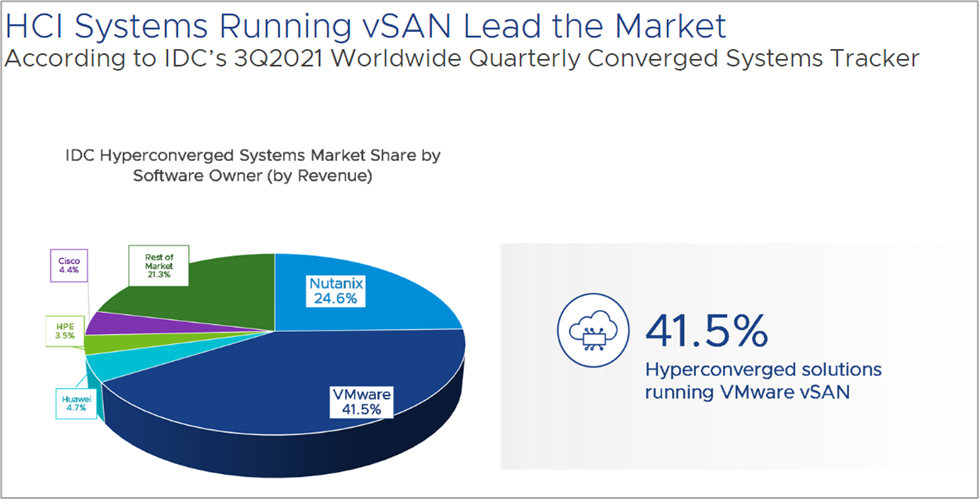
The major competition for this solution comes from existing vendors such as Nutanix, Scale Computing, Pivot3, StorMagic, Starwind, etc
Sizing Guidelines
Tools and compatibility: Proper sizing and design exercises are very important for making the VSAN solution future-proof. Before deploying the solution it is recommended to use existing infrastructure assessment tools such as LiveOptics, and DICE and also use VSAN ReadyNode Sizer and VMware compatibility guide.
Capacity Sizing: Once the existing environment information is available, the application performance and capacity requirement also need to consider to select the correct replication factor ( RF1, RF2, or RF 3). And based on that net usable capacity calculation could be derived. For example, if the number of failures to tolerance is set to 1 in the virtual machine storage policy, then there is another replica of the VMDK created on the capacity layer on another host (two copies of data). If it is set to two then there are two replica copies of the VMDK across the cluster ( three copies of the data)
Scale/Configuration Limits: Some of the interesting limits include such as with vSAN all-flash configuration allows a maximum of 64 nodes/hosts in a cluster and allows up to 62 TB for VMDK size
Licensing and Pricing
The licensing and pricing are based on the specific use cases of the customer, below are the common licensing tiers and sample list pricing details.
| Editions | Standard | Advanced | Enterprise | Enterprise Plus |
| Overview | – Best for hybrid deployments – Does not provide all-flash space efficiency features – For price-sensitive customers | – Most suitable for flash deployments – For price-sensitive customers – Provides all-flash space efficiency features (i.e Deduplication, Compression and Erasure coding) – For customers invested in all-flash | – Most features rich edition Provides encryption and stretch clusters – For enterprise-grade deployments – Data persistence platform for modern stateful services | – Soft bundle of vSAN ENT and vROps ADV – Provides ease of HCI management features -For enterprise-grade deployments – Data persistence platform for Modern stateful services |
| License Metrics Datacenter | Per CPU | Per CPU | Per CPU | Per CPU |
| VDI | Per CCU (10/100 pack) | Per CCU (10/100 pack) | per CCU (10/100 pack) | N/A |
| ROBO | Per VM (25 VM pack) minimum, 1 pack/site max | Per VM (25 VM pack) minimum, 1 pack/site max | Per VM (25 VM pack) minimum, 1 pack/site max | N/A |
| Bundled in | -VxRail Appliance -HCI Kit STD -HCI Kit ESS -NFV Advanced | VxRAIL Appliance VMware Cloud Foundation HCI Kit ADV | VxRail Appliance HCI Kit ENT VMware Cloud Foundation | HCI Kit Ops Management |
| Host Requirements | 2 modes + witness to 64 node cluster | 2 nodes + witness to 64 node cluster | 2 nodes + witness to 64 node cluster | 2 nodes + witness to 64 node cluster |
| List Price ( Subject to Change) Per CPU | $2565 | $4115 | $6050 | $7845 |
| Per VDI (10/100 CCP pack) | $55 | $102.5 | $140 | N/A |
| Per VM (25 VM Pack Minimum) | $514 | $822 | $1210 | N/A |
Conclusion: Is VMware vSAN the Right Solution for Your Enterprise?
VMware vSAN provides a software-defined storage approach for organizations looking to simplify infrastructure management, improve scalability, and support virtualized workloads.
However, a successful implementation requires more than selecting compatible hardware. Organizations must also evaluate storage performance, network bandwidth, cluster resilience, capacity requirements, and long-term operating costs.
This VMware vSAN Solution Analysis highlights several important considerations:
- Architecture: First, compare VMware vSAN ESA and OSA to determine which architecture best supports your infrastructure requirements.
- Performance: Additionally, assess application workloads, storage latency, IOPS, and network connectivity before deployment.
- Scalability: Furthermore, plan for future growth by evaluating cluster capacity, resource utilization, and expansion requirements.
- Resilience: Equally important, select appropriate storage policies and failure-tolerance settings to support business continuity.
- Cost optimization: Finally, review hardware compatibility, licensing requirements, and total cost of ownership before making an investment.
Although VMware vSAN can simplify storage operations within supported VMware environments, it may not be the ideal solution for every organization. Therefore, enterprises should compare available hyperconverged infrastructure and storage alternatives based on technical requirements, operational complexity, and business objectives.
Ultimately, a well-designed VMware vSAN environment depends on accurate sizing, validated architecture, and effective infrastructure planning.
By evaluating these factors early, organizations can reduce deployment risks, improve resource utilization, and build a more resilient storage infrastructure.
Planning a VMware vSAN Deployment or Infrastructure Upgrade?
Choosing the right storage architecture requires careful evaluation of performance, scalability, resilience, and cost.
TREZBON TECHNOLOGIES helps enterprises assess their infrastructure requirements, evaluate technology options, and plan reliable IT solutions aligned with business objectives.
Whether you are reviewing VMware vSAN, modernizing your data center, or comparing hyperconverged infrastructure solutions, our consultants can help you identify the right approach.
Discuss your infrastructure requirements with TREZBON TECHNOLOGIES.
vLLM in 2026: Infrastructure Engineer’s Guide to LLM Inference
AlgoSec – NSPM Solution Quick Review
vLLM RL Rollouts and Speculative Decoding Guide
About Author

Muhammad Marakkoottathil(MM)
Expert in the field of SDN, cloud computing, virtualization, active-active data center design & migration. Passionate about helping organizations to achieve their digital transformation objectives with strong 15+ years of experience in design, deployment, and managing heterogeneous network solutions across the industry verticals. Major Industry Certifications: Cisco CCIE, CCDP, VMware VCAP-NV_DESIGN, TOGAF, ITIL, NUTANIX NCSE, Google Cloud Architect, Azure Fundamentals More info please visit my page @ LinkedIn: https://www.linkedin.com/in/contactmm/
Easy read and you made it simple. One question though !, How is this solution compared with Cisco and Nutanix, and how does it ensure required performance?
Hi Saad,
Thanks for reaching out, Cisco and Nutanix has their on hardware solution to kind of ensure the compatibilty and perfornace. Cisco uses UCS HX platform and Nutanix makes use of NX-nodes ( Supermicro appliances.
regards
Muhammad Marakkoottathil
very useful read