Secure Data Destruction: NIST SP 800-88 Guide for HDDs, SSDs & Cloud
We live in a digital age where data is currency. From intellectual property and financial records to personal identifiers and locally stored AI interaction logs, organizations and individuals amass terabytes of information daily. But what happens when that data reaches the end of its lifecycle?
Deleting a file or performing a quick format does not necessarily make the underlying data unrecoverable. Depending on the storage technology and subsequent activity, remnants may remain recoverable. Therefore, organizations need a structured data sanitization process.
To prevent data leaks, comply with privacy regulations, and practice responsible IT asset management, you need a structured approach to data sanitization.
The Gold Standard Framework: NIST SP 800-88
When discussing secure data removal, the benchmark framework is NIST SP 800-88 (Guidelines for Media Sanitization). It breaks data destruction down into three progressive tiers:
Organizations should destroy failed media or devices that cannot undergo secure sanitization. They should also destroy media containing highly sensitive data that requires the strongest protection.
Modern Technologies & Methods for Data Destruction
Storage media has evolved dramatically—shifting away from traditional mechanical spinning disks (HDDs) to lightning-fast Solid-State Drives (SSDs), NVMe drives, and cloud environments. Consequently, the technologies used to destroy data have had to adapt.
1. Advanced Overwriting Software & Native Secure Erase
For operational drives slated for reuse, software-based overwriting is the go-to method.
- How it works: Software replaces existing data blocks with zeros, ones, or pseudorandom patterns.
- The SSD Challenge: Modern SSDs utilize wear-leveling algorithms that scatter data across memory chips, making traditional multi-pass software overwriting unreliable on its own.
- The Modern Solution: Enterprise tools (like Blancco Drive Eraser) or manufacturer-native Secure Erase / Sanitize commands interact directly with the drive controller. This triggers a block-level erasure across all cells—including hidden or over-provisioned areas—preserving the hardware while ensuring compliance.
2. Cryptographic Erasure (CE)
As encryption becomes standard practice for modern operating systems and cloud repositories, Cryptographic Erasure has emerged as a premier technique.
- How it works: A self-encrypting drive (SED) automatically encrypts the data it stores. Similarly, cloud platforms can encrypt stored data when configured appropriately. When you retire the data, you securely erase the encryption key.
- Why it’s modern: Destroying the encryption key makes the encrypted data infeasible to recover when cryptographic erasure is implemented correctly. This approach can sanitize large volumes of encrypted data much faster than traditional overwriting. It is exceptionally scalable for cloud data lakes and modern SSD arrays.
3. Degaussing (Magnetic Erasure)
- How it works: A degausser exposes magnetic media to a powerful magnetic field, instantly scrambling and flattening the magnetic domains.
- The Caveat: Degaussing is exceptionally fast for traditional hard disk drives (HDDs) and magnetic tapes. However, it is entirely useless on SSDs and flash memory, which store data electrically rather than magnetically. Using a degausser on an SSD may damage components, but it will leave flash memory cells untouched.
4. Physical Destruction & Shredding
Organizations should physically destroy damaged or obsolete devices when they cannot sanitize them securely. Regulatory requirements may also prohibit asset resale and require physical destruction.
- How it works: Industrial media shredders, crushers, and disintegrators mechanically pulverize hard drives, circuit boards, and flash chips into tiny fragments.
- Best Practice: Simply drilling a hole through a hard drive or bending a connector no longer qualifies as secure destruction. Modern high-security shredders reduce storage media to tiny particles and completely destroy individual memory chips.
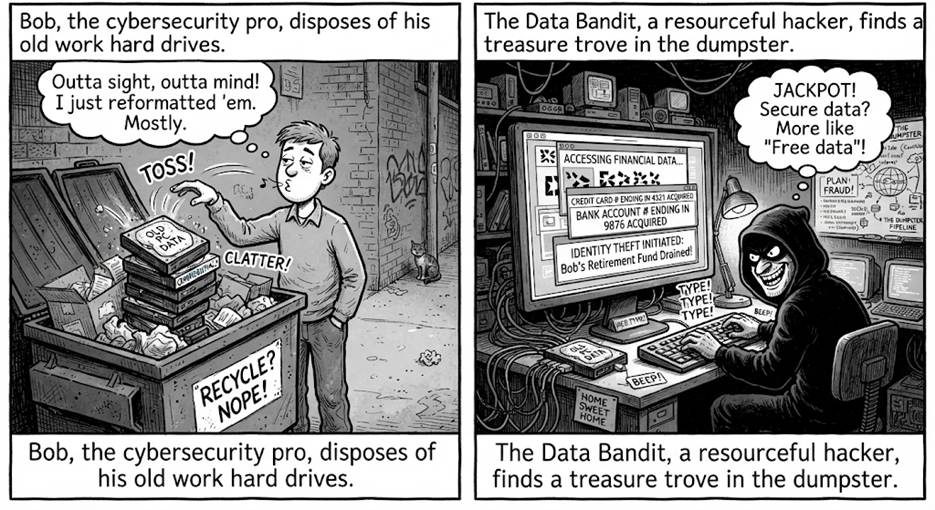
The Danger of Improper Disposal
Balancing Security with Sustainability
While the “smash it with a hammer” approach offers absolute psychological peace of mind, it contributes heavily to the global e-waste crisis and destroys residual hardware value.
The modern philosophy of IT asset management relies on risk-based sanitization: utilize certified software erasure, cryptographic wiping, or native secure-erase commands whenever possible. This completely neutralizes data risk while allowing functional laptops, servers, and enterprise drives to be securely repurposed or recycled responsibly.
Final Thoughts
Secure data destruction is no longer an afterthought handled by an IT intern with a drill. It requires a documented policy, certified tooling that provides verifiable serial-number reporting, and a clear chain of custody. Whether you choose cryptographic erasure for cloud assets or industrial shredding for failing hardware, ensuring your data is truly gone is the ultimate defense against tomorrow’s data breach.
Need Professional Guidance?
At Trezbon Technologies LLC, we help organizations safeguard their digital perimeter from end to end. If you require any professional services, expert guidance, or support for your cybersecurity strategy and data governance initiatives, please reach out to us at www.trezbon.com
Conclusion: Make Data Destruction Part of Your Security Strategy
Secure data destruction is an essential part of modern cybersecurity and data lifecycle management. Deleting files, formatting drives, or physically damaging a device without a defined process may not provide sufficient assurance that sensitive information is unrecoverable.
Instead, organizations should adopt a risk-based data sanitization policy aligned with recognized guidance such as NIST SP 800-88 Rev. 2. Depending on the storage technology, data sensitivity, and intended use of the device, the appropriate approach may involve Clear, Purge, or Destroy methods.
For reusable storage, secure erase, device-specific sanitization, or cryptographic erasure can help protect sensitive data while preserving the value of the hardware. When storage devices are damaged, cannot be reliably sanitized, or must not be reused, approved physical destruction may be appropriate.
Equally important, organizations should document the process. Sanitization records, verification, asset identification, defined responsibilities, and chain-of-custody controls provide evidence that sensitive data has been handled appropriately.
Ultimately, secure data destruction should not begin when a device reaches the recycling bin. It should be built into the organization’s cybersecurity, data governance, IT asset management, and information lifecycle policies from the start.
Need Guidance on Cybersecurity and Data Governance?
Protecting information requires controls across its entire lifecycle—from creation and storage to access, retention, and secure disposal.
TREZBON Technologies LLC helps organizations strengthen their cybersecurity strategy, IT infrastructure, and data governance practices with practical guidance aligned to their business and technology requirements.
Need professional guidance for your cybersecurity or data governance initiative?
Talk to the TREZBON team about your requirements:
🌐 www.trezbon.com
👉 Contact us: https://trezbon.com/#contact
The Questions No Single Team Can Answer
NSX-T Series: Part 16 – NSX-T Segment T1 Gateway with EDGE Cluster(SR)
NSX-T Series: Part 17 – NSX-T Segment T1 and T0 on same Edge Cluster T0 as SR
About Author

Muhammad Marakkoottathil(MM)
Expert in the field of SDN, cloud computing, virtualization, active-active data center design & migration. Passionate about helping organizations to achieve their digital transformation objectives with strong 15+ years of experience in design, deployment, and managing heterogeneous network solutions across the industry verticals. Major Industry Certifications: Cisco CCIE, CCDP, VMware VCAP-NV_DESIGN, TOGAF, ITIL, NUTANIX NCSE, Google Cloud Architect, Azure Fundamentals More info please visit my page @ LinkedIn: https://www.linkedin.com/in/contactmm/