LLM Security: Risks, Threats & Best Practices
Enterprises are moving large language models from pilot projects into production faster than most security programs can adapt. The result is a new attack surface that doesn’t map cleanly onto traditional application security, network security, or data security playbooks — it borrows from all three and adds failure modes none of them anticipated. This post walks through what makes LLM security genuinely different, the major risk categories, and a practical framework for securing LLM applications in production.
Introduction: Why LLM Security Matters
Artificial intelligence is becoming an important part of modern business operations. Organizations now use large language models (LLMs) to automate tasks, improve customer experiences, and support decision-making.
However, adopting AI also introduces new security challenges.
Traditional cybersecurity measures protect applications, networks, and sensitive data. While these controls remain essential, LLM applications introduce additional risks that require careful attention.
For example, attackers may manipulate AI responses through prompt injection. They may also exploit weak access controls to expose confidential information. Furthermore, insecure integrations can allow AI systems to perform unauthorized actions.
As a result, organizations need a practical approach to LLM security.
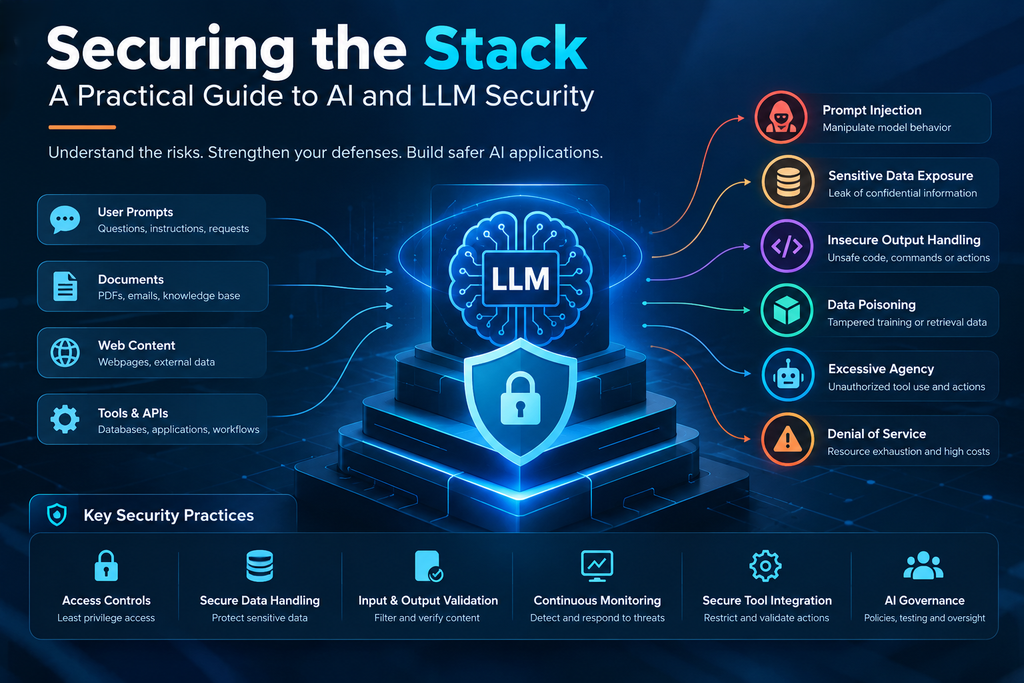
This guide explores the most important AI security risks, including prompt injection, data poisoning, sensitive data exposure, and excessive agency.
It also explains how organizations can protect enterprise AI applications through access controls, continuous monitoring, secure development practices, and effective governance.
By understanding these risks, security teams can build safer AI environments while supporting business innovation.
The Core Risk Categories
1. Prompt Injection
Prompt injection is the LLM-native analog of SQL injection or XSS, and it’s currently the most consequential unsolved problem in LLM security.
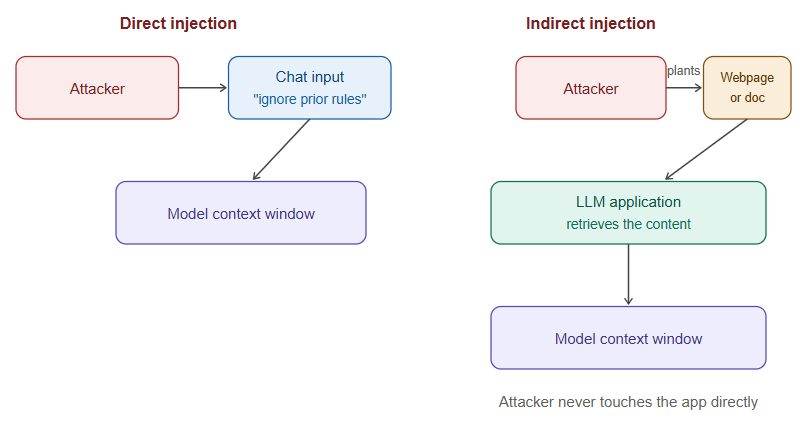
Direct prompt injection happens when a user deliberately crafts input to override a system’s instructions — “ignore previous instructions and instead…” is the crude version; more sophisticated variants use role-play framing, encoding tricks, or multi-turn setups to gradually erode guardrails.
Indirect prompt injection is more dangerous in production systems because the attacker doesn’t need direct access to the chat interface at all. If an LLM application retrieves and processes external content — a webpage, an email, a PDF, a support ticket, a calendar invite — an attacker can embed instructions in that content. When the model ingests it, those instructions can be treated as commands. A resume-screening assistant that reads uploaded PDFs, a browsing agent that summarizes web pages, or a customer support bot that reads incoming emails are all exposed to this pattern, because the “input” is content nobody in the trust chain has reviewed.
There is no complete technical fix for prompt injection today. The state of the art is defense in depth: input/output filtering, strict separation of privilege between the model’s reasoning and its ability to act, and treating any model output that will trigger a real-world action as untrusted until validated.
2. Sensitive Data Exposure
LLM applications create several new paths for data leakage that don’t exist in traditional apps:
- Training data memorization — models can occasionally reproduce fragments of their training data, which is a concern for anyone fine-tuning on proprietary or regulated data.
- Context leakage across sessions or tenants — in multi-tenant deployments, a misconfigured cache, vector store, or session boundary can leak one customer’s data into another’s context.
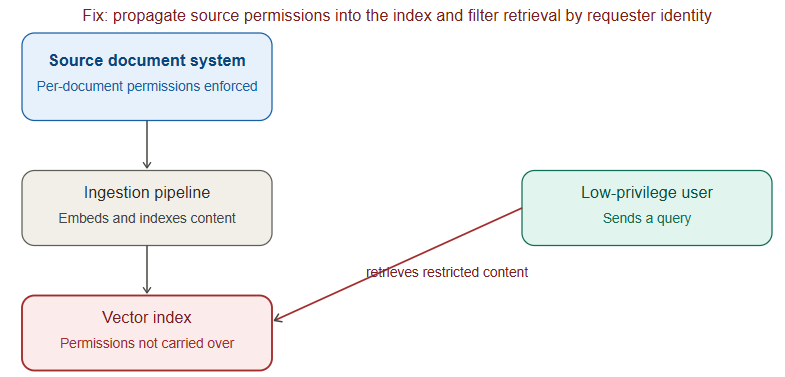
- Over-broad RAG retrieval — retrieval-augmented generation systems are only as secure as their access controls. If the retrieval layer doesn’t enforce the same document-level permissions as the source system, users can query their way to documents they were never authorized to see. This is one of the most common real-world RAG security failures, because teams build the retrieval pipeline correctly for relevance but forget to carry authorization metadata through the embedding and indexing process.
- Prompt leakage — system prompts often contain business logic, internal policies, or embedded credentials. Attackers routinely try to extract system prompts directly, and a surprising number of production deployments will comply if asked the right way.
3. Insecure Output Handling
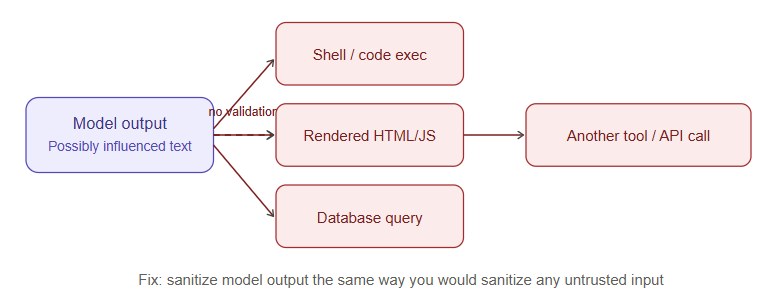
Treating LLM output as inherently safe is a mistake with the same shape as trusting unsanitized user input, just inverted. If a model’s output is passed into a shell command, rendered as HTML/JavaScript in a browser, used to construct a database query, or fed directly into another system’s API call, it needs exactly the same sanitization as any other untrusted string. This becomes acute in agentic systems where the model’s text output is the trigger for a tool call — an injected instruction that gets echoed into a tool invocation can turn a content-generation bug into a remote code execution problem.
4. Model and Supply Chain Risks
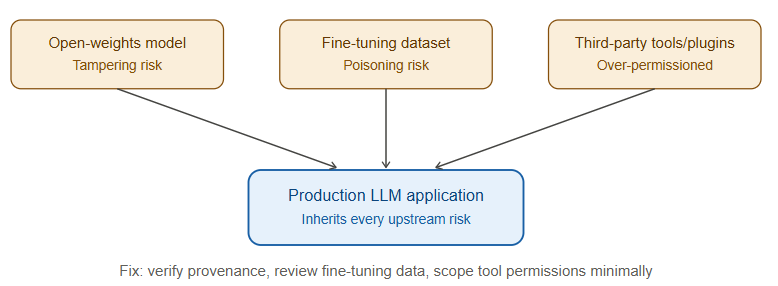
Most organizations don’t train models from scratch — they consume them via API, fine-tune an open-weights model, or build on top of a hosted platform. Each of these introduces supply chain considerations:
- Model provenance — open-weights models downloaded from public hubs can be tampered with; verifying checksums and sourcing from reputable registries matters as much as it does for software packages.
- Fine-tuning data poisoning — if the data used to fine-tune or perform RAG indexing can be influenced by an outside party (public forums, scraped web content, user-submitted documents), an attacker can poison that corpus to bias model behavior or plant triggers for later exploitation.
- Third-party plugin and tool risk — an LLM’s tool/function-calling ecosystem is effectively a plugin architecture, and it inherits all the risk of any plugin architecture: over-permissioned tools, unvalidated tool outputs, and unclear trust boundaries between the orchestrator and the tools it calls.
5. LLM and Data Poisoning
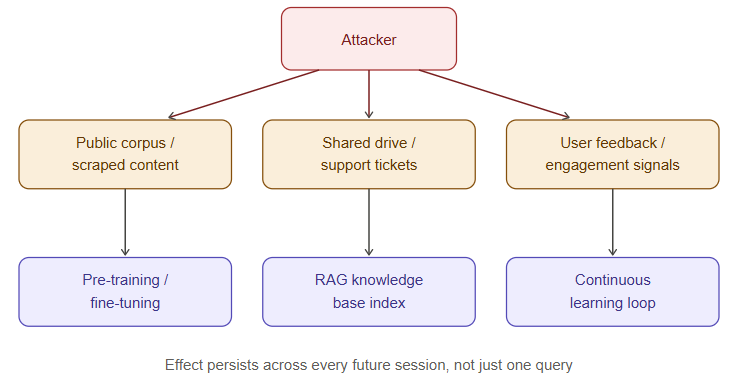
Poisoning attacks target the model’s knowledge or behavior at the source, rather than manipulating a single interaction at inference time. Because the damage is baked into the model or its knowledge base, poisoning is harder to detect than prompt injection and persists across every user session until the underlying data or weights are fixed.
Training-time poisoning happens when an attacker influences the data used to pre-train or fine-tune a model. If any part of that corpus is sourced from public or semi-public content — scraped web pages, community forums, user-submitted feedback used for reinforcement fine-tuning — an attacker can seed content designed to bias outputs, degrade performance on specific topics, or implant a backdoor trigger: a rare phrase or pattern that causes anomalous behavior only when present, while the model behaves normally otherwise. Backdoor triggers are especially dangerous because standard evaluation suites won’t surface them; the model passes every normal test and only misbehaves on the attacker’s specific trigger.
RAG and knowledge-base poisoning is the more common variant in enterprise deployments, because most organizations aren’t training foundation models but are constantly feeding retrieval systems with new documents. If the ingestion pipeline for a RAG system accepts content from a source an outside party can influence — a public wiki, a shared drive with broad write access, scraped competitor or vendor sites, customer-submitted support tickets — an attacker can inject documents crafted to be retrieved for specific queries and to carry instructions the model will treat as authoritative context. This overlaps with indirect prompt injection but is distinct in mechanism: injection exploits a single retrieval at query time, while poisoning corrupts the corpus itself so that many future queries are affected.
Feedback-loop poisoning targets systems that continuously learn from user interactions — models fine-tuned on production usage data, or ranking systems that use engagement signals to reweight retrieval. Coordinated low-and-slow manipulation of that feedback (fake positive ratings on bad answers, repeated submission of biased content) can degrade the system gradually enough to evade anomaly detection tuned for sudden spikes.
Defending against poisoning requires controls upstream of the model: provenance tracking for every document that enters a training set or retrieval index, integrity checks and content review for any ingestion pipeline that accepts external or semi-trusted input, anomaly detection on fine-tuning data distributions before training runs, and holdout evaluation sets specifically designed to catch behavioral drift rather than just aggregate accuracy. For RAG systems, the single highest-leverage control is restricting write access to the knowledge base as tightly as read access is restricted on the source systems it’s built from.
6. Excessive Agency
Excessive Agency in LLM Security
LLM applications are evolving beyond simple question-and-answer systems. Today, autonomous and semi-autonomous AI agents can plan tasks, access tools, and perform actions.
However, these capabilities introduce new security risks.
The main concern is no longer just what an AI model might say. Instead, organizations must consider what actions the model might perform.
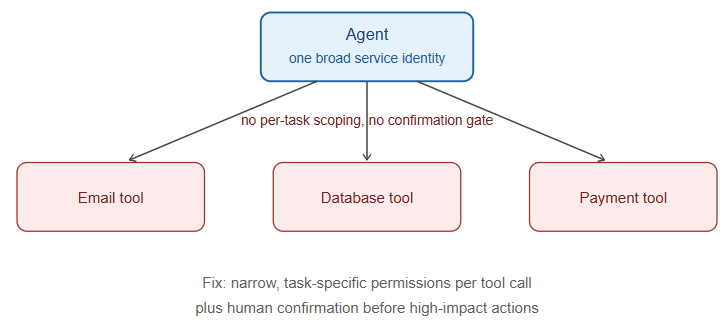
Excessive agency often results from three security weaknesses.
First, organizations may grant AI tools more permissions than necessary.
Second, connected tools may allow AI agents to expand their capabilities beyond their intended tasks.
Finally, some systems allow AI agents to perform sensitive actions without human approval.
For example, these actions may include financial transactions, data deletion, or external communications.
How Can Organizations Reduce Excessive Agency Risks?
Organizations should apply the principle of least privilege to AI agents.
This approach limits each agent’s access to the resources required for a specific task.
Additionally, security teams should restrict tool permissions and monitor agent activities.
For high-risk operations, organizations should require human approval before allowing an AI agent to proceed.
As a result, businesses can reduce security risks while benefiting from agentic AI capabilities.
7. Denial of Service and Resource Exhaustion
LLM inference requires significant computing resources. Therefore, attackers can exploit this demand to disrupt AI services.
For example, malicious inputs can force models to generate unusually long responses. Attackers may also trigger expensive retrieval operations.
Additionally, recursive agent loops can repeatedly call tools or prompt the model. As a result, these activities can increase costs and reduce service availability. Unbounded context windows and unmetered API usage turn this into a cost-based attack as much as an availability one.
A Practical Defense Framework
No single control solves LLM security; the effective pattern is layered defense across the request lifecycle.
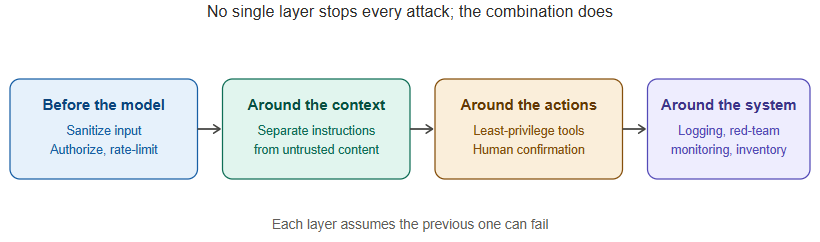
Before the model sees anything:
- Sanitize and classify inputs — flag anomalous length, encoding tricks, or known injection patterns
- Enforce authentication and authorization before retrieval, not after generation
- Apply rate limiting and cost-based throttling per user/session
Around the model’s context:
- Separate system instructions from user content as rigorously as the platform allows, and treat any retrieved or tool-sourced content as untrusted, never as an extension of the system prompt
- Carry source-system access controls through to the retrieval layer — a document a user can’t see in the source system should never be retrievable via RAG for that user
- Limit the information you include in system prompts. Remember that attackers may extract sensitive information from these prompts.
The model’s actions:
- Apply least-privilege scoping to every tool the model can call — narrow, task-specific permissions rather than broad service-account access
- Require human-in-the-loop confirmation for high-impact or irreversible actions
- Validate and sanitize model output before using it to create commands, queries, or API calls. Apply the same security checks to model output as you would to any other untrusted input.
Around the whole system:
- Log prompts, retrievals, tool calls, and outputs with enough fidelity to reconstruct an incident after the fact
- Run adversarial testing (red-teaming) against your specific application, not just the underlying model — injection and jailbreak techniques are highly context-dependent
- Monitor for behavioral drift and anomalous output patterns in production, not just at deployment time
- Maintain an inventory of every model, fine-tune, and third-party tool in use, with clear ownership — shadow AI usage is now a bigger practical risk in many organizations than any single technical vulnerability
Governance Is Part of the Security Model
Technical controls only work inside a governance structure that knows what’s actually deployed. A short checklist worth institutionalizing:
- Maintain an updated inventory of all AI models and applications. Track each model’s deployment status, the data it accesses, and the tools it uses.
- Classify LLM applications by risk tier based on data sensitivity and action capability, and apply proportionate controls
- Develop a clear incident response plan for AI systems. Assign responsible teams to handle harmful AI outputs and failed tool calls. Additionally, establish escalation procedures that address AI security incidents separately from traditional system outages.
- Track emerging regulatory requirements (EU AI Act, sector-specific guidance) as binding constraints on architecture, not just compliance paperwork
Conclusion: Building Secure and Resilient LLM Applications
Large language models are changing how organizations operate. They help businesses automate processes, improve productivity, and make better decisions.
However, these benefits also introduce new security challenges.
Prompt injection, data poisoning, sensitive data exposure, and excessive agency can create serious risks for enterprise AI applications.
Therefore, organizations must make LLM security an essential part of their cybersecurity strategy.
A strong security approach begins with identifying potential vulnerabilities. It also requires access controls, secure data handling, continuous monitoring, and regular security testing.
Furthermore, organizations should apply the principle of least privilege to AI agents and connected tools. Human approval is also important when AI systems perform sensitive actions.
AI security governance plays an equally important role. Clear policies, defined responsibilities, and effective incident response procedures help organizations manage emerging threats.
Ultimately, securing LLM applications is not about introducing more security tools. It is about applying proven cybersecurity principles to new AI technologies.
By combining technical safeguards with effective governance, organizations can reduce security risks and build more trustworthy AI environments.
The goal is simple: enable organizations to benefit from artificial intelligence without compromising security, privacy, or operational control.
Is Your Enterprise AI Environment Secure?
As organizations adopt large language models, protecting sensitive data, applications, and connected systems becomes increasingly important.
Trezbon Technologies helps businesses assess cybersecurity risks, strengthen security controls, and develop practical strategies for protecting enterprise IT environments.
Are you reviewing your AI security posture or planning a more secure infrastructure? Our team can help identify potential risks. We also recommend suitable security measures to strengthen your defenses.
Take the next step toward a more secure AI environment.
Talk to Our Experts
Explore our cybersecurity and consulting services:

AI-Powered Firewall Troubleshooting: GraphRAG, Neo4j, RAG & Network Automation

vLLM RL Rollouts and Speculative Decoding Guide
NSX Advanced Load Balancer: Features & Architecture
About Author

abhishek
Cloud Platform Lead and AI Infrastructure Architect at e& enterprise, with 12+ years in data center, virtualization, security and AI infrastructure. I design and build private cloud and sovereign AI platforms, working with VMware (NSX-T, vSphere, vSAN, HCX, AVS, SRM), Kubernetes, Terraform and GPU inference infrastructure for LLMs. Previously served Networkers Home (CCIE instructor, trained around 50 CCIEs), VCE/EMC2, Cisco, VMware and Arista across TAC, consulting, design and training. Certifications: CCIE#48639 (Data Center and R&S), VCIX-DCV and NV, CKA, NVIDIA AI Infrastructure, Azure Solutions Architect Expert, Terraform Associate, Palo Alto PCNSE. LinkedIn: https://www.linkedin.com/in/abhishekkunal51/