Distributed LLM Inference: GPU Networking, vLLM & llm-d
What happens when a large language model becomes too big for a single GPU?
Adding more GPUs might seem like the obvious solution. However, scaling AI inference introduces another critical challenge: network communication.
Modern distributed LLM inference depends on more than GPU computing power. In fact, network latency, bandwidth, collective communication, and KV cache transfers can significantly influence inference performance.
As large language models grow, infrastructure engineers must distribute workloads across multiple GPUs and servers. Consequently, the network becomes an essential part of the AI serving architecture.
For example, tensor parallelism requires frequent GPU communication. Meanwhile, expert parallelism in Mixture-of-Experts (MoE) models introduces complex all-to-all traffic patterns. Additionally, separating prefill and decode workloads requires efficient KV cache transfers between GPU resources.
So, how can engineers design a network that supports high-performance distributed AI inference?
In Part 3 of our vLLM in 2026: An Infrastructure Engineer’s Field Guide, we explore:
- GPU parallelism: Tensor, pipeline, data, and expert parallelism.
- MoE networking: All-to-all communication and expert load balancing.
- Prefill/decode disaggregation: KV cache transfers and network requirements.
- Kubernetes-native inference: How vLLM and llm-d support distributed serving.
- Operational reliability: Monitoring, troubleshooting, and failure handling.
By the end of this guide, you will understand why distributed LLM inference is not simply a GPU scaling problem. Instead, it requires a carefully designed network architecture that balances performance, scalability, and reliability.
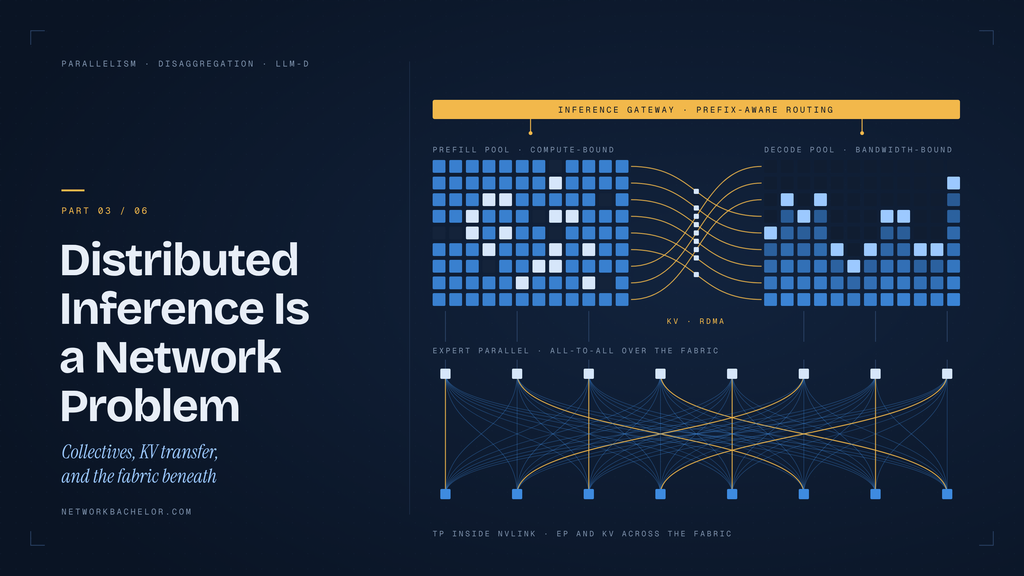
Part 3 of “vLLM in 2026: An Infrastructure Engineer’s Field Guide”
If you’ve designed a lossless RoCEv2 fabric or debugged NCCL rings, you already know most of what matters here. Serving a frontier-scale model is no longer “one model on one GPU.” It is a distributed system whose performance is set by collectives, KV cache movement, and load balancing across ranks.
This post maps every parallelism strategy in vLLM to the traffic it creates, then covers disaggregated prefill/decode and the Kubernetes-native routing layer built around it (llm-d).
[Add from talks: “Production-Grade Distributed Inference with llm-d” (Red Hat) and “Serving MiniMax M3 at Scale” (MiniMax): architecture diagrams, cluster sizes, measured throughput/latency, failure-handling lessons.]
1.Why a Single GPU Is No Longer Enough
Large language models require significant GPU memory and processing capacity. However, a single GPU may not have enough memory to store model weights and the KV cache.
For example, a model with more than 400 billion parameters can require over 400 GB just for its weights at FP8 precision. Additionally, long-context inference increases KV cache memory requirements.
Therefore, engineers often distribute model execution across multiple GPUs.
Although this approach increases available resources, it also introduces communication overhead. Consequently, network bandwidth and latency become critical design considerations.unication. The design question is which communication, and over which links.
2. Understanding GPU Parallelism
| Strategy | What is split | Collective pattern | Frequency | Best link |
|---|---|---|---|---|
| Tensor parallel (TP) | Each weight matrix, across GPUs | All-reduce (roughly twice per layer) | Every layer, every step | NVLink / scale-up domain |
| Pipeline parallel (PP) | Layers, across stages | Point-to-point activations between stages | Per micro-batch per stage boundary | Can cross nodes |
| Data parallel (DP) | Whole model replicas (or attention replicas) | None for independent replicas; coordination for MoE | Low | Any |
| Expert parallel (EP) | MoE experts, across GPUs | All-to-all dispatch and combine | Every MoE layer, every step | Scale-up first, scale-out for wide EP |
Rules of thumb:
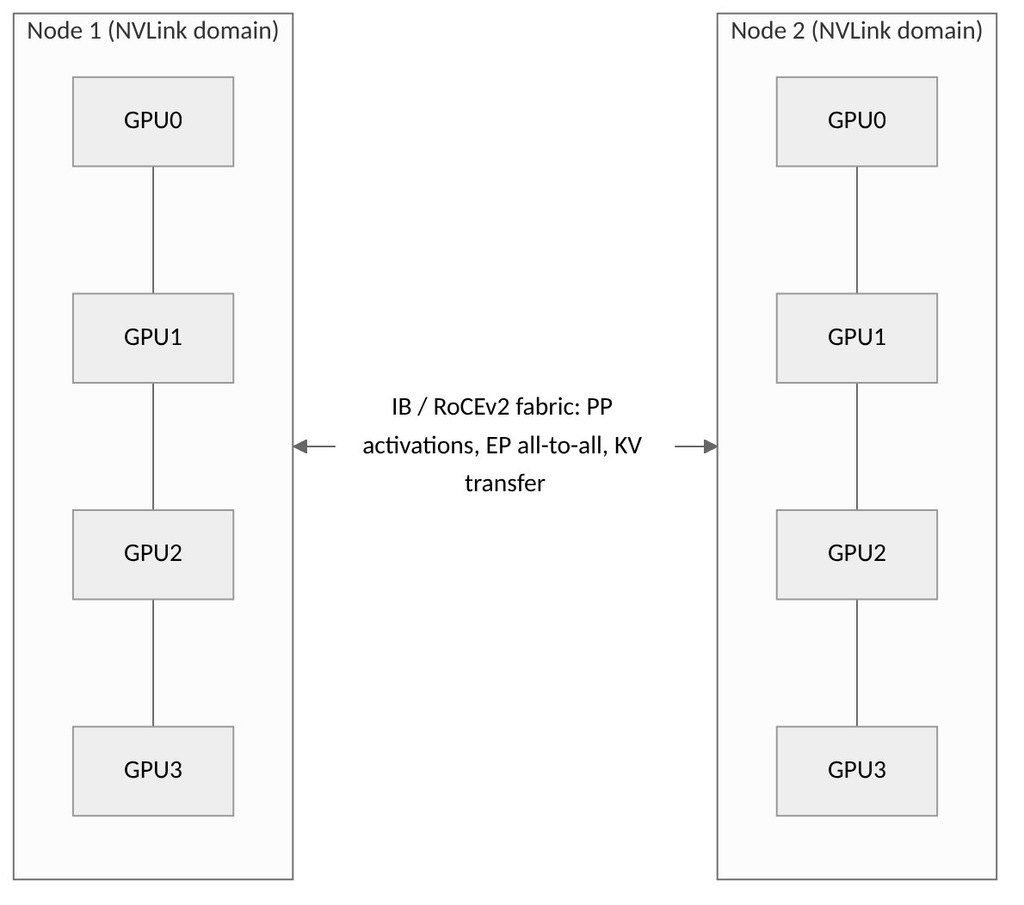
- Keep TP inside the NVLink domain. All-reduce on every layer is latency-critical; pushing it over InfiniBand is expensive.
- Use PP or DP across nodes when the model outgrows a node but you don’t want cross-node all-reduce.
- MoE changes everything. Dense-model intuition breaks because the dominant collective becomes all-to-all.
3. MoE Serving and All-to-All Communication
Mixture-of-Experts models improve computational efficiency by activating selected experts for each token. However, distributing these experts across GPUs creates additional network traffic.
First, the system routes token representations to the selected experts. Next, each expert performs its computation. Finally, the results return for combination.
As a result, expert parallelism can generate repeated all-to-all communication during inference.
Moreover, uneven expert utilization can create bottlenecks. For example, heavily loaded experts may delay other participating GPUs.
Therefore, engineers must consider expert placement, load balancing, network congestion, and communication efficiency.
Ultimately, effective MoE serving requires coordination between model architecture, GPU resources, and network infrastructure.
4. Prefill/Decode Disaggregation
LLM inference typically involves two important stages: prefill and decode.
During prefill, the model processes the input prompt. In contrast, decode generates output tokens incrementally.
Although these stages share model resources, their performance characteristics differ. Therefore, running both on the same GPU pool may introduce resource contention.
To address this challenge, distributed inference architectures can separate prefill and decode workloads.
As a result, infrastructure teams can tune and scale each workload independently.
However, this approach introduces a new requirement: transferring KV cache data between GPU resources.
Consequently, network bandwidth, transfer latency, and congestion directly influence the effectiveness of disaggregated inference.
The key insight: Prefill/decode disaggregation is both a compute architecture decision and a network design decision.
Disaggregation separates them into distinct pools:

5. Kubernetes-Native Inference with llm-d
Running vLLM on a single server is relatively straightforward. However, operating distributed inference across multiple Kubernetes nodes introduces additional challenges.
For example, infrastructure teams must manage request routing, workload scheduling, scaling, and resource utilization.
This is where llm-d becomes relevant.
Built around Kubernetes-native components and vLLM, llm-d provides an architecture for distributed LLM serving.
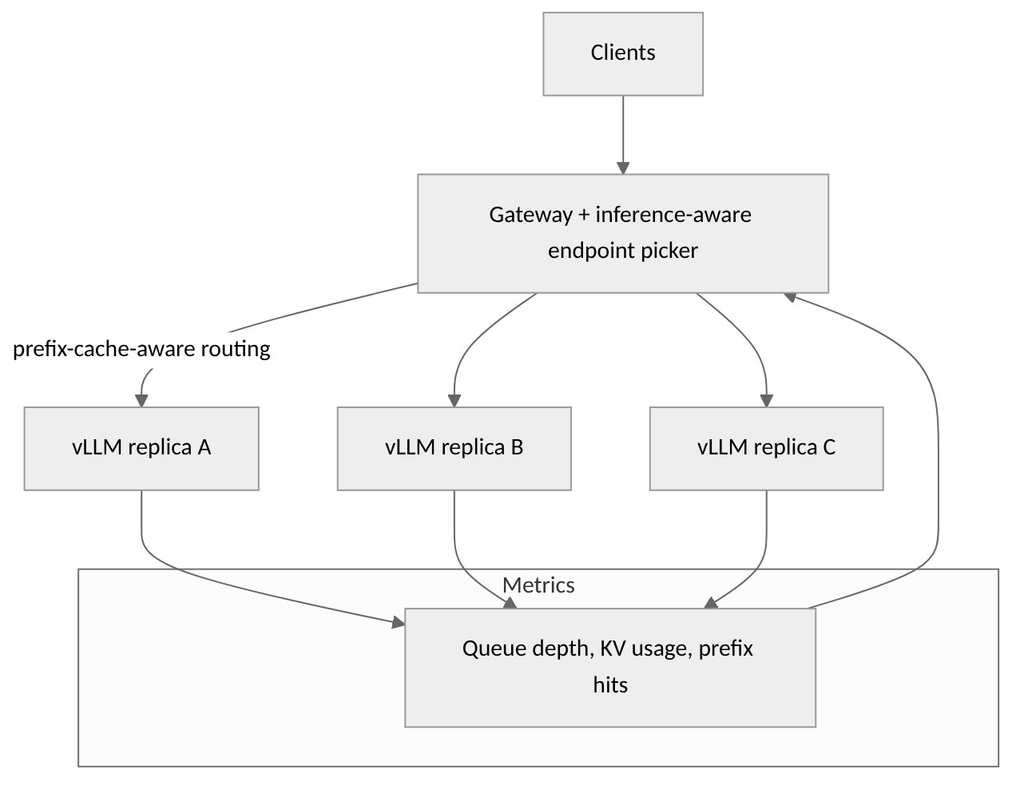
Additionally, inference-aware routing can consider factors such as queue conditions and prefix cache locality.
As a result, requests may be directed toward replicas that can process them more efficiently.
Furthermore, llm-d supports deployment patterns for separating prefill and decode workloads.
Therefore, Kubernetes becomes more than a container orchestration platform. It also provides the foundation for managing distributed AI inference services.
6. Reliability and Operational Challenges
Distributed inference introduces operational complexity because multiple GPUs, network links, and serving components must work together.
For example, a failed GPU or unstable network connection may affect an entire parallel execution group.
Therefore, infrastructure teams should monitor both application performance and network health.
Additionally, metrics such as RDMA errors, ECN marking, and PFC pause activity can help identify fabric-related issues.
Meanwhile, inference metrics provide visibility into request latency, throughput, and serving performance.
Finally, engineers should test recovery procedures and deployment rollouts under realistic failure conditions.
As a result, organizations can better understand system behavior and design more reliable inference infrastructure.
Design-review checklist
- Is TP confined to the scale-up (NVLink) domain?
- For MoE: have we sized all-to-all traffic per step and validated the fabric under it?
- Do we have an expert-load-imbalance metric?
- If disaggregating: KV transfer time budgeted and tested under contention?
- Is routing cache-aware, or are we round-robining away our prefix hits?
- Are fabric counters (PFC, ECN, RDMA errors) on the same dashboard as vLLM metrics?
- Is restart granularity and rollout capacity planned for group-level failures?
Conclusion: Why Distributed LLM Inference Depends on Network Architecture
Distributed LLM inference is no longer just a GPU computing challenge. It is also a critical network architecture challenge.
As large language models grow in complexity, organizations must distribute workloads across multiple GPUs and servers. However, adding computing resources alone does not guarantee better inference performance.
Instead, engineers must carefully consider network bandwidth, latency, GPU communication patterns, and workload placement.
Throughout this guide, we explored how tensor parallelism, pipeline parallelism, data parallelism, and expert parallelism influence distributed inference architecture.
Additionally, we examined how Mixture-of-Experts models generate all-to-all communication traffic. Consequently, efficient GPU networking and expert load balancing become essential for maintaining predictable inference performance.
Furthermore, prefill/decode disaggregation introduces new networking requirements. Although separating these workloads can improve resource utilization, KV cache transfers must remain efficient to deliver measurable benefits.
Meanwhile, Kubernetes-native frameworks such as vLLM and llm-d provide capabilities for managing distributed inference workloads, request routing, and resource allocation.
Nevertheless, operational reliability remains equally important. Therefore, infrastructure teams should monitor network congestion, RDMA performance, GPU utilization, and inference latency together.
Key Takeaway
The performance of distributed AI inference depends on how effectively GPUs, networks, and inference software work together.
Ultimately, a well-designed GPU network can help organizations improve scalability, reduce communication bottlenecks, and build more predictable AI inference environments.
As enterprise AI adoption expands, understanding distributed LLM inference architecture will become increasingly important for infrastructure engineers and technology decision-makers.
Continue exploring the vLLM in 2026 series on NETWORK BACHELOR for practical insights into GPU infrastructure, Kubernetes, AI networking, and production inference architectures.
Building Enterprise AI Infrastructure? Start with the Right Network Architecture.
Deploying more GPUs is only part of the solution.
Reliable AI infrastructure requires careful planning across high-performance networking, Kubernetes, security, and system integration.
TREZBON TECHNOLOGIES works with organizations to evaluate enterprise infrastructure requirements and design networking and cybersecurity solutions aligned with their operational goals.
Whether you are planning a GPU cluster, evaluating data center connectivity, or preparing your infrastructure for AI workloads, the right architecture matters.
Planning your next infrastructure project?
🌐 Explore our consulting services: https://www.trezbon.com/
📩 Discuss your requirements: https://trezbon.com/contact
Follow NETWORK BACHELOR for practical technical insights into distributed AI inference, vLLM, Kubernetes, and enterprise networking.
NVIDIA GPU Operator on Kubernetes: Cluster Validation Guide – Part 3
Gigamon TLS Decryption: Passive vs. Inline Architecture and TLS 1.3 Challenges

Choosing the Right NAC Platform for Your Enterprise: A Data-Driven Evaluation
About Author

abhishek
Cloud Platform Lead and AI Infrastructure Architect at e& enterprise, with 12+ years in data center, virtualization, security and AI infrastructure. I design and build private cloud and sovereign AI platforms, working with VMware (NSX-T, vSphere, vSAN, HCX, AVS, SRM), Kubernetes, Terraform and GPU inference infrastructure for LLMs. Previously served Networkers Home (CCIE instructor, trained around 50 CCIEs), VCE/EMC2, Cisco, VMware and Arista across TAC, consulting, design and training. Certifications: CCIE#48639 (Data Center and R&S), VCIX-DCV and NV, CKA, NVIDIA AI Infrastructure, Azure Solutions Architect Expert, Terraform Associate, Palo Alto PCNSE. LinkedIn: https://www.linkedin.com/in/abhishekkunal51/