Zero Trust Microsegmentation: Security & Best Practices
Traditional network segmentation has helped organizations manage network traffic for decades. However, modern cybersecurity requires more granular control over communication between applications, workloads, and devices.
Today, enterprises operate across data centers, public clouds, remote offices, and hybrid environments. As a result, traditional perimeter-based security alone cannot adequately address every internal threat.
Zero Trust microsegmentation helps organizations restrict unnecessary communication between workloads. Furthermore, it reduces opportunities for attackers to move laterally after gaining initial access.
In this article, we explore how microsegmentation supports Zero Trust security, strengthens workload protection, and helps organizations address compliance requirements.
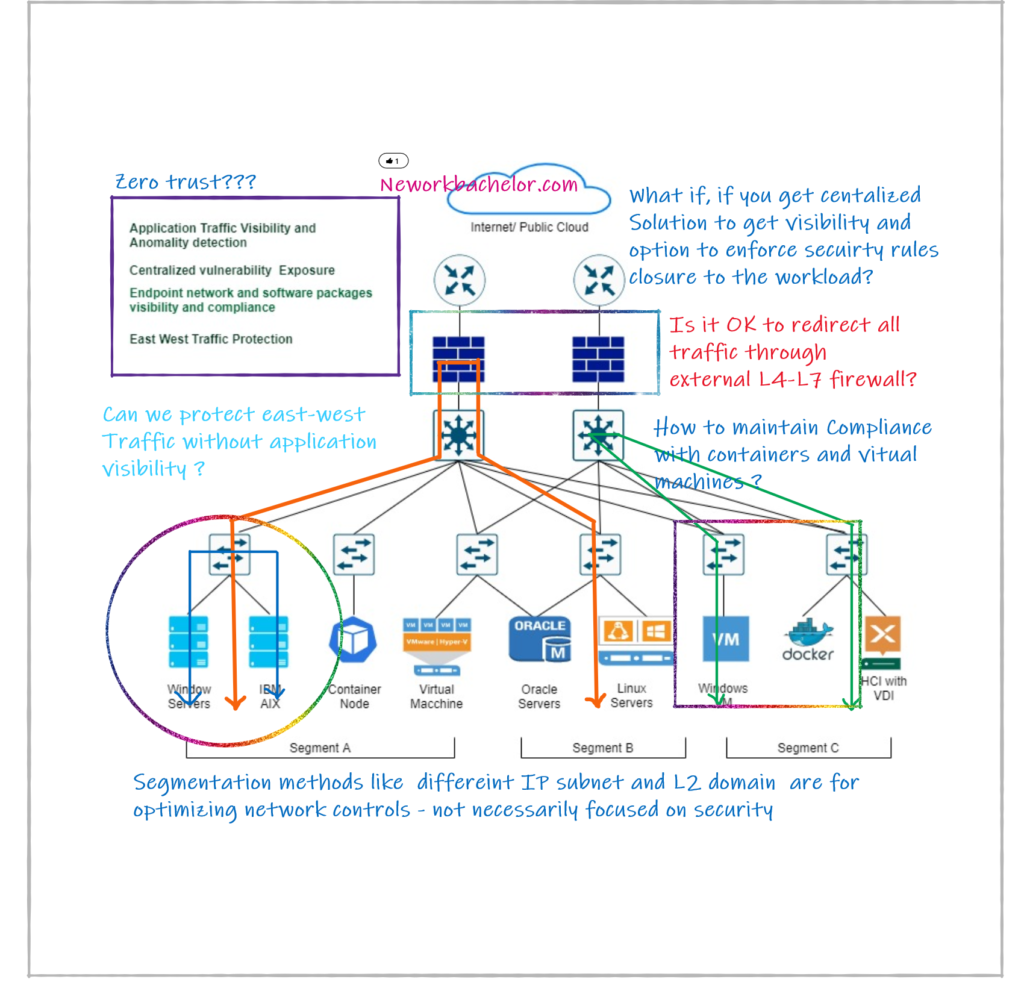
Why a New Approach to Zero-Trust Required?
The modern application and business models demand anywhere access and processing. With the cloud proliferation of mobile IoT and OT, the traditional security controls are no longer sustainable from economic or from the business processing perceptive. And moreover, currently with application workloads spans across on-premises, to edge to the cloud, it is tough to say where the perimeter begins and ends. This really complicates the security and control and enabling compliance on it
Now let’s discuss using the traditional model like physical or virtual firewalls. Yes, you may want to go buy firewalls and use these solutions to do your micro-segmentation. However, think about the complexity it brings when you do security policies and postures, as well as meet compliance requirements. Think about the sheer number of access control lists and firewall rule sets you’re going to have to build in places. And also maintaining that and who’s going to age those things off. By the time you know, they become points of vulnerability and points of escalating costs
Changing Compliance Requirements
Another challenge is, adapting compliance requirements changes in your network. How does your network change, and at what will be the cost of implementing the required changes on the infrastructure?. Apparently it is a huge burden on the folks that are maintaining the network and the security posture of an organization. Let’s take look at mergers and acquisitions from corporations like General Electric perspective. They’re working in the health field, financial sector, power sector, and transportation sector, etc, and they’re also working in the ICS industrial control and the ICS IoT world. Think about just that one use case how many standards that they have to comply with for their infrastructure, that’s before we even, talk about security.
So how do you build a network that can enable you to compliant irrespective of the changes put in place?. And keep in mind, if you’re doing it with hardware, you’re going to run out of money very fast, and just in terms of sheer complexity. it’s just it’s an untenable situation is the bottom line.
Real Worl Scenario Analysis
In my experience, a lot of times an organization building security infrastructure is to meet compliance standards, not for security. Security was almost seen as an afterthought. In fact, a lot of times, when you read the after-action reports on a lot of these hacks and breaches. The interesting questions basically pop-ups are, not how much data did we lose or money did we lose. The question was, were we compliant, at the time of the breach because if we were compliant nobody goes to jail !!
How Micros-segmentation is Helping?
By doing micro-segmentation we are actually doing two things- increasing the level of compliance and security.
Micro-segmentation with zero trust policy reduce the audit scope and attack surface that is presented to my compliance requirements. And don’t forget, the very reason that we have compliance standards in the first place is to protect data. With micro-segmentation, we are talking about protecting each of the east-west traffic flowing across your workloads within or between the on-prem datacenters and cloud. A simple analogy could be, you know, when you rob a bank, you open the door. And there’s all your money, right. That’s the easy way. That’s segmentation. What we’re talking about here with micro-segmentation is opening that vault door, and inside the vault door is yet more vault doors. And then when I get inside those vault doors, there are probably smaller compartments in there
In short, with micro-segmentation, it becomes a very interesting proposition in terms of compliance and zero-trust for your application as well as presenting a very tough problem set for an attacker.
Why Modern Enterprises Need Zero Trust Security
Modern applications operate across distributed infrastructure.
For example, organizations increasingly rely on:
- Public and private cloud environments
- Hybrid data centers
- Remote access infrastructure
- Internet of Things (IoT) devices
- Operational Technology (OT) systems
- Containerized applications and virtual machines
As these environments expand, defining a single network perimeter becomes increasingly difficult.
Moreover, attackers who compromise one workload may attempt to access other systems through internal connections.
Traditional perimeter defenses may not prevent every unauthorized east-west connection.
Therefore, organizations need security controls that protect individual workloads and restrict unnecessary communication.
Zero Trust microsegmentation helps address this challenge through granular access policies and workload isolation.
Challenges with Traditional Security Architectures
Organizations often rely on physical firewalls, virtual firewalls, and access control lists to secure network traffic.
These technologies remain important. However, managing large numbers of security rules can become challenging as infrastructure expands.
Complex Firewall Policies
First, administrators may need to manage hundreds or thousands of firewall rules.
Over time, unused or outdated rules can increase operational complexity.
Limited Workload Visibility
Additionally, security teams may struggle to identify all communication paths between applications.
Without sufficient visibility, administrators risk creating overly permissive policies or disrupting legitimate traffic.
Changing Infrastructure Requirements
Furthermore, cloud migration, application updates, and organizational restructuring can introduce new traffic patterns.
Consequently, security teams must regularly review and update access policies.
Operational and Compliance Challenges
Finally, organizations must maintain security controls while meeting changing business and regulatory requirements.
Therefore, scalable policy management and continuous monitoring are essential.
How Microsegmentation Strengthens Zero Trust Security
Microsegmentation helps organizations apply granular security policies to workloads and applications.
Instead of relying exclusively on broad network boundaries, administrators can control communication based on workload requirements.
1. Reduce the Attack Surface
First, microsegmentation restricts unnecessary connections between systems.
As a result, attackers have fewer communication paths available after compromising a workload.
2. Limit Lateral Movement
Next, workload isolation can prevent compromised systems from freely communicating with unrelated applications.
Consequently, attackers may find it more difficult to move across the environment.
3. Secure East-West Traffic
Additionally, microsegmentation provides controls for traffic moving between workloads inside data centers and cloud environments.
This is particularly important because internal application communication may not cross traditional perimeter firewalls.
4. Apply Least-Privilege Access
Furthermore, administrators can define policies that permit only required application communication.
For example, a database server may accept connections only from authorized application servers.
5. Improve Security Visibility
Finally, compatible microsegmentation platforms can provide traffic insights and policy monitoring.
These capabilities help security teams identify unexpected connections and investigate potential risks.
However, microsegmentation alone does not provide complete Zero Trust security. Organizations must also consider identity, device security, monitoring, and continuous verification.
Microsegmentation and Compliance Requirements
Regulatory requirements continue to influence enterprise cybersecurity strategies.
For example, organizations operating in financial services, healthcare, and other regulated industries must protect sensitive systems and data.
Microsegmentation can help organizations support these requirements through workload isolation and controlled access.
Supporting Security Controls
First, organizations can restrict communication between sensitive and non-sensitive systems.
Improving Audit Visibility
Additionally, documented security policies and traffic monitoring can provide useful evidence during security assessments.
Reducing Unnecessary Access
Furthermore, granular policies help organizations enforce least-privilege communication.
Supporting Compliance Scope Management
In some environments, properly designed segmentation may help reduce the scope of particular compliance assessments.
However, this depends on the applicable standard, implementation, and validation requirements.
For example, PCI DSS segmentation scope reduction requires appropriate assessment and testing. Simply deploying microsegmentation does not automatically establish compliance.
Therefore, organizations should treat microsegmentation as a supporting security control rather than a guarantee of regulatory compliance.
Real-World Scenario: Protecting Enterprise Applications
Consider an organization operating a three-tier application.
The environment contains:
- A web server
- An application server
- A database server
Without appropriate internal controls, a compromised workload might communicate with systems beyond its intended scope.
However, microsegmentation can restrict communication between these application components.
For example:
- The web server communicates with the application server through approved ports.
- The application server accesses the database only through required connections.
- Unauthorized communication between workloads is denied.
- Security teams monitor traffic and review policy violations.
As a result, the organization reduces unnecessary network access.
Moreover, these controls can make lateral movement more difficult for attackers.
Best Practices for Implementing Zero Trust Microsegmentation
Successful microsegmentation requires careful planning and continuous improvement.
Discover Application Dependencies
First, identify workloads, application components, and communication patterns.
Classify Critical Workloads
Next, prioritize sensitive applications, critical infrastructure, and regulated systems.
Define Least-Privilege Policies
Then, create policies that allow required communication while restricting unnecessary access.
Test Policies Before Enforcement
Additionally, validate policies in monitoring or simulation mode when supported.
This helps reduce the risk of application disruption.
Monitor and Refine Security Policies
Finally, review traffic behavior, application changes, and policy effectiveness regularly.
Consequently, microsegmentation remains aligned with business and security requirements.
Microsegmentation Solutions for Enterprise Environments
Organizations can evaluate several technologies to implement workload-level segmentation.
For example, Cisco Secure Workload, historically known as Cisco Tetration, provides workload visibility and segmentation capabilities.
Similarly, VMware NSX offers distributed firewall and microsegmentation capabilities for supported environments.
However, solution selection should depend on architecture, workload coverage, operational requirements, integration capabilities, and licensing.
Therefore, organizations should conduct a technical assessment before selecting a microsegmentation platform.
Conclusion: Why Zero Trust Microsegmentation Matters
Zero Trust microsegmentation plays an important role in modern enterprise cybersecurity.
By restricting unnecessary workload communication, organizations can reduce their attack surface and limit lateral movement.
Furthermore, granular security policies help protect east-west traffic across data centers and hybrid cloud environments.
Microsegmentation can also support compliance initiatives through controlled access, workload isolation, and improved visibility.
However, effective implementation requires accurate application discovery, well-designed policies, and continuous monitoring.
Ultimately, organizations should view microsegmentation as part of a broader Zero Trust security architecture.
A well-planned strategy can strengthen workload protection while supporting operational flexibility.
For additional technical insights, explore these NetworkBachelor resources:
Need Help Designing a Zero Trust Security Architecture?
Building a secure enterprise environment requires more than deploying firewalls.
TREZBON TECHNOLOGIES helps organizations assess cybersecurity requirements, evaluate network architectures, and plan practical security improvements.
Whether you are exploring microsegmentation, network security, or hybrid infrastructure protection, our consulting team can help you evaluate your options.
Strengthen your network security strategy with TREZBON.
Securing Internet Access with Cisco Umbrella and Cisco Secure Access
Comparing Cisco Tetration with VMware NSX
ZTNA Platform Comparison 2026 | 11 Zero Trust Solutions
About Author

Muhammad Marakkoottathil(MM)
Expert in the field of SDN, cloud computing, virtualization, active-active data center design & migration. Passionate about helping organizations to achieve their digital transformation objectives with strong 15+ years of experience in design, deployment, and managing heterogeneous network solutions across the industry verticals. Major Industry Certifications: Cisco CCIE, CCDP, VMware VCAP-NV_DESIGN, TOGAF, ITIL, NUTANIX NCSE, Google Cloud Architect, Azure Fundamentals More info please visit my page @ LinkedIn: https://www.linkedin.com/in/contactmm/
this article was helpful in understanding the micro-segmentation requirements. Thanks, Marakkottahil for simplifying it.
Zero-Trust is clearly the present and future of Security with micro-segmentation being a key tenet of it. Good one MM.