NSX-T Routing Explained: DR vs SR and Edge Node Deployment
In NSX-T Series Part 10, we will explore NSX-T routing and understand how Distributed Routing (DR) and Service Routing (SR) work within an NSX-T environment.
We will also look at East-West and North-South routing, the role of the NSX-T Gateway, and the different Edge Node deployment options, including VM and Bare Metal Edge Nodes.
Understanding the difference between Distributed Router (DR) and Service Router (SR) is essential for designing and troubleshooting NSX-T networking. This article explains these concepts in a simple and practical way.
If you are new to the NSX-T series, you can start with Part 1 and continue through the previous articles listed below.
This version improves:
- Keyword placement
- Sentence length
- Readability
- Search intent
- Introduction clarity
- User engagement
But if you want to start from beginning you can refer my previous part of the Series:
NSX-T Series : Part 1 -Architecture and Deploy
NSX-T Series : Part 2 – Adding Compute Manager
NSX-T Series : Part 3 – Planning NSX VXLAN
NSX-T Series : Part 4 – Transport Zones and Use cases for Multi-Transport Zone
NSX-T Series: Part 5 – NSX-T N-VDS and VDS 7.0
NSX-T Series: Part 6 – NSX-T Uplink Profile
NSX-T Series: Part 7 – NSX-T ESXi Transport Node
NSX-T Series: Part 8 – NSX-T Series Part 8 – Logical Switching Use Cases
NSX-T Series: Part 9 – NSX-T Logical Switching Services
What You Will Learn
By the end of this article, you will understand:
- What NSX-T routing is
- How Distributed Routing (DR) works
- How Service Routing (SR) works
- The difference between East-West and North-South routing
- The role of the NSX-T Gateway
- How NSX-T Edge Nodes support network services
- The difference between Bare Metal Edge and VM Edge
- How to choose an appropriate Edge deployment model
NSX-T Gateway and Logical Router
A gateway provides Layer 3 routing between different IP subnets. In NSX-T, gateways provide routing and connectivity between virtual networks and external networks.
Depending on the network design, NSX-T can use static routing or dynamic routing protocols such as BGP.
In addition, NSX-T Edge Nodes can provide centralized network services, including:
- NAT
- Firewall
- Load Balancing
- VPN
- North-South connectivity
Therefore, understanding the role of the gateway makes it easier to understand Distributed Routing (DR) and Service Routing (SR).
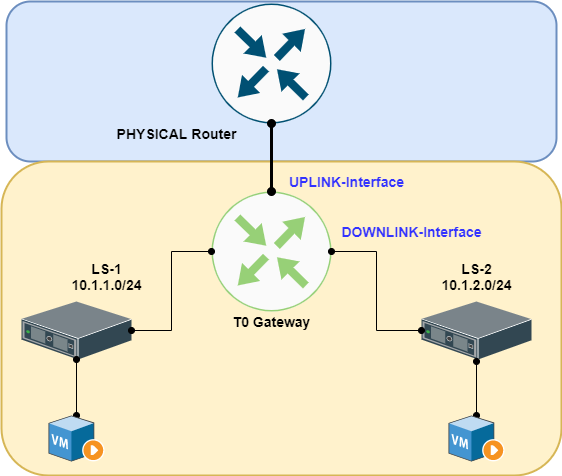
NSX-T DR vs SR: Distributed Routing vs Service Routing
The difference between Distributed Routing (DR) and Service Routing (SR) is an important concept in NSX-T.
To understand the difference more easily, we can compare their location, routing functions and network services.
First, let’s look at the key differences between DR and SR.
| Feature | Distributed Routing (DR) | Service Routing (SR) |
|---|---|---|
| Location | Transport Nodes | NSX-T Edge Node |
| Routing | Distributed East-West | Centralized services / North-South |
| Processing | Distributed | Centralized |
| Hypervisor traffic | Can remain local | Traffic may be sent to Edge |
| NAT | No | Yes |
| BGP | No centralized service | Yes |
| Firewall services | No centralized Edge service | Yes |
| Typical use | East-West routing | North-South and network services |
Distributed Routing (DR)
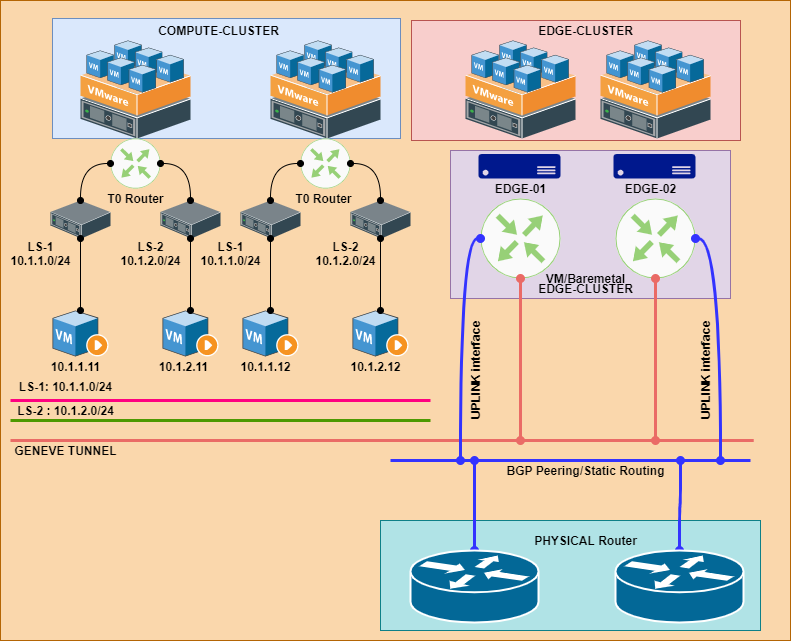
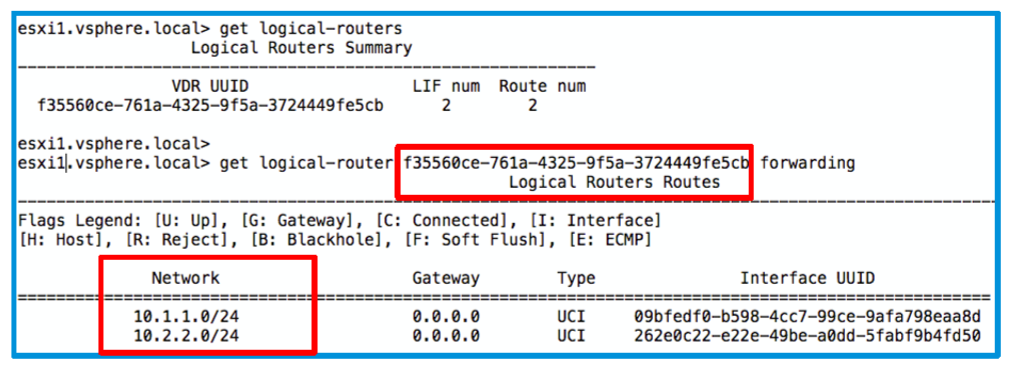
Distributed Routing (DR) provides routing capabilities directly on NSX transport nodes.
Key characteristics include:
- NSX transport nodes run DR locally.
- The routing function is distributed across the environment.
- As a result, DR provides efficient East-West routing between workloads.
- When workloads on the same ESXi host communicate across different subnets, traffic can be routed locally without unnecessarily leaving the host.
This distributed architecture helps reduce unnecessary network hops and improves traffic efficiency.
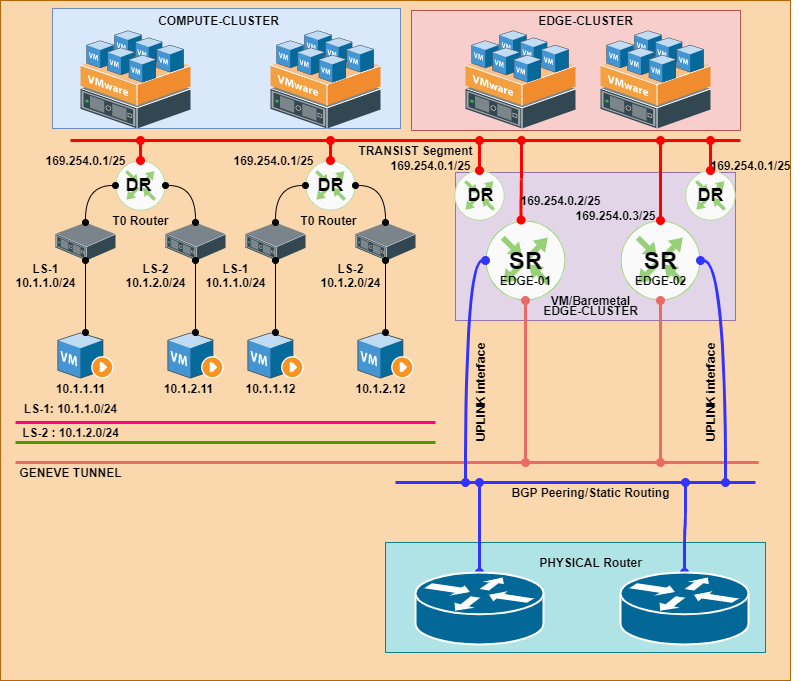
Service Routing (SR)
Service Routing (SR) provides centralized gateway services through an NSX-T Edge Node.
The SR component is typically used when traffic needs to access centralized services or external networks.
For example, these services can include:
- North-South routing
- NAT
- BGP
- Gateway Firewall
- Load Balancing
- VPN services
Unlike Distributed Routing, SR relies on the Edge infrastructure to provide centralized network services.
Therefore, understanding the relationship between DR and SR is important when designing an NSX-T routing architecture.
NSX-T Bare Metal Edge vs VM Edge
NSX-T supports different Edge Node deployment models, including VM-based Edge Nodes and Bare Metal Edge Nodes.
In general, the appropriate deployment model depends on factors such as performance requirements, scalability, available infrastructure, and workload requirements.
For example, Bare Metal Edge Nodes can provide dedicated physical resources for demanding workloads. In contrast, VM-based Edge Nodes provide greater deployment flexibility within a virtualized environment.
As a result, the right Edge deployment model depends on the specific requirements of the NSX-T environment.
The following comparison highlights the key differences discussed in this NSX-T 3.1-era design.
Bare Metal EDGE Node
- Higher Thoughput : 35 Gbps
- Faster Convergence : sub second
- Specific/Certified NIC : Intel i40e, Mellanox, CX-4/5
- Rack & Stack
- High Service Scale
VM Form Factor EDGE Node
- Throughput : 20 Gbps
- Convergence: 1.5+ seconds
- No NIC requirements: VMXNET3 driver required
- Flexible deployment
- Services scale varies by the VM size
Faq Content
What is NSX-T routing?
NSX-T routing provides Layer 3 connectivity between different networks and supports distributed and centralized routing functions within the NSX environment.
What is Distributed Routing in NSX-T?
Distributed Routing provides routing capabilities directly on NSX transport nodes, allowing efficient East-West traffic forwarding between workloads.
What is Service Routing in NSX-T?
In addition, Service Routing provides centralized gateway services through NSX-T Edge Nodes. These services include functions such as North-South connectivity, NAT, and other network services.
Therefore, Service Routing is typically used when centralized gateway services are required within the NSX-T environment.
What is the difference between DR and SR in NSX-T?
In contrast, Distributed Routing provides routing close to workloads, while Service Routing provides centralized gateway services through the Edge infrastructure.
As a result, DR is commonly associated with distributed East-West traffic, whereas SR handles centralized gateway functions.
What is an NSX-T Edge Node?
An NSX-T Edge Node provides centralized networking services and connectivity between the NSX environment and external networks.
What is the difference between Bare Metal Edge and VM Edge?
For deployment flexibility, a Bare Metal Edge runs directly on physical certified hardware, while a VM Edge runs as a virtual machine.
However, the appropriate choice depends on factors such as performance, scalability, and available infrastructure.
Conclusion
In this article, we explored NSX-T routing and the key differences between Distributed Routing (DR) and Service Routing (SR).
Overall, we learned how Distributed Routing provides efficient East-West routing across NSX transport nodes, while Service Routing provides centralized gateway services through NSX-T Edge Nodes.
In addition, we looked at the role of the NSX-T Gateway and the different Edge Node deployment options.
Together, these concepts provide a foundation for understanding NSX-T routing architecture.
Thanks for visiting Network Bachelor. Happy Learning!

Securing the Stack: A Practical Guide to AI and LLM Security
vLLM in 2026: Infrastructure Engineer’s Guide to LLM Inference

LLM Kubernetes Projects: 5 Hands-On AI Infrastructure Labs
About Author

abhishek
Cloud Platform Lead and AI Infrastructure Architect at e& enterprise, with 12+ years in data center, virtualization, security and AI infrastructure. I design and build private cloud and sovereign AI platforms, working with VMware (NSX-T, vSphere, vSAN, HCX, AVS, SRM), Kubernetes, Terraform and GPU inference infrastructure for LLMs. Previously served Networkers Home (CCIE instructor, trained around 50 CCIEs), VCE/EMC2, Cisco, VMware and Arista across TAC, consulting, design and training. Certifications: CCIE#48639 (Data Center and R&S), VCIX-DCV and NV, CKA, NVIDIA AI Infrastructure, Azure Solutions Architect Expert, Terraform Associate, Palo Alto PCNSE. LinkedIn: https://www.linkedin.com/in/abhishekkunal51/
Very Informative article about DR & SR.
Keep continue…