VMware Carbon Black Solution Analysis
Cyber threats continue to challenge organizations of every size. Ransomware, malware, credential theft, and sophisticated attacks can compromise endpoints and disrupt business operations.
Therefore, organizations need more than traditional antivirus software to protect their devices, applications, and sensitive information.
Carbon Black endpoint security combines endpoint protection and threat detection capabilities to help organizations identify, investigate, and respond to cyber threats.
The platform includes capabilities such as next-generation antivirus (NGAV), Endpoint Detection and Response (EDR), and behavioral threat analysis.
Furthermore, Carbon Black collects endpoint activity data to provide security teams with visibility into suspicious processes and potential attacks.
Its architecture generally includes two primary components:
- Endpoint Sensors: These agents run on supported endpoints and collect security telemetry.
- Centralized Management Platform: This component processes endpoint information and provides security monitoring, investigation, and management capabilities.
As a result, security teams can investigate suspicious activity and strengthen their endpoint protection strategy.
In this article, we examine Carbon Black’s security capabilities, architecture, compatibility, industry evaluations, licensing considerations, and enterprise use cases.
We also explore the factors organizations should consider when evaluating Carbon Black for their cybersecurity requirements.
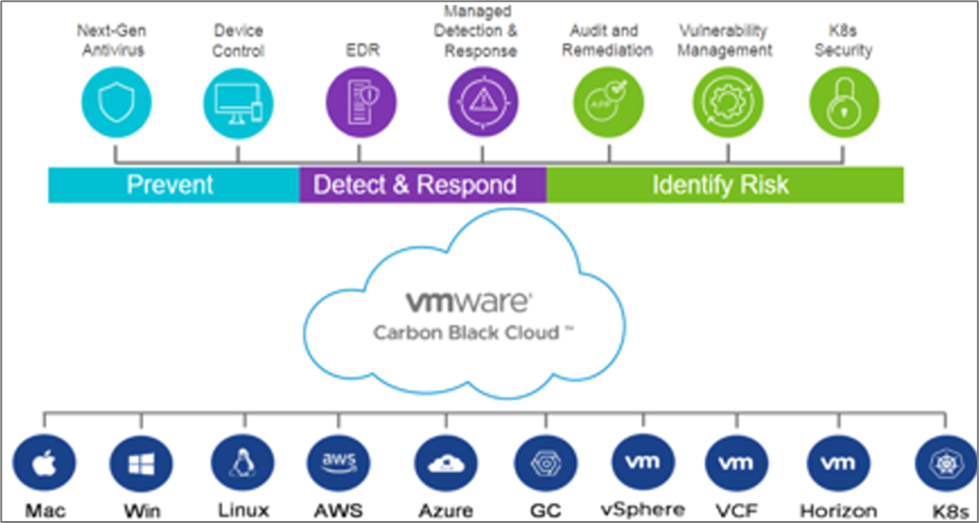
Which Organizations Can Benefit from Carbon Black?
Carbon Black provides endpoint security capabilities for organizations that require advanced threat visibility and investigation tools.
However, the platform’s suitability depends on the organization’s security requirements, available resources, and operational maturity.
For example, medium-sized and large enterprises often need centralized endpoint monitoring across distributed environments.
Additionally, organizations with a Security Operations Center (SOC) can use EDR telemetry to investigate suspicious endpoint activity.
Common use cases include:
- Enterprise endpoint protection
- Security operations and threat investigation
- Ransomware and malware detection
- Endpoint activity monitoring
- Incident response and forensic analysis
- Distributed workforce security
Furthermore, organizations should evaluate the operational effort required to deploy, configure, and maintain endpoint security controls.
Ultimately, selecting an EDR platform requires balancing security capabilities, operational complexity, integration requirements, and total cost of ownership.
Carbon Black Compatibility and System Requirements
Carbon Black supports various endpoint operating systems, depending on the product edition and sensor version.
Supported environments may include Windows workstations, Windows servers, Linux systems, and macOS devices.
However, organizations must verify compatibility before deployment.
For example, sensor support can vary based on operating system versions, kernel requirements, product releases, and deployment configurations.
Resource Requirements
Endpoint resource consumption depends on several factors, including:
- Operating system and hardware configuration
- Sensor version
- Enabled protection and monitoring features
- Endpoint activity and workload characteristics
- Security policy configuration
Therefore, organizations should conduct pilot testing before deploying sensors across production environments.
Network Communication Requirements
Carbon Black sensors communicate with their management infrastructure through designated network connections.
For example, HTTPS over TCP port 443 is commonly used for cloud management communication.
However, the exact network requirements depend on the Carbon Black product, deployment architecture, and supported configuration.
Consequently, security teams should verify firewall rules, proxy settings, and connectivity requirements using current product documentation.
Before a large-scale rollout, organizations should also evaluate endpoint performance and operational compatibility.
Industry Validation and Competition
The below table summarizes some of the industry studies on the solution
| Validators | Date | Malware | Real-world protection | EDR Evaluation | Detection Rate |
| AV comparatives | May 2020 | 100% | 99.8% | ||
| MITRE | April 2020 | Success | |||
| AV-TEST | June 2020 | 100% | 100% | ||
| OPSWAT | July 2018 | GOLD | |||
| ICSA Labs | June 2018 | 100% |
The solution competitive landscape includes Crowdstrike, Trend Micro, Sophos, FireEye, Palo Alto Networks, Tanium McAfee, Microsoft, and SentinelOne
Carbon Black Pricing and Licensing Considerations
Carbon Black pricing depends on the selected product, licensing model, deployment requirements, and commercial agreement.
Therefore, organizations should request a current quotation from an authorized sales channel.
Several factors can influence the total cost:
- Number of protected endpoints
- Selected security capabilities
- Subscription duration
- Deployment architecture
- Support requirements
- Additional integrations and services
Furthermore, organizations should consider implementation and ongoing management costs.
For example, an endpoint security platform may require dedicated resources for policy management, alert investigation, and incident response.
As a result, buyers should evaluate the total cost of ownership rather than subscription pricing alone.
Carbon Black Support Options
Support requirements vary depending on the product, service agreement, and available support offerings.
Before purchasing, organizations should confirm:
- Technical support availability
- Severity-based response targets
- Support escalation procedures
- Software updates and maintenance
- Access to documentation and knowledge resources
- Availability of advanced technical assistance
Additionally, organizations should verify which support services are included in their licensing agreement.
Understanding Carbon Black Security Capabilities
Carbon Black offers different endpoint protection and detection capabilities across its product portfolio.
For example, endpoint prevention helps reduce exposure to malicious activity. Meanwhile, EDR capabilities provide additional visibility for threat investigation.
Advanced capabilities may also support threat hunting, endpoint queries, and incident response.
However, feature availability depends on the purchased product and current licensing terms.
Therefore, organizations should confirm the latest product bundles before comparing editions or making procurement decisions.
Support Levels
There are different levels of support available, please find them below
| Feature | Standard | Premium | Platinum |
| Support availability | 8 AM to 8:00 PM (based on geo) | 24*7 | 24*7 |
| Unlimited cases | Yes | Yes | Yes |
| Phone, email, and customer portal support | Yes | Yes | Yes |
| Access to the knowledge base | Yes | Yes | Yes |
| Access to user exchange community | Yes | Yes | Yes |
| Designated support engineer | NO | NO | Yes |
Solution Licensing Bundle
| Prevention | Standard | Advanced | Enterprise |
| NGAV | NGAV | NGAV | NGAV |
| Device Control | Device Control | Device Control | |
| Behavioral EDR | Behavioral EDR | Enterprisel EDR | |
| Audit and remediation | Audit and Remediation | ||
| Vulnerability Management | Vulnerability Management |
Conclusion: Is Carbon Black the Right Endpoint Security Solution?
As cyber threats become more sophisticated, organizations need effective endpoint protection, continuous monitoring, and reliable incident response capabilities.
Carbon Black endpoint security offers a combination of threat prevention, behavioral analysis, and Endpoint Detection and Response (EDR) capabilities.
Furthermore, its endpoint telemetry and investigation tools help security teams identify suspicious activity and investigate potential threats.
For example, security analysts can examine endpoint events, analyze process behavior, and investigate indicators of compromise.
Additionally, Carbon Black supports security operations through centralized monitoring and integrations with other cybersecurity technologies.
However, organizations must evaluate several factors before selecting the platform. These include operating system compatibility, endpoint performance, licensing costs, security requirements, and operational complexity.
Although Carbon Black provides valuable endpoint security capabilities, no single solution can guarantee protection against every cyberattack.
Therefore, organizations should combine endpoint protection with vulnerability management, identity security, network monitoring, and effective incident response procedures.
Ultimately, Carbon Black can be a suitable option for organizations seeking stronger endpoint visibility, threat detection, and security investigation capabilities.
The right decision depends on how effectively the solution aligns with the organization’s security architecture, operational requirements, and long-term cybersecurity strategy.
Is Your Endpoint Security Strategy Ready for Modern Cyber Threats?
Protecting enterprise endpoints requires more than installing antivirus software. Organizations need the right security architecture, effective monitoring, and a clear incident response strategy.
TREZBON TECHNOLOGIES provides cybersecurity consulting and IT infrastructure expertise to help organizations assess their security requirements and identify practical improvements.
Whether you are evaluating endpoint security solutions, reviewing your cybersecurity architecture, or planning infrastructure improvements, our consultants can help you determine the next steps.
Strengthen your enterprise cybersecurity strategy with TREZBON.
👉 Contact Our Cybersecurity Consultants
Your trusted partner in cybersecurity and IT infrastructure consulting.
ZTNA Platform Comparison 2026 | 11 Zero Trust Solutions
VMware NSX-T and AVI Load Balancer: Architecture & Use Cases
Multi-Environment Security Challenges & Cyber Resilience
About Author

Muhammad Marakkoottathil(MM)
Expert in the field of SDN, cloud computing, virtualization, active-active data center design & migration. Passionate about helping organizations to achieve their digital transformation objectives with strong 15+ years of experience in design, deployment, and managing heterogeneous network solutions across the industry verticals. Major Industry Certifications: Cisco CCIE, CCDP, VMware VCAP-NV_DESIGN, TOGAF, ITIL, NUTANIX NCSE, Google Cloud Architect, Azure Fundamentals More info please visit my page @ LinkedIn: https://www.linkedin.com/in/contactmm/
Good luck.