VMware NSX Microsegmentation: How Traffic Is Secured
NSX microsegmentation helps organizations protect workloads by applying granular security policies within virtualized data centers.
Traditionally, organizations have used VLANs, subnets, and perimeter firewalls to separate networks. However, these approaches often focus on network boundaries rather than individual applications.
As enterprise environments grow, this limitation can create security challenges.
For example, attackers may compromise a less-protected workload and attempt to access other systems through lateral movement.
Therefore, organizations need security controls that protect workloads even when they share the same network segment.
VMware NSX microsegmentation addresses this challenge through distributed firewall policies that control traffic close to individual workloads.
In this guide, we explain how NSX microsegmentation manages traffic, how it differs from traditional segmentation, and why it supports Zero Trust security.
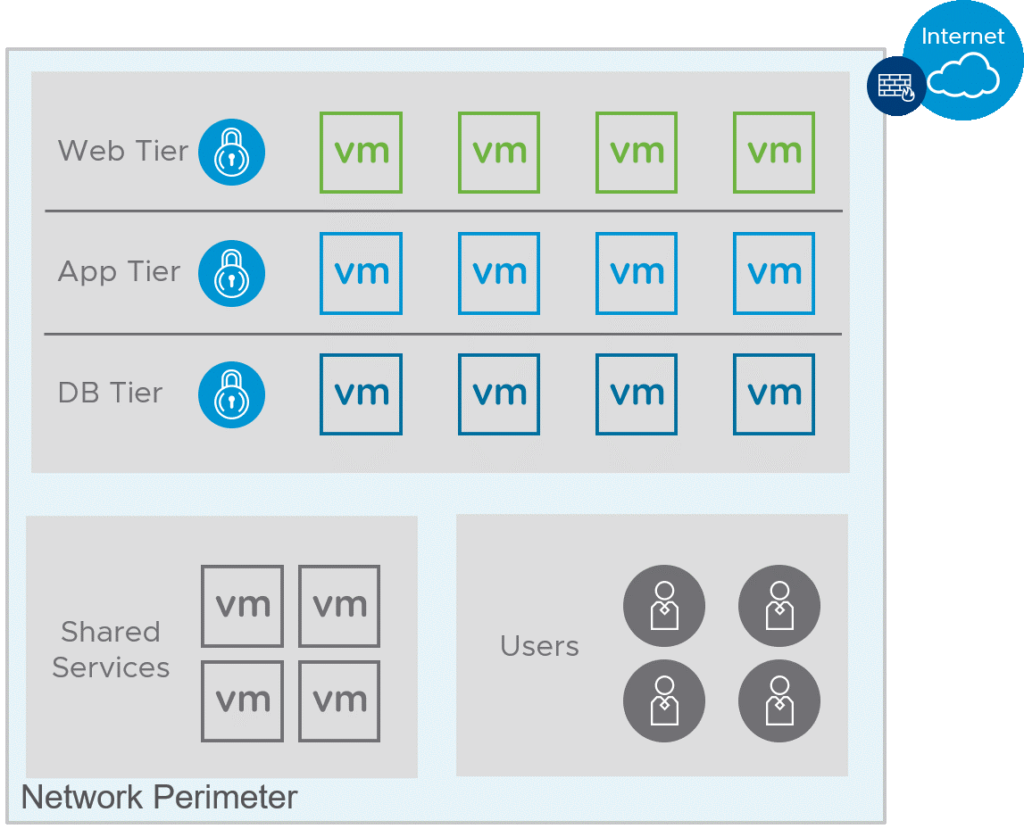
1. What Is VMware NSX Microsegmentation?
Microsegmentation is a security approach that divides workloads into smaller, individually controlled security zones.
Instead of relying only on broad network boundaries, organizations can define security policies based on application requirements.
For example, a three-tier application may contain:
- Web Tier: Handles incoming application requests.
- Application Tier: Processes business logic.
- Database Tier: Stores critical application data.
Each tier has different communication requirements.
Therefore, security teams can create policies that permit only the traffic required between these workloads.
Additionally, microsegmentation can restrict unnecessary communication between workloads within the same subnet.
As a result, organizations can reduce the opportunities for unauthorized lateral movement.
2. Microsegmentation vs. VLANs, Firewalls, and ACLs
Traditional network segmentation commonly uses VLANs, Layer 3 subnets, access control lists, and firewalls.
These technologies remain valuable for controlling network traffic.
However, they may require additional configuration to enforce granular workload-level security.
How traffic is managed in Traditional Data Center
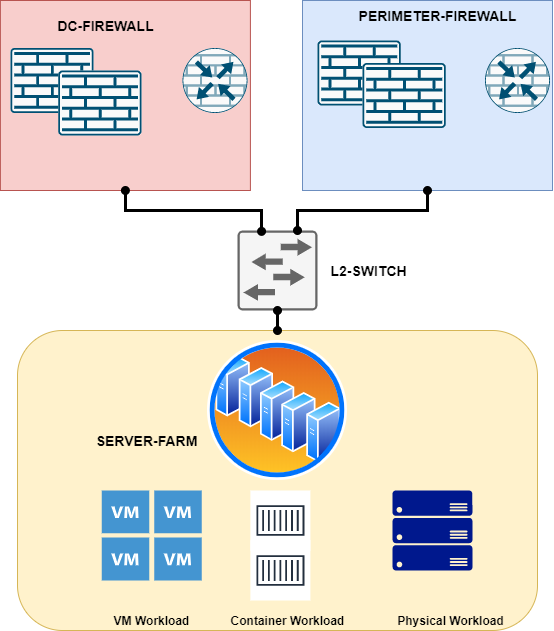
A VLAN separates devices into logical Layer 2 broadcast domains.
For example, administrators may create separate VLANs for web servers, application servers, and database systems.
Next, they can configure firewalls or ACLs to control communication between those networks.
However, workloads within the same VLAN may still communicate unless additional security controls restrict that traffic.
How Traffic Managed with NSX Microsegmentation
VMware NSX uses distributed firewall (DFW), with the help of DFW it logically divides a data center into distinct security segments down to the individual workload/VM level. This gives power to distinct controls and security services based on applications. Therefore, specific application will have their respective rules which can be managed and operated centrally and applies the rule to each VM’s vnic level.
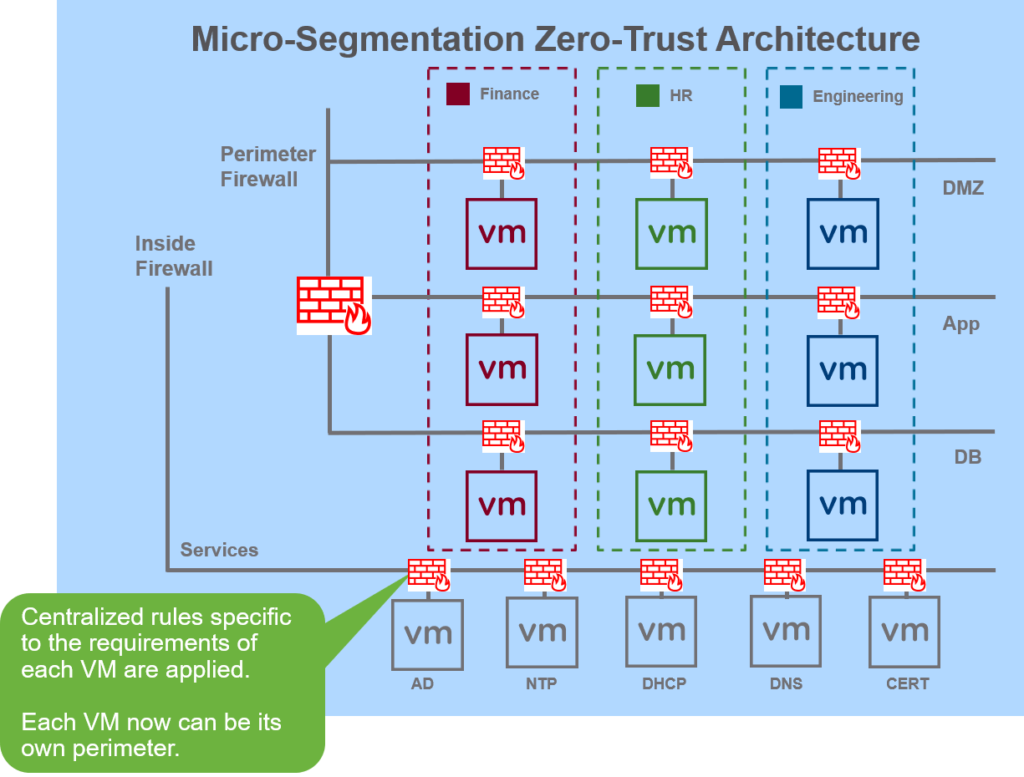
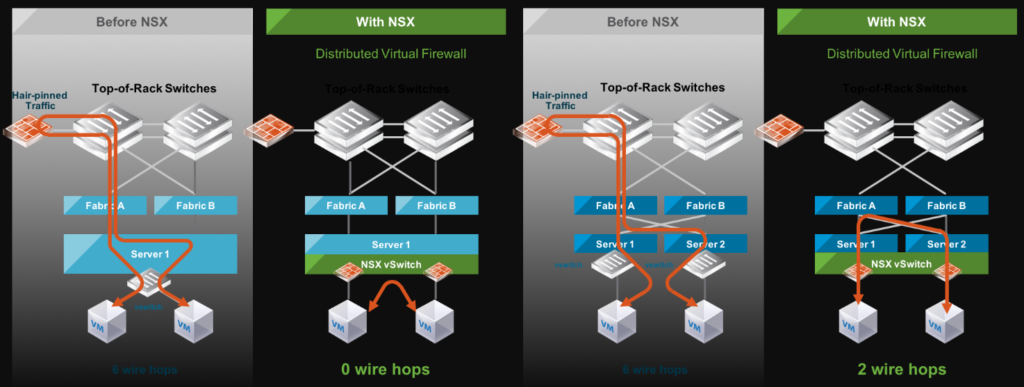
Regarding traffic pinning we will see that it won’t require to send the traffic to physical firewall, therefore, reducing traffic reaching the upstream network or firewall. Furthermore, for detailed use case and benefits you can refer VMware published whitepaper on microsegmention
And for key features on NSX 3.0.0 version please refer this blog
Conclusion: Why NSX Microsegmentation Matters
NSX microsegmentation provides a practical approach to securing east-west traffic in virtualized data centers.
Unlike traditional network segmentation, which often relies on VLANs, subnets, and centralized firewalls, NSX can enforce granular security policies close to individual workloads.
As a result, organizations can restrict unnecessary communication, improve workload isolation, and reduce opportunities for lateral movement.
Additionally, the NSX Distributed Firewall supports application-focused security policies without requiring every protected traffic flow to pass through a centralized physical firewall.
However, successful implementation requires accurate application dependency mapping, careful policy design, and ongoing monitoring.
Ultimately, VMware NSX microsegmentation helps organizations strengthen internal network security while supporting Zero Trust architecture and more manageable data center operations.
Continue Learning
Explore our related technical guides on NETWORK BACHELOR:
- VMware NSX-T 3.0 Segmentation: Configuration and Verification
- VMware NSX-T 3.0 Key Features
- NSX-T-Based DMZ Rack Design for Banking
Strengthen Your Enterprise Network Security with TREZBON TECHNOLOGIES
Is your organization struggling with east-west traffic visibility, workload isolation, or complex network security policies?
TREZBON TECHNOLOGIES provides enterprise networking, cybersecurity consulting, and IT infrastructure expertise to help organizations evaluate security challenges and plan practical improvements.
Whether you are reviewing microsegmentation strategies, modernizing your data center, or strengthening your Zero Trust architecture, our team can discuss your requirements.
Explore our services: https://www.trezbon.com/
Contact TREZBON TECHNOLOGIES: https://trezbon.com/#contact
Follow NETWORK BACHELOR for practical technical guides on VMware NSX, microsegmentation, enterprise networking, and cybersecurity.
Comparing Cisco Tetration with VMware NSX
VMware Carbon Black Solution Analysis

Choosing the Right NAC Platform for Your Enterprise: A Data-Driven Evaluation
About Author

abhishek
Cloud Platform Lead and AI Infrastructure Architect at e& enterprise, with 12+ years in data center, virtualization, security and AI infrastructure. I design and build private cloud and sovereign AI platforms, working with VMware (NSX-T, vSphere, vSAN, HCX, AVS, SRM), Kubernetes, Terraform and GPU inference infrastructure for LLMs. Previously served Networkers Home (CCIE instructor, trained around 50 CCIEs), VCE/EMC2, Cisco, VMware and Arista across TAC, consulting, design and training. Certifications: CCIE#48639 (Data Center and R&S), VCIX-DCV and NV, CKA, NVIDIA AI Infrastructure, Azure Solutions Architect Expert, Terraform Associate, Palo Alto PCNSE. LinkedIn: https://www.linkedin.com/in/abhishekkunal51/
Hi Abhishek,
Very lucid article about NSX micro-segmentation. I would like to add that in NSX also it is possible for shared services/processes to communicate with VMs across isolated VM environments. In today’s enterprise network, it cannot be completely done away with it. But surely, the choice of such services always remain with the enterprise.
Thanks,
Susmita