NSX-T Manager Cluster Design: VIP, HA & Failures
Introduction: NSX-T Manager Cluster Design
A reliable NSX-T environment starts with a well-designed management cluster. However, deploying NSX Manager nodes is only one part of the process. Network administrators must also consider connectivity, high availability, load balancing, and failure recovery.
In this second part of the NSX-T 3.0 Design Bootcamp, we explore the key considerations for NSX-T Manager cluster design. We focus on how administrators access the management cluster and what happens when one or more Manager nodes become unavailable.
First, we will examine the different management access methods, including individual management IP addresses, cluster virtual IPs (VIPs), and external load balancers.
Next, we will discuss the network port requirements that support communication between NSX-T components.
Finally, we will explore three NSX Manager failure scenarios. These examples will help you understand cluster quorum, management availability, and recovery considerations.
By the end of this guide, you will have a clearer understanding of how to design a resilient NSX-T management environment.
NSX-T Manager Cluster Design: Logical Connectivity and Load Balancing
When designing an NSX-T Manager cluster, administrators must decide how users and external applications will access the management environment.
There are several connectivity options. Each method offers different benefits in terms of availability, scalability, and administration.
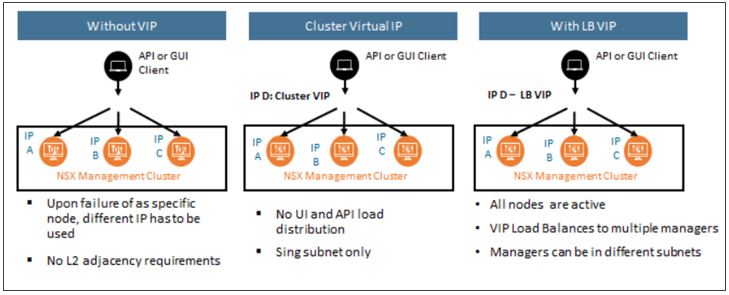
1. NSX-T Manager Cluster with Individual Management IP Addresses
By default, each NSX Manager node has its own management IP address. Administrators can use these addresses to access and manage individual nodes.
This approach is straightforward because it does not require a separate load balancer.
However, applications must know which Manager endpoint to use. Therefore, administrators should consider how management access will continue if a particular node becomes unavailable.
2. NSX-T Manager Cluster with a Cluster VIP
Another option is to configure a cluster virtual IP address (VIP).
A cluster VIP provides a common management endpoint. As a result, administrators can access the cluster without remembering individual node addresses.
However, in NSX-T 3.0, the built-in cluster VIP is associated with one active Manager node at a time. It does not distribute incoming requests across all Manager nodes.
Consequently, applications that generate large numbers of API requests may encounter scalability limitations.
For example, a Kubernetes management platform interacting frequently with NSX-T could generate substantial API traffic.
Therefore, organizations should evaluate API workloads before selecting the built-in cluster VIP.
3. NSX-T Manager Cluster with an External Load Balancer
An external load balancer provides another way to access the NSX Manager cluster.
Unlike the built-in cluster VIP, an appropriately configured external load balancer can distribute incoming management requests across multiple Manager nodes.
As a result, this approach may be suitable for environments with frequent API requests or additional availability requirements.
Furthermore, external load balancing can provide greater flexibility when designing management connectivity across network segments.
However, this approach introduces additional infrastructure and configuration requirements.
Therefore, administrators should evaluate load balancer health checks, supported persistence settings, security policies, and the NSX-T version’s compatibility requirements before deployment.
4. NSX-T Manager TCP and UDP Port Requirements
Network connectivity is another important part of NSX-T Manager cluster design.
NSX-T components use specific TCP and UDP ports to communicate with each other. Therefore, administrators must verify that firewalls allow the required traffic.
Before deployment, review the communication requirements between NSX Manager nodes, transport nodes, and other relevant infrastructure components.
In addition, validate the firewall rules against the documentation for the exact NSX-T version being deployed.
This step helps prevent connectivity problems during installation and ongoing management.
NSX Manager: Failure Scenarios
NSX Manager Failure Scenarios: Understanding Cluster Availability
A resilient NSX-T design must account for unexpected failures. Although a three-node Manager cluster provides redundancy, its availability depends on maintaining cluster quorum.
Let’s examine three important failure scenarios.
Scenario 1: One NSX Manager Node Fails
Consider a three-node NSX Manager cluster where one node becomes unavailable.
In this situation, the remaining two nodes can maintain cluster quorum. Therefore, the management cluster can generally continue operating.
Administrators can still access the available management services and perform supported operations.
However, the failed node should be restored as soon as possible. This is important because the cluster has temporarily lost part of its redundancy.
Scenario 2: Two NSX Manager Nodes Fail
Now consider a more serious situation where two nodes become unavailable.
Only one Manager node remains operational. Consequently, the cluster loses quorum and normal management operations become restricted.
For example, administrators may experience limited management functionality or lose access through the cluster VIP.
Although the existing data plane may continue forwarding traffic, the management environment requires urgent attention.
Recovery may involve supported cluster recovery procedures, depending on the remaining node’s condition and the NSX-T version.
Therefore, administrators should follow the official recovery documentation rather than immediately making unsupported cluster changes.
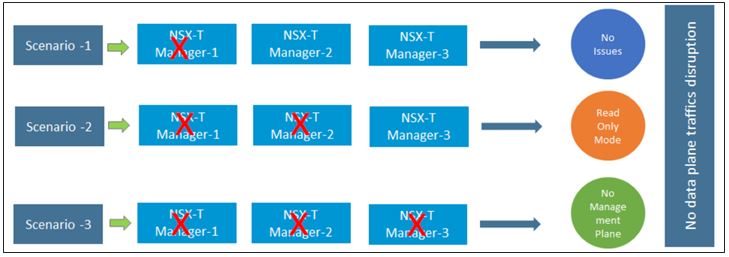
Scenario 3: All Three NSX Manager Nodes Fail
The third scenario involves the complete loss of the NSX Manager cluster.
In this case, both management and centralized control-plane capabilities may become unavailable.
However, existing data-plane forwarding can continue using previously programmed forwarding information.
This does not mean that the environment is fully operational. New configuration changes, control-plane updates, and some dependent services may be affected.
Therefore, restoring the management cluster becomes a critical priority.
A reliable recovery strategy should include validated NSX-T backups, documented recovery procedures, and regular recovery testing.
Key Design Consideration
A three-node NSX Manager cluster is designed to tolerate a single Manager node failure while maintaining quorum.
However, multiple failures can affect management availability and recovery complexity.
For this reason, administrators should distribute Manager nodes across appropriate failure domains and maintain a tested backup strategy.
These precautions help reduce operational risk and support faster recovery.
Conclusion: Building a Reliable NSX-T Manager Cluster
A reliable NSX-T environment begins with careful management cluster design. Although deploying three NSX Manager nodes provides redundancy, administrators must also consider how the nodes communicate, handle management requests, and respond to failures.
In this guide, we explored the main NSX-T Manager connectivity options, including individual management IP addresses, cluster VIPs, and external load balancers. Each approach has its advantages. Therefore, selecting the right option depends on the organization’s operational requirements, API traffic, and infrastructure design.
We also examined three important failure scenarios. While a single Manager node failure can be tolerated by a healthy three-node cluster, losing two or more nodes creates significant management challenges.
The key takeaway is simple: high availability requires more than deploying multiple nodes. It also depends on proper connectivity, quorum awareness, failure-domain planning, and tested recovery procedures.
In the next part of our NSX-T 3.0 Design Bootcamp, we will explore single-site and multi-site deployment considerations, interoperability, and infrastructure sizing.
Continue exploring our VMware NSX-T tutorials on Network Bachelor to strengthen your understanding of enterprise data center networking.
Happy learning!
Continue Your NSX-T Learning Journey
Designing a reliable NSX-T environment requires a clear understanding of cluster connectivity, high availability, and failure recovery.
Whether you are a network engineer, virtualization administrator, or IT architect, practical knowledge of NSX-T design can help you make better infrastructure decisions.
Explore more technical tutorials, deployment guides, and real-world networking insights from Network Bachelor.
Explore More VMware Networking Tutorials
Follow Network Bachelor for more practical insights into VMware NSX-T, enterprise networking, and data center technologies.

AI Training Infrastructure: From Jupyter to InfiniBand

vLLM Multi-Hardware Inference: NVIDIA vs AMD vs TPU vs Intel
VMware NSX-T and AVI Load Balancer: Architecture & Use Cases
About Author

Muhammad Marakkoottathil(MM)
Expert in the field of SDN, cloud computing, virtualization, active-active data center design & migration. Passionate about helping organizations to achieve their digital transformation objectives with strong 15+ years of experience in design, deployment, and managing heterogeneous network solutions across the industry verticals. Major Industry Certifications: Cisco CCIE, CCDP, VMware VCAP-NV_DESIGN, TOGAF, ITIL, NUTANIX NCSE, Google Cloud Architect, Azure Fundamentals More info please visit my page @ LinkedIn: https://www.linkedin.com/in/contactmm/