NSX-T Edge Deployment: Collapsed vs Non-Collapsed: Part 13 Guide
In this “NSX-T Series: Part 13 – NSX-T EDGE Deploy Part-2” part, we will discuss the difference between collapsed EDGE/Compute model and Non Collapsed. We will walk through the issue faced in Collapsed design and how to overcome from it.
If you want to start from beginning you can refer my previous part of the Series:
NSX-T Series : Part 1 -Architecture and Deploy
NSX-T Series : Part 2 – Adding Compute Manager
NSX-T Series : Part 3 – Planning NSX VXLAN
NSX-T Series : Part 4 – Transport Zones and Use cases for Multi-Transport Zone
NSX-T Series: Part 5 – NSX-T N-VDS and VDS 7.0
NSX-T Series: Part 6 – NSX-T Uplink Profile
NSX-T Series: Part 7 – NSX-T ESXi Transport Node
NSX-T Series: Part 8 – NSX-T Logical Switching Use Cases
NSX-T Series: Part 9 – NSX-T Logical Switching Services
NSX-T Series: Part 10 – NSX-T Routing
NSX-T Series: Part 11– NSX-T Multi-Tier Routing
NSX-T Series: Part 12 – NSX-T EDGE Deploy Part-1
Introduction
In this part of the VMware NSX-T series, we will explore two important Edge deployment models: collapsed and non-collapsed designs.
First, we will understand how Edge node placement affects network architecture and traffic flow. Next, we will compare both deployment approaches and examine their advantages and limitations.
In a collapsed design, NSX-T Edge nodes and compute workloads share the same ESXi host cluster. In contrast, a non-collapsed design uses separate ESXi hosts for Edge nodes and compute workloads.
Both approaches support NSX-T networking. However, the choice depends on infrastructure capacity, network design, and operational requirements.
We will also examine a common connectivity issue that can occur in certain collapsed deployments. This issue may cause VTEP tunnel failures and unexpected packet drops.
To understand the problem, we will review how Host TEP and Edge TEP traffic travels through the physical network.
Furthermore, we will explore three approaches to resolving the issue:
- Deploying Edge nodes on dedicated ESXi hosts.
- Using a separate distributed virtual switch or vSwitch for Edge traffic.
- Configuring separate VLANs or IP subnets for Host TEP and Edge TEP communication.
Finally, we will discuss transport zone configuration, uplink connectivity, and MTU requirements.
By the end of this guide, you will better understand how to plan NSX-T Edge deployments and troubleshoot connectivity problems.
Collapsed NSX-T Edge Deployment
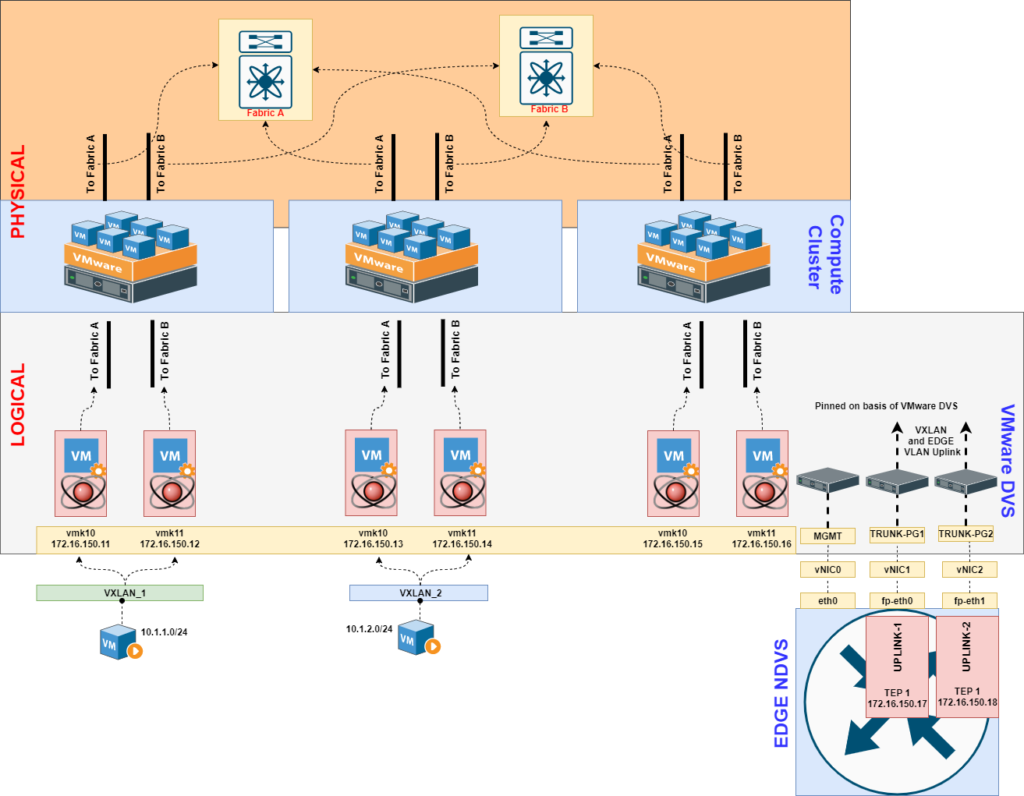
In a collapsed design, NSX-T Edge nodes and compute workloads run within the same ESXi cluster.
This approach can be useful for small and medium-sized data centers with limited infrastructure resources.
First, ESXi hosts are prepared as NSX-T transport nodes. Next, the required transport zones and TEP interfaces are configured.
Once the environment is ready, Edge nodes can be deployed on suitable hosts within the shared cluster.
Advantages of Collapsed Design
A collapsed design offers several benefits:
- Reduces the need for dedicated Edge hosts.
- Makes better use of existing compute resources.
- Provides flexible workload and Edge node placement.
- Can reduce infrastructure requirements in smaller environments.
However, this design also requires careful planning.
For example, Host TEP and Edge TEP connectivity must be configured correctly. Otherwise, traffic forwarding problems may occur.
Silent Packet Drops and VTEP Tunnel Failures
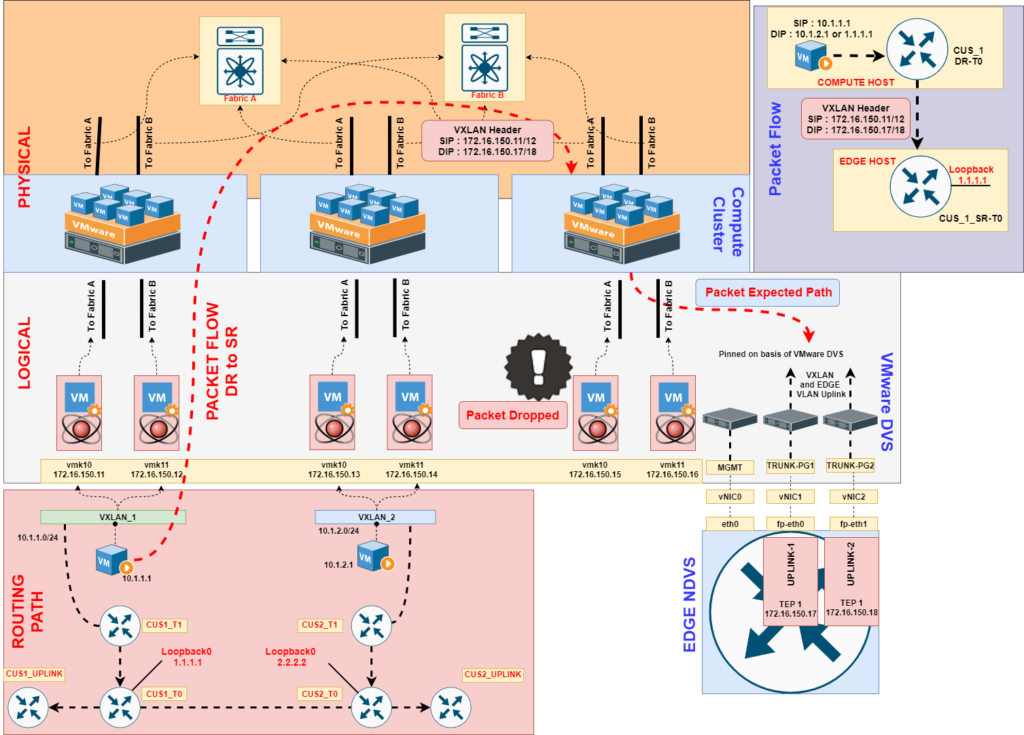
One issue that can occur in certain collapsed deployments involves communication between Host TEP and Edge TEP interfaces.
When both interfaces use the same IP subnet, the physical and virtual switching configuration must support the required connectivity.
If the network cannot correctly forward traffic between these endpoints, packets may be dropped.
As a result, VTEP tunnels may fail to establish. The affected transport nodes may also report degraded connectivity.
Therefore, engineers should verify TEP reachability, VLAN configuration, virtual switch connectivity, and the underlying network before troubleshooting higher-layer services.

Solutions:
To solve this issue design issue there could be 3 approaches which might us to get either more ESXi ( for separating EDGE Cluster in terms of ESXi: Collapsed Design ), or more Uplink ( for separating DVS/vSwitch for EDGE VM ) or Separate VLAN/Subnet for HOST TEP and EDGE TEP. This is all we discussed in following section:
1.Non-Collapsed NSX-T Edge Deployment
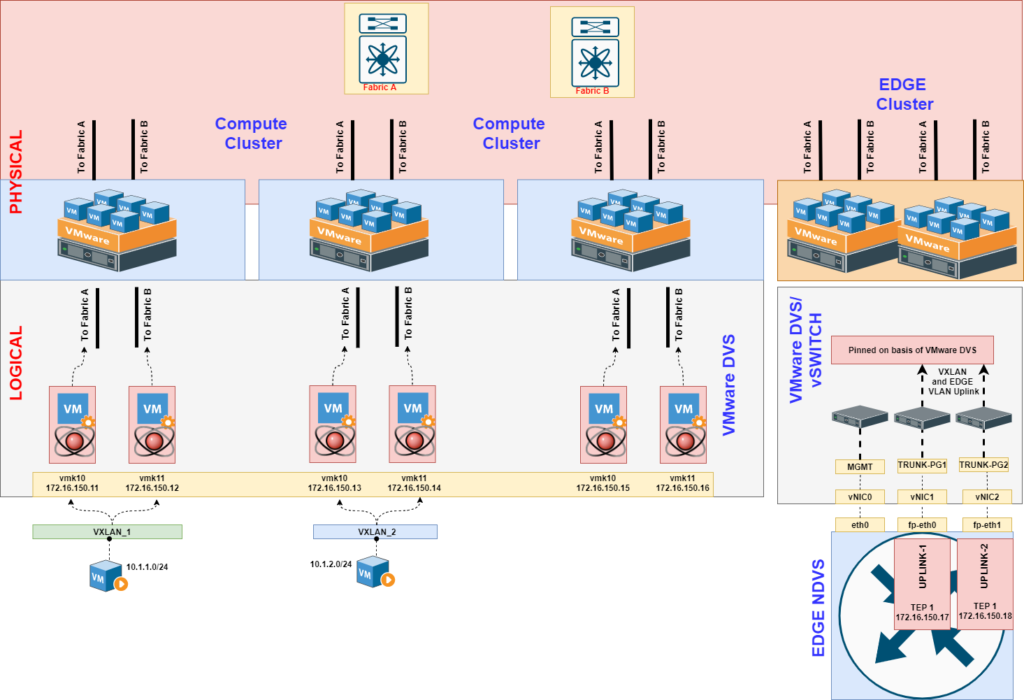
In contrast, a non-collapsed design separates Edge nodes from compute workloads.
Here, dedicated ESXi hosts run the Edge nodes, while separate transport hosts support application workloads.
This architecture provides clearer separation between Edge services and compute resources.
Furthermore, dedicated Edge hosts can simplify resource planning and network connectivity management.
However, this approach requires additional infrastructure capacity. Therefore, organizations should evaluate hardware availability, operational requirements, and expected network traffic before selecting this design.
Three Approaches to Resolving Connectivity Issues
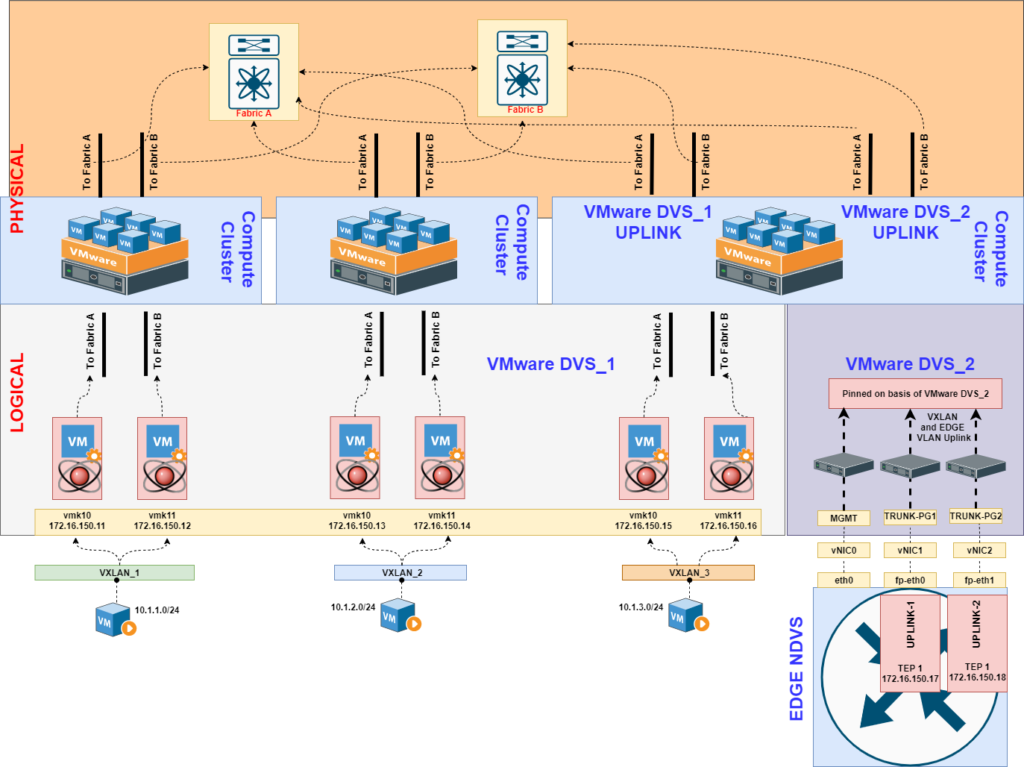
1. Use Dedicated ESXi Hosts for Edge Nodes
The first approach is to deploy Edge nodes on separate ESXi hosts.
This separates Edge connectivity from the compute transport hosts. Consequently, engineers can manage the underlying networking independently.
However, dedicated hosts alone do not guarantee connectivity. VLANs, TEP reachability, and physical network configuration must still be correct.
2. Use a Separate DVS or vSwitch for Edge Traffic
Another approach is to configure a separate distributed virtual switch or vSwitch for Edge node traffic.
This design allows engineers to isolate Edge networking from the host transport configuration.
In addition, dedicated physical uplinks can provide clearer separation between traffic types.
However, this option may require additional network adapters, switch ports, and configuration changes.
3. Separate Host TEP and Edge TEP VLANs or Subnets
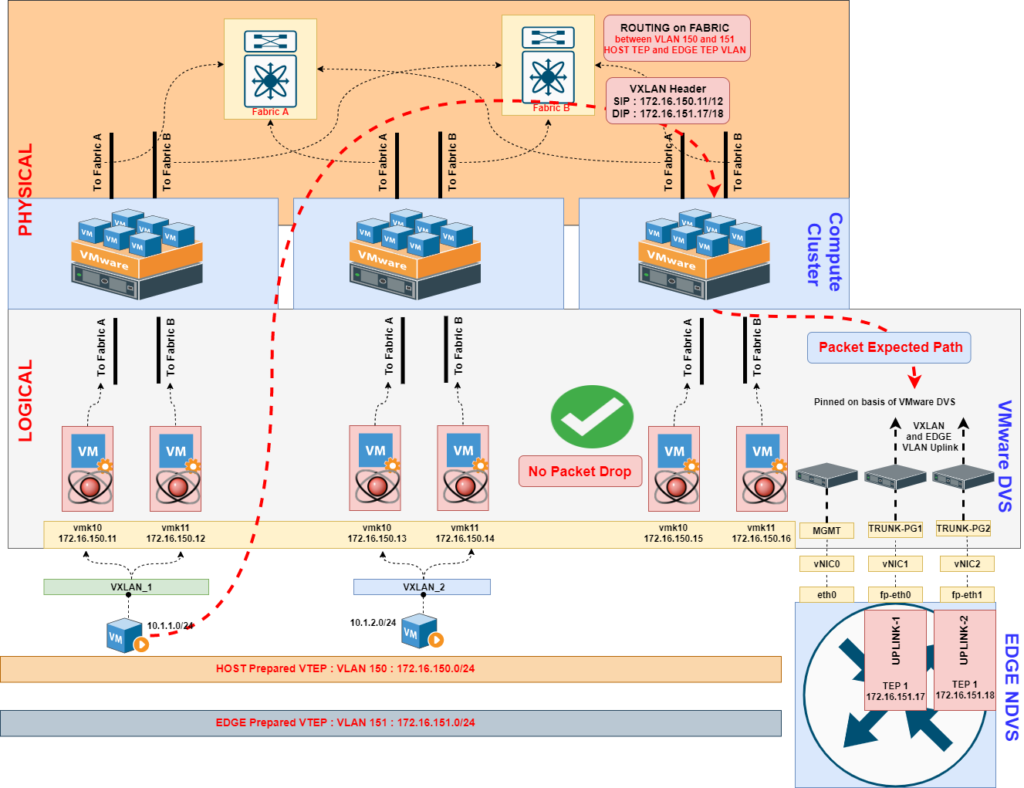
The third approach is to configure Host TEP and Edge TEP interfaces on separate VLANs or IP subnets.
In this design, the physical network routes traffic between the TEP subnets.
As a result, communication no longer depends on direct Layer 2 connectivity between those endpoints.
However, routing and MTU configuration become especially important.
Therefore, engineers must verify that the physical network supports the required encapsulated packet size.
Key Design Considerations
Before selecting an NSX-T Edge deployment model, review the following requirements:
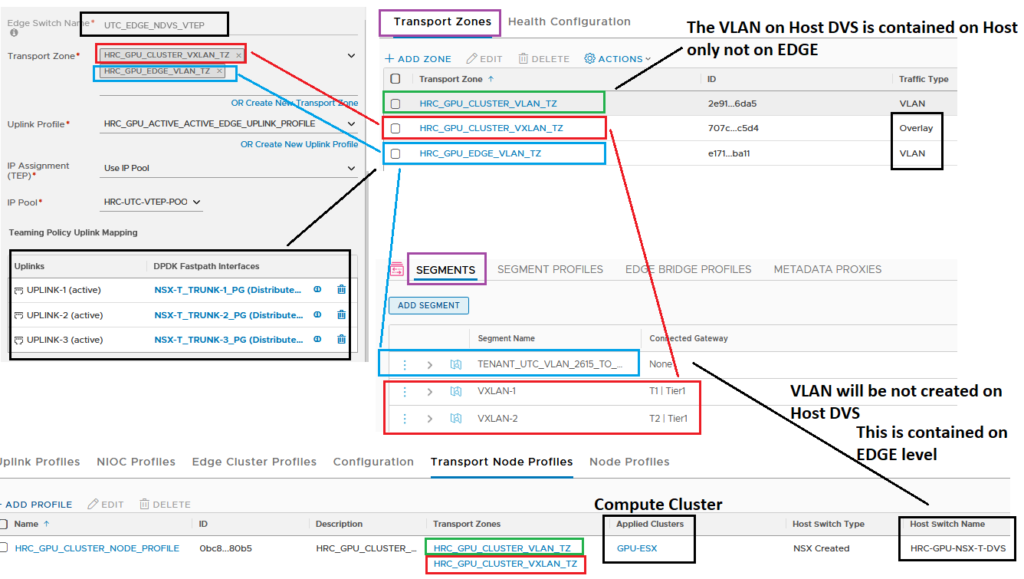
- Transport Zones: Confirm that the required transport nodes participate in the correct transport zones.
- TEP Connectivity: Verify IP reachability between Host TEP and Edge TEP interfaces.
- VLAN Configuration: Ensure the required VLANs are available on the appropriate network paths.
- MTU Settings: Confirm that the physical network supports the encapsulation overhead.
- Physical Uplinks: Check network adapter availability and redundancy.
- Resource Capacity: Evaluate compute, memory, and network requirements for Edge nodes.
Ultimately, a reliable NSX-T deployment depends on the complete network design rather than Edge node placement alone.
Conclusion
Choosing the right NSX-T Edge deployment design is important for building a reliable and manageable data center network.
In this guide, we explored the differences between collapsed and non-collapsed NSX-T Edge architectures. We also examined how Edge node placement affects infrastructure planning, network connectivity, and traffic forwarding.
First, we learned that a collapsed design allows Edge nodes and compute workloads to share the same ESXi cluster. This approach can help smaller organizations make better use of existing infrastructure.
Next, we explored the non-collapsed design, where dedicated ESXi hosts support Edge nodes. Although this approach requires additional resources, it provides greater separation between Edge services and compute workloads.
We also discussed how incorrect Host TEP and Edge TEP connectivity can lead to VTEP tunnel failures and silent packet drops.
To address these issues, we examined three possible solutions: dedicated Edge hosts, separate virtual switches, and different VLANs or subnets for TEP traffic.
Furthermore, we highlighted the importance of transport zones, physical uplinks, routing, and MTU configuration.
The key takeaway is simple: A successful NSX-T Edge deployment depends on proper network design, connectivity validation, and careful infrastructure planning.
By understanding these concepts, network engineers can troubleshoot connectivity problems more effectively and make informed deployment decisions.
What’s Next in the NSX-T Series?
In the next article, we will explore how an NSX-T segment operates without an IP subnet or gateway.
We will examine logical switching, segment realization, VTEP tables, and communication between virtual machines across ESXi hosts.
Continue learning through practical examples and real network scenarios.
Continue Your VMware NSX-T Learning Journey
Want to understand NSX-T architecture beyond basic configurations?
Explore practical tutorials covering Edge deployment, logical switching, distributed routing, VTEP connectivity, and real-world troubleshooting.
Whether you’re a network engineer, virtualization specialist, or IT professional, these guides will help you strengthen your understanding of enterprise network virtualization.
Explore more VMware NSX-T tutorials:
https://www.networkbachelor.com/category/enterprise-dc-networking-storage/vmware-nsx-t
Continue to Part 14 – NSX-T Segment Without IP Subnet/Gateway:
https://www.networkbachelor.com/nsx-t-series-part-14-nsx-t-segment-without-ip-subnet-edge-cluster
Follow Network Bachelor for more practical networking guides, technical tutorials, and data center infrastructure insights.
Have you experienced VTEP tunnel failures in a collapsed NSX-T deployment? Share your troubleshooting experience in the comments.

Deep Observability Platform Comparison 2026

vLLM in 2026: Infrastructure Engineer’s Guide to LLM Inference

NVIDIA DGX SuperPOD: Build a Mini SuperPOD Lab Step by Step
About Author

abhishek
Cloud Platform Lead and AI Infrastructure Architect at e& enterprise, with 12+ years in data center, virtualization, security and AI infrastructure. I design and build private cloud and sovereign AI platforms, working with VMware (NSX-T, vSphere, vSAN, HCX, AVS, SRM), Kubernetes, Terraform and GPU inference infrastructure for LLMs. Previously served Networkers Home (CCIE instructor, trained around 50 CCIEs), VCE/EMC2, Cisco, VMware and Arista across TAC, consulting, design and training. Certifications: CCIE#48639 (Data Center and R&S), VCIX-DCV and NV, CKA, NVIDIA AI Infrastructure, Azure Solutions Architect Expert, Terraform Associate, Palo Alto PCNSE. LinkedIn: https://www.linkedin.com/in/abhishekkunal51/
well explained sir,
Legend!