Explore NVIDIA GPU node architecture in Kubernetes and understand the essential software components required to run GPU-accelerated artificial intelligence, machine learning, and high-performance computing workloads.
This comprehensive technical guide explains what runs on an NVIDIA GPU node, including NVIDIA GPU drivers, NVIDIA Container Toolkit, Kubernetes device plugins, NVIDIA GPU Operator, GPU Feature Discovery, and NVIDIA Data
Learn how to add NVIDIA GPU worker nodes to an existing Kubernetes cluster and prepare them for enterprise artificial intelligence, machine learning, and high-performance computing workloads.
This comprehensive technical guide explains the essential steps involved in configuring GPU-enabled Kubernetes worker nodes, installing containerd and kubeadm, integrating NVIDIA GPU software components, validating accelerator functionality, and verifying high-performance
Running AI workloads on Kubernetes requires more than installing a GPU in a server.
Before an application can use NVIDIA GPUs, several software components must work together. These include GPU drivers, container runtime integration, Kubernetes device plugins, monitoring tools, and supporting infrastructure services.
Managing all these components manually can become complicated, especially when an organization operates multiple
Master Kubernetes GPU scheduling and discover how to efficiently manage NVIDIA GPU workloads using RuntimeClass, taints and tolerations, node affinity, topology-aware placement, and Volcano gang scheduling.
This comprehensive technical guide explains how Kubernetes schedules GPU-accelerated artificial intelligence, machine learning, deep learning, and high-performance computing workloads across GPU-enabled clusters.
Learn how NVIDIA RuntimeClass configurations can select compatible container
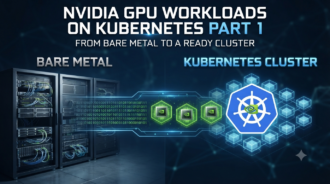
Learn how to build a production-ready Kubernetes cluster for NVIDIA GPU workloads from bare-metal infrastructure. This comprehensive technical guide covers the essential steps involved in deploying Kubernetes on physical servers, configuring containerd, installing kubeadm, establishing highly available control planes, integrating Container Network Interface (CNI) networking, and validating cluster readiness for AI and machine learning applications.
Discover
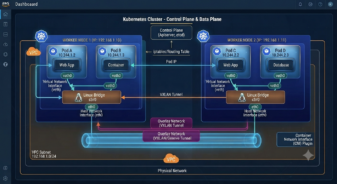
Explore Kubernetes CNI networking and understand how containers and pods communicate across Kubernetes clusters. This comprehensive technical guide explains the fundamentals of Kubernetes networking, including pod IP addressing, Container Network Interface (CNI) plugins, IP Address Management (IPAM), Flannel networking, VXLAN overlays, host-gw routing, and practical network configuration.
Learn how Kubernetes assigns IP addresses to pods and
Explore Kubernetes networking fundamentals and learn how containerized applications communicate across nodes, pods, and network environments. This comprehensive technical guide explains the essential networking concepts behind Kubernetes, including the OSI model, overlay networks, VXLAN encapsulation, Linux network namespaces, virtual Ethernet (veth) pairs, Linux bridges, and pod networking.
Understand how the OSI networking layers relate to container
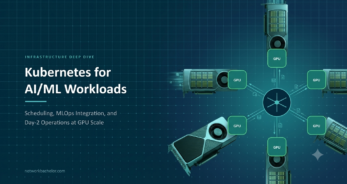
Explore how Kubernetes manages artificial intelligence and machine learning workloads, from GPU resource scheduling and infrastructure orchestration to model development, distributed training, experiment tracking, and production operations.
This comprehensive technical guide explains how Kubernetes provides a scalable foundation for AI/ML infrastructure by coordinating containerized applications, managing computing resources, and supporting GPU-accelerated workloads across enterprise clusters.
Learn how
Managing an HPC or AI cluster involves much more than simply scheduling jobs and allocating computing resources. Behind every successful AI training workload is a well-managed infrastructure that requires continuous monitoring, troubleshooting, and performance optimization.
In this practical guide, discover what a Slurm administrator does every day to keep high-performance computing environments running smoothly. Learn how
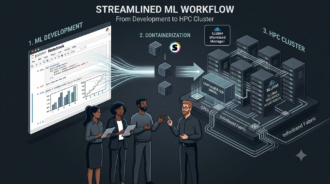
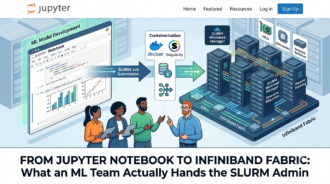
Building and managing AI training infrastructure involves much more than connecting powerful GPUs and running machine learning models. Behind every successful AI training workload is a complex environment where machine learning teams, network engineers, and HPC administrators work together to ensure reliable performance.
This practical guide explains how an AI training workload moves from a Jupyter